
⏱ 9 min read
A 2026 fNIRS hyperscanning study involving 20 dyads found that structured chord progressions paired with live eye contact increased activity in social-brain regions and produced partner-specific neural synchrony more than scrambled-note control music.1 The result supports a plausible mechanism for music-supported connection, but it does not prove that chord progressions treat loneliness or replace clinical social interventions.
Research Highlights
- Live gaze plus chords changed social-brain activity: In 20 dyads, face-to-face gaze with a structured chord progression increased right angular gyrus activity vs. face gaze with scrambled-note control music (t = 2.26, p = 0.0152).1
- Connectedness tracked the chord condition: Subjective connection ratings covaried with the chord-progression contrast in the angular gyrus (t = 6.78, p = 0.0011), a cortical region involved in integrating social and sensory information.1
- Partner synchrony was interaction-specific: Cross-brain coherence increased between real partners during face-plus-chord conditions, including a somatosensory-to-visual link (t(28) = 2.96, p < 0.006) and no matching effect in scrambled pairs.1
- The adjacent literature points in the same direction: A 2022 fNIRS meta-analysis linked cooperation to interbrain synchrony, while a 2020 eye-contact study tied live gaze to angular-gyrus coupling.2,3
- The clinical claim stays narrow: Music therapy reviews and bonding experiments support music as a social tool, but this 2026 experiment was a 16-minute healthy-adult mechanism study, not a loneliness-treatment trial.4,5,6
Functional near-infrared spectroscopy (fNIRS) is a brain-imaging method that uses near-infrared light to estimate changes in oxygenated and deoxygenated blood near the cortical surface. It is less spatially detailed than functional MRI, but it works well when researchers need people to sit upright, look at each other, move naturally within limits, or interact in real time.
Hyperscanning means recording brain activity from 2 people at the same time. In this study, hyperscanning let Watts et al. ask a sharper question than ordinary music-listening imaging can answer: did structured music change each person’s brain, and did it change the timing relationship between partners’ brains during live face gaze?1
20 Dyads Heard Structured Chords or Scrambled Notes During Live Gaze
The 2026 experiment enrolled 40 typically healthy adults arranged into 20 dyads. The group included 20 men, 18 women, and 2 nonbinary participants, with a mean age of 27.2 years. Each pair sat across a table separated by smart glass that could turn transparent or opaque.
The design crossed 2 factors:
- Social condition: live face gaze vs. no-face viewing through opaque glass.
- Music condition: a structured ii-V-I-vi chord progression vs. a no-chord control made from the same notes shuffled in time.
Chord progression means an ordered sequence of chords that creates harmonic expectation. The study used a common Western ii-V-I-vi progression, a familiar pattern in jazz and popular music. The control music preserved many acoustic ingredients but disrupted the harmonic and rhythmic organization of the tonal notes, which made the comparison more specific than music vs. silence.
Each run included four 15-second task blocks separated by 15-second rest blocks. Across 8 runs, participants experienced face-plus-chord, face-plus-no-chord, no-face-plus-chord, and no-face-plus-no-chord conditions while fNIRS recorded cortical signals from both partners. After each run, participants rated how connected they felt to the partner on a 0–5 scale.1
Angular Gyrus Linked Chords to Connectedness
Auditory regions responded across conditions, as expected when people listen to music. The more important result was that live face gaze plus chord progression recruited social-association cortex more strongly than live face gaze plus the scrambled-note control.
The face-plus-chord vs. face-plus-no-chord contrast identified several cortical signals:
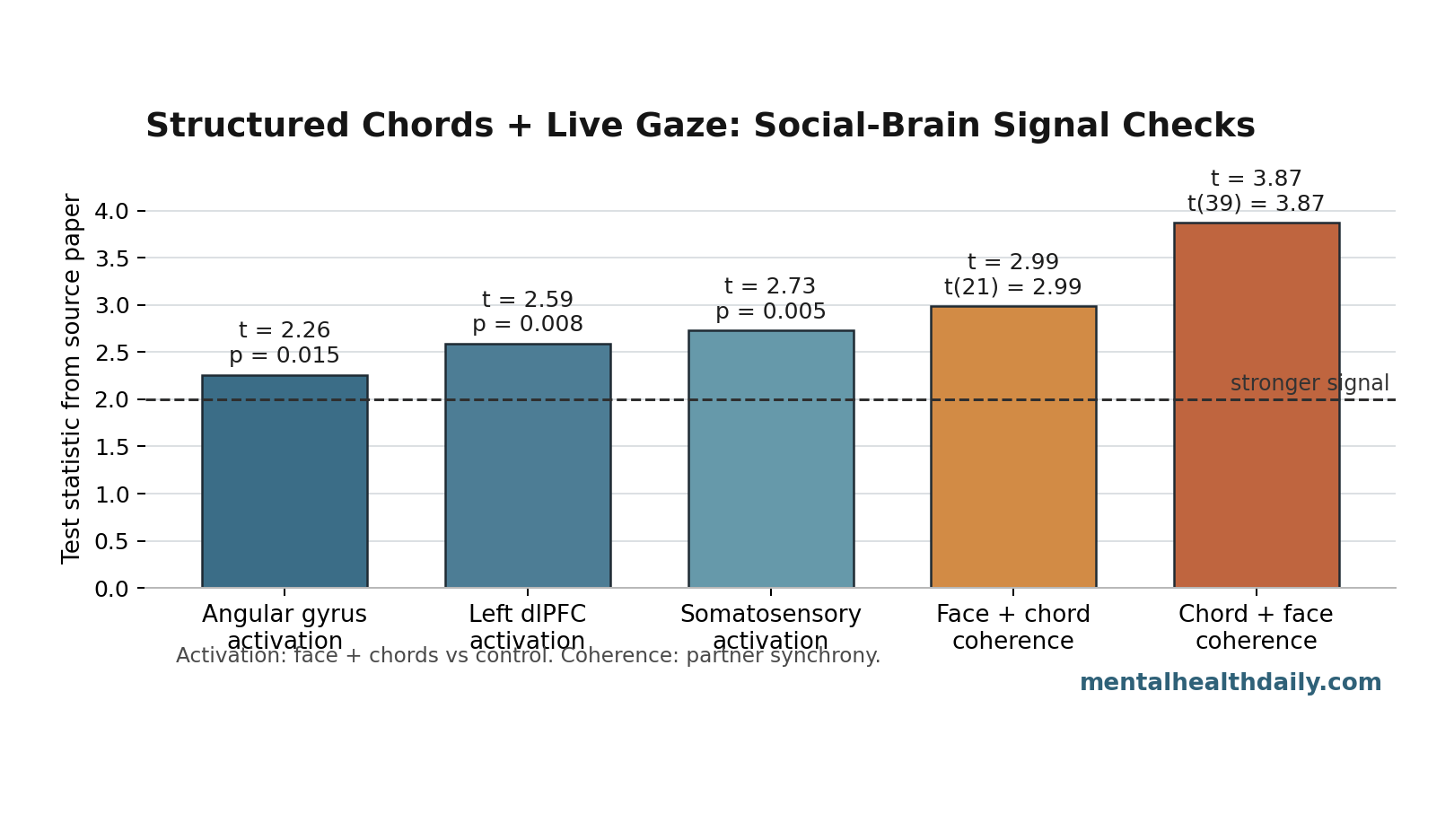
- Right angular gyrus: t = 2.26, p = 0.0152.
- Left dorsolateral prefrontal cortex: t = 2.59, p = 0.0077.
- Primary somatosensory cortex: t = 2.73, p = 0.005.
- Right middle temporal gyrus: t = 2.40, p = 0.0216.
Angular gyrus is a parietal-lobe region involved in combining sensory, semantic, attention, and social information. It is not a “music center.” Its relevance here is integrative: the region can help connect what a person hears, sees, predicts, and infers about another person during a live social event.
Subjective connectedness also pointed toward the same neighborhood. The chord-progression contrast covaried with connectedness ratings in angular gyrus/V3 (t = 6.78, p = 0.0011), superior temporal gyrus (t = 2.03, p = 0.025), and dorsolateral prefrontal cortex (t = 9.66, p = 0.012).1 That pattern is stronger than a vague “music feels social” claim: the self-report signal aligned with cortical regions that process social, auditory, visual, and prediction-related information.
Cross-Brain Coherence Was Partner-Specific
Cross-brain coherence means that rhythmic components of 2 people’s brain signals fluctuate together over time. In hyperscanning work, that coupling can reflect shared attention, reciprocal cue processing, joint action, or common sensory input. The hard part is separating real interaction from 2 people simply hearing the same stimulus.
Watts et al. addressed that problem by comparing real interacting pairs with scrambled pairs. In the scrambled-pair control, neural data from people who were not actually partners were aligned to the same task timing. If coherence were only a byproduct of hearing the same music, the scrambled pairs should show similar coupling. They did not.1
During live face gaze, chord progression increased partner coherence between social and perceptual regions:
- Somatosensory association cortex and visual cortex: t(28) = 2.96, p < 0.006.
- Dorsolateral prefrontal cortex and supramarginal gyrus: t(37) = 2.72, p < 0.01.
- Middle temporal gyrus and somatosensory association cortex: t(21) = 2.99, p < 0.001.
When the researchers focused on chord-progression trials, live face gaze increased coherence between dorsolateral prefrontal cortex and somatosensory association cortex (t(37) = 3.14, p < 0.003), dorsolateral prefrontal cortex and premotor cortex (t(37) = 3.44, p < 0.001), supramarginal gyrus and premotor cortex (t(39) = 3.87, p < 0.001), and dorsolateral prefrontal cortex and superior temporal gyrus (t(37) = 3.14, p < 0.003).1
Those are not clinical endpoints. They are mechanism-level signals. The practical interpretation is narrower: structured harmonic predictability may make a live social scene more mutually predictable, and that shared predictability may help partners’ social-perceptual systems align.
Prior Hyperscanning Studies Make the Mechanism Plausible
The 2026 result fits a broader social-neuroscience literature in which cooperation and eye contact can synchronize activity across brains. Czeszumski et al. reviewed fNIRS hyperscanning studies and found that cooperative behavior evokes interbrain synchrony in prefrontal and temporoparietal cortex.2 That matters here because the chord experiment’s strongest coherence results involved the same broad social-control and temporoparietal systems.
Noah et al. previously reported that real-time eye-to-eye contact was associated with cross-brain neural coupling in angular gyrus.3 Watts et al. extended that logic by asking whether one structured musical feature changes the live-gaze signal. The answer was directionally yes: the structured chord condition made the face-gaze state look more socially coupled than the scrambled-note condition.
The music side also has adjacent behavioral support:
- Adult group singing: Weinstein et al. found that group singing increased social bonding.4
- Early synchrony cues: Cirelli et al. found that 14-month-old infants used interpersonal synchrony as a cue for later helpfulness.5
Those studies do not prove the chord-progression mechanism, but they make the larger claim plausible: synchronized musical experience can change social behavior or social feeling.
The Loneliness and Music-Therapy Claim Should Stay Calibrated
The temptation is to jump from “chords plus eye contact synchronized brains” to “music treats social isolation.” That jump is too large. The 2026 experiment used healthy adults, short stimuli, a laboratory dyad, a Western chord progression, a 0–5 connectedness rating, and cortical fNIRS channels. It did not test lonely patients, group therapy outcomes, depression remission, social-anxiety symptoms, or durability after the session ended.
Evidence-strength note: this was a small mechanistic experiment. It can support a causal inference about the immediate laboratory manipulation more strongly than a cross-sectional study can, because each dyad experienced the key conditions. It cannot support a treatment-efficacy claim for loneliness, depression, autism, schizophrenia, dementia, or any other clinical condition.
Music therapy evidence is real but broader. Aalbers et al. reviewed music therapy for depression and found that adding music therapy to treatment as usual may improve depressive symptoms and anxiety compared with treatment as usual alone.6 Chen et al. argued that music-based interventions need sharper mechanistic research so clinical work can move from “music helps” toward identifying which musical features affect which brain circuits and outcomes.7
The Watts et al. study is useful because it starts to specify the feature: predictable chord progressions during live gaze. That is more actionable than treating music as one undifferentiated exposure.
Questions About Music, Eye Contact, and Social-Brain Synchrony
Does this mean certain chords can make people bond?
Not by themselves. The strongest condition combined structured chords with live face gaze. Chords without the social context were not the whole effect, and the study measured short-term connectedness and cortical synchrony rather than long-term bonding.
Could this apply to group therapy or loneliness treatment?
It gives researchers a mechanism to test. A clinical study would still need lonely or socially disconnected participants, a real intervention dose, appropriate controls, patient-centered outcomes, and follow-up after the music session.
Why use scrambled notes as the control?
The control preserved many auditory ingredients while disrupting harmonic structure. That made the comparison more specific than music vs. silence and helped isolate the predictable chord progression as the musical feature of interest.
Is fNIRS enough to prove a brain mechanism?
fNIRS is useful for live interaction because it tolerates naturalistic face-to-face settings better than many scanners. It still measures cortical blood-flow changes indirectly and cannot resolve deep reward systems such as the nucleus accumbens.
Would non-Western musical systems show the same pattern?
The study does not answer that. The ii-V-I-vi progression is common in Western music, so cultural familiarity, musical training, and expectation could change the result in other musical systems.
References
- Watts DA, Allsop AS, Compton S, Zhang X, Noah JA, Hirsch J. Listening to a consonant chord progression during live face-to-face gaze enhances neural activity in social systems. Journal of Neuroscience. 2026;46(15):e1116252026. doi:10.1523/jneurosci.1116-25.2026
- Czeszumski A, Liang SHY, Dikker S, Konig P, Lee CP, Koole SL, Kelsen B. Cooperative behavior evokes interbrain synchrony in the prefrontal and temporoparietal cortex: a systematic review and meta-analysis of fNIRS hyperscanning studies. eNeuro. 2022;9:ENEURO.0268-21.2022. doi:10.1523/eneuro.0268-21.2022
- Noah JA, Zhang X, Dravida S, Ono Y, Naples A, McPartland JC, Hirsch J. Real-time eye-to-eye contact is associated with cross-brain neural coupling in angular gyrus. Frontiers in Human Neuroscience. 2020;14:19. doi:10.3389/fnhum.2020.00019
- Weinstein D, Launay J, Pearce E, Dunbar RIM, Stewart L. Singing and social bonding: changes in connectivity and pain threshold as a function of group size. Evolution and Human Behavior. 2016;37:152–158. doi:10.1016/j.evolhumbehav.2015.10.002
- Cirelli LK, Wan SJ, Trainor LJ. Fourteen-month-old infants use interpersonal synchrony as a cue to direct helpfulness. Philosophical Transactions of the Royal Society B. 2014;369:20130400. doi:10.1098/rstb.2013.0400
- Aalbers S, Fusar-Poli L, Freeman RE, et al. Music therapy for depression. Cochrane Database of Systematic Reviews. 2017;11:CD004517. doi:10.1002/14651858.cd004517.pub3
- Chen WG, Iversen JR, Kao MH, et al. Music and brain circuitry: strategies for strengthening evidence-based research for music-based interventions. Journal of Neuroscience. 2022;42:8498–8507. doi:10.1523/jneurosci.1135-22.2022
Leave a Reply