
⏱ 11 min read
References
-
Khalsa, S. S. et al. Interoception and mental health: a roadmap. Biol. Psychiatry Cogn. Neurosci. Neuroimaging 3, 501–513 (2018).
-
Nord, C. L. & Garfinkel, S. N. Interoceptive pathways to understand and treat mental health conditions. Trends Cogn. Sci. 26, 499–513 (2022).
-
Bruton, A. et al. Diminished interoceptive accuracy in attention-deficit/hyperactivity disorder: a systematic review. Psychophysiology 62, e14750 (2025).
-
Eggart, M., Lange, A., Binser, M. J., Queri, S. & Müller-Oerlinghausen, B. Major depressive disorder is associated with impaired interoceptive accuracy: a systematic review. Brain Sci. 9, 131 (2019).
-
Van der Does, A. J. W., Antony, M. M., Ehlers, A. & Barsky, A. J. Heartbeat perception in panic disorder: a reanalysis. Behav. Res. Ther. 38, 47–62 (2000).
-
Williams, Z. J. et al. Characterizing interoceptive differences in autism: a systematic review and meta-analysis of case–control studies. J. Autism Dev. Disord. 53, 947–962 (2023).
-
Brewer, R., Murphy, J. & Bird, G. Atypical interoception as a common risk factor for psychopathology: a review. Neurosci. Biobehav. Rev. 130, 470 (2021).
-
Khalsa, S. S. & Lapidus, R. C. Can interoception improve the pragmatic search for biomarkers in psychiatry? Front. Psychiatry 7, 121 (2016).
-
Nord, C. L., Lawson, R. P. & Dalgleish, T. Disrupted dorsal mid-insula activation during interoception across psychiatric disorders. Am. J. Psychiatry 178, 761–770 (2021).
-
Dunn, B. D. et al. Can you feel the beat? Interoceptive awareness is an interactive function of anxiety- and depression-specific symptom dimensions. Behav. Res. Ther. 48, 1133–1138 (2010).
-
Ehlers, A. Interoception and panic disorder. Adv. Behav. Res. Ther. 15, 3–21 (1993).
-
Katkin, E. S. Blood, sweat, and tears: individual differences in autonomic self-perception. Psychophysiology 22, 125–137 (1985).
-
Pollatos, O., Traut-Mattausch, E., Schroeder, H. & Schandry, R. Interoceptive awareness mediates the relationship between anxiety and the intensity of unpleasant feelings. J. Anxiety Disord. 21, 931–943 (2007).
-
Pollatos, O., Herbert, B. M., Kaufmann, C., Auer, D. P. & Schandry, R. Interoceptive awareness, anxiety and cardiovascular reactivity to isometric exercise. Int. J. Psychophysiol. 65, 167–173 (2007).
-
Schandry, R. Heart beat perception and emotional experience. Psychophysiology 18, 483–488 (1981).
-
Banellis, L. et al. Interoceptive ability is uncorrelated across respiratory and cardiac axes in a large scale psychophysical study. Commun. Psychol. 4, 43 (2026).
-
Ditzer, J. et al. A meta-analytic review of child maltreatment and interoception. Nat. Ment. Health 3, 821–837 (2025).
-
Jenkinson, P. M., Fotopoulou, A., Ibañez, A. & Rossell, S. Interoception in anxiety, depression, and psychosis: a review. eClinicalMedicine 73, 102673 (2024).
-
Loureiro, F., Ringold,Sofronia, M. & Aziz-Zadeh, L. Interoception in autism: a narrative review of behavioral and neurobiological data. Psychol. Res. Behav. Manag. 17, 1841–1853 (2024).
-
Adams, K. L. et al. The association between anxiety and cardiac interoceptive accuracy: a systematic review and meta-analysis. Neurosci. Biobehav. Rev. 140, 104754 (2022).
-
Desmedt, O. et al. How does heartbeat counting task performance relate to theoretically-relevant mental health outcomes? A meta-analysis. Collabra Psychol. 8, 33271 (2022).
-
Desmedt, O., Luminet, O. & Corneille, O. The heartbeat counting task largely involves non-interoceptive processes: evidence from both the original and an adapted counting task. Biol. Psychol. 138, 185–188 (2018).
-
Hickman, L., Seyedsalehi, A., Cook, J. L., Bird, G. & Murphy, J. The relationship between heartbeat counting and heartbeat discrimination: a meta-analysis. Biol. Psychol. 156, 107949 (2020).
-
Murphy, J. et al. Knowledge of resting heart rate mediates the relationship between intelligence and the heartbeat counting task. Biol. Psychol. 133, 1–3 (2018).
-
Ring, C., Brener, J., Knapp, K. & Mailloux, J. Effects of heartbeat feedback on beliefs about heart rate and heartbeat counting: a cautionary tale about interoceptive awareness. Biol. Psychol. 104, 193–198 (2015).
-
Ring, C. & Brener, J. Heartbeat counting is unrelated to heartbeat detection: a comparison of methods to quantify interoception. Psychophysiology 55, e13084 (2018).
-
Brener, J. & Ring, C. Towards a psychophysics of interoceptive processes: the measurement of heartbeat detection. Phil. Trans. R. Soc. B 371, 20160015 (2016).
-
Green, D. M. & Swets, J. A. Signal Detection Theory and Psychophysics Vol. 1 (Wiley, 1966).
-
Ainley, V., Apps, M. A. J., Fotopoulou, A. & Tsakiris, M. ‘Bodily precision’: a predictive coding account of individual differences in interoceptive accuracy. Phil. Trans. R. Soc. B 371, 20160003 (2016).
-
Allen, M. & Friston, K. J. From cognitivism to autopoiesis: towards a computational framework for the embodied mind. Synthese 195, 2459–2482 (2018).
-
Smith, R. et al. A Bayesian computational model reveals a failure to adapt interoceptive precision estimates across depression, anxiety, eating, and substance use disorders. PLoS Comput. Biol. 16, e1008484 (2020).
-
Garfinkel, S. N. et al. Interoceptive dimensions across cardiac and respiratory axes. Phil. Trans. R. Soc. B 371, 20160014 (2016).
-
Harrison, O. et al. Interoception of breathing and its relationship with anxiety. Neuron 109, 4080–4093.e8 (2021).
-
Paulus, M. P. The breathing conundrum—interoceptive sensitivity and anxiety. Depress. Anxiety 30, 315–320 (2013).
-
Tiller, J., Pain, M. & Biddle, N. Anxiety disorder and perception of inspiratory resistive loads. Chest 91, 547–551 (1987).
-
Garfinkel, S. N., Seth, A. K., Barrett, A. B., Suzuki, K. & Critchley, H. D. Knowing your own heart: distinguishing interoceptive accuracy from interoceptive awareness. Biol. Psychol. 104, 65–74 (2015).
-
Clemente, R., Murphy, A. & Murphy, J. The relationship between self-reported interoception and anxiety: a systematic review and meta-analysis. Neurosci. Biobehav. Rev. 167, 105923 (2024).
-
Hielscher, E. & Zopf, R. Interoceptive abnormalities and suicidality: a systematic review. Behav. Ther. 52, 1035–1054 (2021).
-
Huang, Y.-H., Huang, Y.-T. & Yen, N.-S. Interoceptive sensibility differentiates the predictive pattern of emotional reactivity on depression. Front. Psychol. 14, 1011584 (2023).
-
Desmedt, O., Heeren, A., Corneille, O. & Luminet, O. What do measures of self-report interoception measure? Insights from a systematic review, latent factor analysis, and network approach. Biol. Psychol. 169, 108289 (2022).
-
Murphy, J., Catmur, C. & Bird, G. Classifying individual differences in interoception: implications for the measurement of interoceptive awareness. Psychon. Bull. Rev. 26, 1467–1471 (2019).
-
Suksasilp, C. & Garfinkel, S. N. Towards a comprehensive assessment of interoception in a multi-dimensional framework. Biol. Psychol. 168, 108262 (2022).
-
Caspi, A. et al. The p factor: one general psychopathology factor in the structure of psychiatric disorders? Clin. Psychol. Sci. 2, 119–137 (2014).
-
Smith, G. T., Atkinson, E. A., Davis, H. A., Riley, E. N. & Oltmanns, J. R. The general factor of psychopathology. Annu. Rev. Clin. Psychol. 16, 75–98 (2020).
-
Benwell, C. S. Y., Mohr, G., Wallberg, J., Kouadio, A. & Ince, R. A. A. Psychiatrically relevant signatures of domain-general decision-making and metacognition in the general population. npj Ment. Health Res. 1, 1–17 (2022).
-
Gillan, C. M., Kosinski, M., Whelan, R., Phelps, E. A. & Daw, N. D. Characterizing a psychiatric symptom dimension related to deficits in goal-directed control. Elife 5, e11305 (2016).
-
Kaczkurkin, A. N. et al. Common and dissociable regional cerebral blood flow differences associate with dimensions of psychopathology across categorical diagnoses. Mol. Psychiatry 23, 1981–1989 (2018).
-
Smith, S. M. et al. A positive-negative mode of population covariation links brain connectivity, demographics and behavior. Nat. Neurosci. 18, 1565–1567 (2015).
-
Dalgleish, T., Black, M., Johnston, D. & Bevan, A. Transdiagnostic approaches to mental health problems: current status and future directions. J. Consult. Clin. Psychol. 88, 179–195 (2020).
-
Schumann, G. et al. Stratified medicine for mental disorders. Eur. Neuropsychopharmacol. 24, 5–50 (2014).
-
Rössler, W. et al. Sub-clinical psychosis symptoms in young adults are risk factors for subsequent common mental disorders. Schizophr. Res. 131, 18–23 (2011).
-
Barkus, E., Martin, E. A., Wong, K. K. & Chan, R. C. K. The importance of studying psychopathology in subclinical populations. PsyCh Journal. 11, 147 (2022).
-
Heim, N. et al. Psychological interventions for interoception in mental health disorders: a systematic review of randomized-controlled trials. Psychiatry Clin. Neurosci. 77, 530–540 (2023).
-
Quadt, L. et al. Interoceptive training to target anxiety in autistic adults (ADIE): a single-center, superiority randomized controlled trial. eClinicalMedicine 39, 101042 (2021).
-
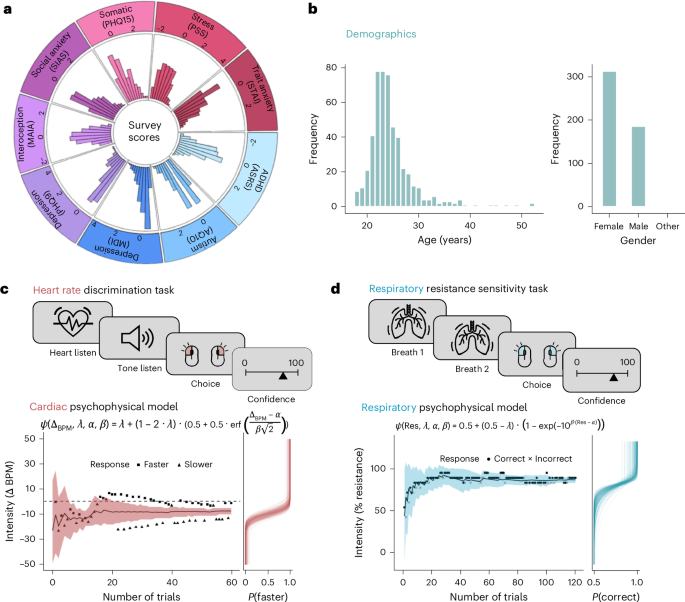
Legrand, N. et al. The heart rate discrimination task: a psychophysical method to estimate the accuracy and precision of interoceptive beliefs. Biol. Psychol. 168, 108239 (2022).
-
Nikolova, N. et al. The respiratory resistance sensitivity task: an automated method for quantifying respiratory interoception and metacognition. Biol. Psychol. 170, 108325 (2022).
-
Courtin, A. S., Ehmsen, J. F., Banellis, L., Fardo, F. & Allen, M. G. Hierarchical Bayesian modelling of interoceptive psychophysics. Behav. Res. Methods (in the press).
-
Fleming, S. M. HMeta-d: hierarchical Bayesian estimation of metacognitive efficiency from confidence ratings. Neurosci. Conscious. 2017, nix007 (2017).
-
Fleming, S. M. Metacognition and confidence: a review and synthesis. Annu. Rev. Psychol. 75, 241–268 (2024).
-
Caspi, A., Houts, R. M., Fisher, H. L., Danese, A. & Moffitt, T. E. The general factor of psychopathology (p): choosing among competing models and interpreting p. Clin. Psychol. Sci. 12, 53–82 (2024).
-
Revelle, W. & Rocklin, T. Very simple structure: an alternative procedure for estimating the optimal number of interpretable factors. Multivar. Behav. Res. 14, 403–414 (1979).
-
Lee, M. D. & Wagenmakers, E.-J. Bayesian Cognitive Modeling: A Practical Course (Cambridge Univ. Press, 2014).
-
Rosenbusch, H., Wanders, F. & Pit, I. L. The Semantic Scale Network: an online tool to detect semantic overlap of psychological scales and prevent scale redundancies. Psychol. Methods 25, 380–392 (2020).
-
Desmedt, O., Luminet, O., Maurage, P. & Corneille, O. Discrepancies in the definition and measurement of human interoception: a comprehensive discussion and suggested ways forward. Perspect. Psychol. Sci. 20, 76–98 (2025).
-
Fiene, L. & Brownlow, C. Investigating interoception and body awareness in adults with and without autism spectrum disorder. Autism Res. 8, 709–716 (2015).
-
Mul, C., Stagg, S. D., Herbelin, B. & Aspell, J. E. The feeling of me feeling for you: interoception, alexithymia and empathy in autism. J. Autism Dev. Disord. 48, 2953–2967 (2018).
-
Pickard, H., Hirsch, C., Simonoff, E. & Happé, F. Exploring the cognitive, emotional and sensory correlates of social anxiety in autistic and neurotypical adolescents. J. Child Psychol. Psychiatry 61, 1317–1327 (2020).
-
Vig, L., Köteles, F. & Ferentzi, E. Questionnaires of interoception do not assess the same construct. PLoS ONE 17, e0273299 (2022).
-
Ferentzi, E. et al. Multichannel investigation of interoception: sensitivity is not a generalizable feature. Front. Hum. Neurosci. 12, 223 (2018).
-
Bodart, A., Invernizzi, S., De Leener, M., Lefebvre, L. & Rossignol, M. The duration discrimination respiratory task: a new test to measure respiratory interoceptive accuracy. Psychophysiology 61, e14632 (2024).
-
Crucianelli, L., Enmalm, A. & Ehrsson, H. H. Interoception as independent cardiac, thermosensory, nociceptive, and affective touch perceptual submodalities. Biol. Psychol. 172, 108355 (2022).
-
Izagirre, N. I. et al. Investigating the relationship between cardiac interoceptive accuracy and stress: a systematic review and meta-analysis. Neurosci. Biobehav. Rev. 180, 106454 (2026).
-
Khalsa, S. S. et al. Panic anxiety in humans with bilateral amygdala lesions: pharmacological induction via cardiorespiratory interoceptive pathways. J. Neurosci. 36, 3559–3566 (2016).
-
Kontsevich, L. L. & Tyler, C. W. Bayesian adaptive estimation of psychometric slope and threshold. Vision Res. 39, 2729–2737 (1999).
-
Gelman, A. & Hill, J. Data Analysis Using Regression and Multilevel/Hierarchical Models (Higher Education from Cambridge Univ. Press, 2006).
-
McGlothlin, A. E. & Viele, K. Bayesian hierarchical models. JAMA 320, 2365–2366 (2018).
-
Gabry, J., Cešnovar, R., Johnson, A. & Bronder, S. cmdstanr: R interface to ‘CmdStan’. R package version 0.9.0. https://mc-stan.org/cmdstanr (2025).
-
Vehtari, A., Gelman, A., Simpson, D., Carpenter, B. & Bürkner, P.-C. Rank-normalization, folding, and localization: an improved (widehat{R}) for assessing convergence of MCMC. Bayesian Anal 16, 667–718 (2021).
-
Maniscalco, B. & Lau, H. A signal detection theoretic approach for estimating metacognitive sensitivity from confidence ratings. Conscious. Cogn. 21, 422–430 (2012).
-
Guggenmos, M. Measuring metacognitive performance: type 1 performance dependence and test-retest reliability. Neurosci. Conscious. 2021, niab040 (2021).
-
Mehling, W. E. et al. The Multidimensional Assessment of Interoceptive Awareness (MAIA). PLoS ONE 7, e48230 (2012).
-
Ventura-Bort, C., Wendt, J. & Weymar, M. The role of interoceptive sensibility and emotional conceptualization for the experience of emotions. Front. Psychol. 12, 712418 (2021).
-
Bartlett, M. S. Tests of significance in factor analysis. Br. J. Psychol. 3, 77–85 (1950).
-
Kaiser, H. F. An index of factorial simplicity. Psychometrika 39, 31–36 (1974).
-
Barendse, M. T., Oort, F. J. & Timmerman, M. E. Using exploratory factor analysis to determine the dimensionality of discrete responses. Struct. Equ. Model. Multidiscip. J. 22, 87–101 (2015).
-
Schreiber, J. B. Issues and recommendations for exploratory factor analysis and principal component analysis. Res. Soc. Adm. Pharm. 17, 1004–1011 (2021).
-
Goretzko, D., Pham, T. T. H. & Bühner, M. Exploratory factor analysis: current use, methodological developments and recommendations for good practice. Curr. Psychol. 40, 3510–3521 (2021).
-
Morey, R. D. et al. BayesFactor: computation of Bayes Factors for common designs. CRAN https://cran.r-project.org/package=BayesFactor
-
Epskamp, S., Borsboom, D. & Fried, E. I. Estimating psychological networks and their accuracy: a tutorial paper. Behav. Res. Methods 50, 195–212 (2018).
-
Jeffreys, H. The Theory of Probability (OUP Oxford, 1998).
Leave a Reply