
⏱ 10 min read
Park, C. L. et al. Emotional well-being: what it is and why it matters. Affect. Sci. 4, 10–20 (2023).
Ryff, C. D. Flotsam, jetsam, and forward-moving vessels on the sea of well-being. Affect. Sci. 4, 49–51 (2023).
Keyes, C. L. M. & Simoes, E. J. To flourish or not: positive mental health and all-cause mortality. Am. J. Public Health 102, 2164–2172 (2012).
Grant, F., Guille, C. & Sen, S. Well-being and the risk of depression under stress. PLoS ONE 8, e67395 (2013).
Keyes, C. L. M. Mental illness and/or mental health? Investigating axioms of the complete state model of health. J. Consult. Clin. Psychol. (2005).
Diener, E. Subjective well-being. Psychol. Bull. 95, 542–575 (1984).
Ryff, C. D. Happiness is everything, or is it? Explorations on the meaning of psychological well-being. J. Pers. Soc. Psychol. 57, 1069 (1989).
Disabato, D. J., Goodman, F. R. & Kashdan, T. B. The hierarchical framework of wellbeing (HiFWB). Front. Psychol. 16, 1515423 (2025).
Gallagher, M. W. & Lopez, S. J. & Preacher, K. J. The hierarchical structure of well-being. J. Pers. 77, 1025–1050 (2009).
Keyes, C. L. M., Shmotkin, D. & Ryff, C. D. Optimizing well-being: the empirical encounter of two traditions. J. Pers. Soc. Psychol. 82, 1007–1022 (2002).
Westerhof, G. J. & Keyes, C. L. M. Mental illness and mental health: the two continua model across the lifespan. J. Adult Dev. 17, 110–119 (2010).
Huppert, F. A. Psychological well-being: evidence regarding its causes and consequences. Appl. Psychol. Health Well-Being 1, 137–164 (2009).
Joshanloo, M. & Blasco-Belled, A. Reciprocal associations between depressive symptoms, life satisfaction, and eudaimonic well-being in older adults over a 16-year period. Int. J. Environ. Res. Public Health 20, 2374 (2023).
Lamers, S. M. A., Westerhof, G. J., Glas, C. A. W. & Bohlmeijer, E. T. The bidirectional relation between positive mental health and psychopathology in a longitudinal representative panel study. J. Posit. Psychol. 10, 553–560 (2015).
Ryff, C. D. Psychological well-being in adult life. Curr. Dir. Psychol. Sci. 4, 99–104 (1995).
Cintron, D. W. & Ong, A. D. Trajectories of affective well-being and survival in middle-aged and older adults. Emotion 24, 1149–1156 (2024).
Ryff, C. D., Radler, B. T. & Friedman, E. M. Persistent psychological well-being predicts improved self-rated health over 9–10 years: longitudinal evidence from MIDUS. Health Psychol. Open 2, 205510291560158 (2015).
Lykken, D. & Tellegen, A. Happiness is a stochastic phenomenon. Psychol. Sci. 7, 186–189 (1996).
Lucas, R. E. Adaptation and the set-point model of subjective well-being: does happiness change after major life events? Curr. Dir. Psychol. Sci. 16, 75–79 (2007).
Headey, B. & Muffels, R. Towards a theory of medium term life satisfaction: two-way causation partly explains persistent satisfaction or dissatisfaction. Soc. Indic. Res. 129, 937–960 (2016).
Rottenberg, J., Devendorf, A. R., Panaite, V., Disabato, D. J. & Kashdan, T. B. Optimal well-being after major depression. Clin. Psychol. Sci. 7, 621–627 (2019).
Wood, A. M. & Tarrier, N. Positive clinical psychology: a new vision and strategy for integrated research and practice. Clin. Psychol. Rev. 30, 819–829 (2010).
Chevance, A. et al. Identifying outcomes for depression that matter to patients, informal caregivers, and health-care professionals: qualitative content analysis of a large international online survey. Lancet Psychiatry 7, 692–702 (2020).
Demyttenaere, K. et al. What is important in being cured from depression? Discordance between physicians and patients (1). J. Affect. Disord. 174, 390–396 (2015).
Zimmerman, M. et al. How should remission from depression be defined? The depressed patient’s perspective. Am. J. Psychiatry 163, 148–150 (2006).
Practice Guideline for the Treatment of Patients with Major Depressive Disorder (Third Edition) (American Psychiatric Association, 2010); https://cir.nii.ac.jp/crid/1370846643062656009
Monroe, S. M. & Anderson, S. F. Depression: the shroud of heterogeneity. Curr. Dir. Psychol. Sci. 24, 227–231 (2015).
Monroe, S. M. & Harkness, K. L. Recurrence in major depression: a conceptual analysis. Psychol. Rev. 118, 655–674 (2011).
Devendorf, A. R., Rum, R., Kashdan, T. B. & Rottenberg, J. Optimal well-being after psychopathology: prevalence and correlates. Clin. Psychol. Sci. 10, 981–996 (2022).
Fuller-Thomson, E., Agbeyaka, S., LaFond, D. M. & Bern-Klug, M. Flourishing after depression: factors associated with achieving complete mental health among those with a history of depression. Psychiatry Res. 242, 111–120 (2016).
Nesse, R. M. Is depression an adaptation. Arch. Gen. Psychiatry 57, 14 (2000).
Ridge, D. & Ziebland, S. “The old me could never have done that”: how people give meaning to recovery following depression. Qual. Health Res. 16, 1038–1053 (2006).
Bylsma, L. M., Taylor-Clift, A. & Rottenberg, J. Emotional reactivity to daily events in major and minor depression. J. Abnorm. Psychol. 120, 155–167 (2011).
Frijda, N. H. The laws of emotion. Am. Psychol. 43, 349–358 (1988).
Samuelson, W. & Zeckhauser, R. Status quo bias in decision making. J. Risk Uncertain. 1, 7–59 (1988).
Swann, W. B. & Read, S. J. Self-verification processes: how we sustain our self-conceptions. J. Exp. Soc. Psychol. 17, 351–372 (1981).
Keyes, C. L. M., Dhingra, S. S. & Simoes, E. J. Change in level of positive mental health as a predictor of future risk of mental illness. Am. J. Public Health 100, 2366–2371 (2010).
Koivumaa-Honkanen, H., Kaprio, J., Honkanen, R., ViinamäKi, H. & Koskenvuo, M. Life satisfaction and depression in a 15-year follow-up of healthy adults. Soc. Psychiatry Psychiatr. Epidemiol. 39, 994–999 (2004).
Wood, A. M. & Joseph, S. The absence of positive psychological (eudemonic) well-being as a risk factor for depression: a ten year cohort study. J. Affect. Disord. 122, 213–217 (2010).
Fujita, F. & Diener, E. Life satisfaction set point: stability and change. J. Pers. Soc. Psychol. 88, 158–164 (2005).
Navarro-Carrillo, G., Alonso-Ferres, M., Moya, M. & Valor-Segura, I. Socioeconomic status and psychological well-being: revisiting the role of subjective socioeconomic status. Front. Psychol. 11, 1303 (2020).
Fava, G. A. & Tomba, E. Increasing psychological well-being and resilience by psychotherapeutic methods. J. Pers. 77, 1903–1934 (2009).
Xu, Y.-Y., Wu, T., Yu, Y.-J. & Li, M. A randomized controlled trial of well-being therapy to promote adaptation and alleviate emotional distress among medical freshmen. BMC Med. Educ. 19, 182 (2019).
Zarski, A.-C. et al. Efficacy of an internet- and mobile-based intervention for subclinical anxiety and depression (ICare Prevent) with two guidance formats: results from a three-armed randomized controlled trial. Psychother. Psychosom. 93, 155–168 (2024).
Tan, J. J. X., Kraus, M. W., Carpenter, N. C. & Adler, N. E. The association between objective and subjective socioeconomic status and subjective well-being: a meta-analytic review. Psychol. Bull. 146, 970–1020 (2020).
Salem, M. & Robenson, J. The impact of socioeconomic factors on mental health: a conceptual framework. Cureus 17, e88244 (2025).
Surachman, A., Wardecker, B., Chow, S.-M. & Almeida, D. Life course socioeconomic status, daily stressors, and daily well-being: examining chain of risk models. J. Gerontol. B Psychol. Sci. Soc. Sci. 74, 126–135 (2019).
Goldberg, D. The heterogeneity of “major depression”. World Psychiatry 10, 226–228 (2011).
Lynall, M.-E. & McIntosh, A. M. The heterogeneity of depression. Am. J. Psychiatry 180, 703–704 (2023).
Liao, Y. et al. Impact of cognitive-affective and somatic symptoms in subthreshold depression transition in adults: evidence from Depression Cohort in China (DCC). J. Affect. Disord. 315, 274–281 (2022).
Monroe, S. M., Anderson, S. F. & Harkness, K. L. Life stress and major depression: the mysteries of recurrences. Psychol. Rev. 126, 791–816 (2019).
Fava, G. A., Cosci, F., Guidi, J. & Tomba, E. Well-being therapy in depression: new insights into the role of psychological well-being in the clinical process. Depress. Anxiety 34, 801–808 (2017).
Fava, G. A., Rafanelli, C., Cazzaro, M., Conti, S. & Grandi, S. Well-being therapy. A novel psychotherapeutic approach for residual symptoms of affective disorders. Psychol. Med. 28, 475–480 (1998).
Allen, M. S., Iliescu, D. & Greiff, S. Single item measures in psychological science: a call to action. Eur. J. Psychol. Assess. (2022).
Fechner-Bates, S., Coyne, J. C. & Schwenk, T. L. The relationship of self-reported distress to depressive disorders and other psychopathology. J. Consult. Clin. Psychol. 62, 550 (1994).
Thombs, B. D., Kwakkenbos, L., Levis, A. W. & Benedetti, A. Addressing overestimation of the prevalence of depression based on self-report screening questionnaires. Can. Med. Assoc. J. 190, E44–E49 (2018).
Boscardin, C. K., Sebok-Syer, S. S. & Pusic, M. V. Statistical points and pitfalls: growth modeling. Perspect. Med. Educ. 11, 104–107 (2022).
Rosenberg, M. Society and the Adolescent Self-Image (Princeton Univ. Press, 1965).
Pearlin, L. I. & Schooler, C. The structure of coping. J. Health Soc. Behav. 19, 2–21 (1978).
Kohout, F. J., Berkman, L. F., Evans, D. A. & Cornoni-Huntley, J. Two shorter forms of the CES-D (Center for Epidemiological Studies Depression) depression symptoms index. J. Aging Health 5, 179–193 (1993).
Radloff, L. S. The CES-D scale. Appl. Psychol. Meas. 1, 385–401 (1977).
Vilagut, G., Forero, C. G., Barbaglia, G. & Alonso, J. Screening for depression in the general population with the Center for Epidemiologic Studies Depression (CES-D): a systematic review with meta-analysis. PLoS ONE 11, e0155431 (2016).
van Buuren, S. & Groothuis-Oudshoorn, K. mice: Multivariate Imputation by Chained Equations in R. J. Stat. Softw. https://www.jstatsoft.org/v45/i03/ (2011).
Lee, D. Y. & Harring, J. R. Handling missing data in growth mixture models. J. Educ. Behav. Stat. https://doi.org/10.3102/10769986221149140 (2023).
Korkmaz S, G. D. & Zararsiz, G. MVN: An R package for assessing multivariate normality. R J. 6, 151–162 (2014).
Kim, H.-Y. Statistical notes for clinical researchers: assessing normal distribution (2) using skewness and kurtosis. Restor. Dent. Endod. 38, 52 (2013).
West, S. G., Finch, J. F. & Curran, P. J. In Structural Equation Modeling: Concepts, Issues, and Applications (ed. Hoyle, R. H.) 56–75 (Sage Publications, 1995).
Rosseel, Y. lavaan: an R package for structural equation modeling. J. Stat. Softw. 48, 1–36 (2012).
Hooper, D., Coughlan, J. & Mullen, M. Structural equation modeling: guidelines for determining model fit. Electron. J. Bus. Res. Methods 6, 53–60 (2008).
Maier, M. Companion Package to the Book “R: Einführung durch angewandte Statistik” (Version 0.9.4) https://CRAN.R-project.org/package=REdaS (2022).
Revelle, W. psych: Procedures for Psychological, Psychometric, and Personality Research. R package (Version 2.4.1) https://cran.r-project.org/package=psych (2024).
Cheung, G. W. & Rensvold, R. B. Evaluating goodness-of-fit indexes for testing measurement invariance. Struct. Equ. Model. 9, 233–255 (2002).
Chen, F. F. Sensitivity of goodness of fit indexes to lack of measurement invariance. Struct. Equ. Model. 14, 464–504 (2007).
Liu, Y. et al. Testing measurement invariance in longitudinal data with ordered-categorical measures. Psychol. Methods 22, 486–506 (2017).
Proust-Lima, C., Philipps, V. & Liquet, B. Estimation of extended mixed models using latent classes and latent processes: The R package lcmm. J. Stat. Softw. 78, 1–56 (2017).
Ram, N. & Grimm, K. Using simple and complex growth models to articulate developmental change: matching theory to method. Int. J. Behav. Dev. 31, 303–316 (2007).
Ram, N. & Grimm, K. J. Methods and measures: growth mixture modeling: a method for identifying differences in longitudinal change among unobserved groups. Int. J. Behav. Dev. 33, 565–576 (2009).
Nylund, K. L., Asparouhov, T. & Muthén, B. O. Deciding on the number of classes in latent class analysis and growth mixture modeling: a Monte Carlo simulation study. Struct. Equ. Model. 14, 535–569 (2007).
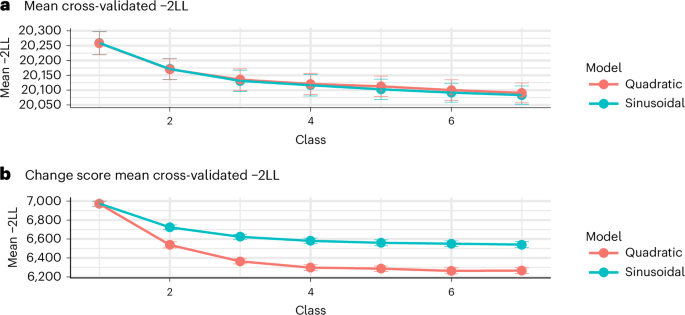
Grimm, K. J., Mazza, G. L. & Davoudzadeh, P. Model selection in finite mixture models: a k-fold cross-validation approach. Struct. Equ. Model. 24, 246–256 (2017).
Infurna, F. J. & Grimm, K. J. The use of growth mixture modeling for studying resilience to major life stressors in adulthood and old age: lessons for class size and identification and model selection. J. Gerontol. B Psychol. Sci. Soc. Sci. 73, 148–159 (2017).
Menard, S. Logistic Regression: From Introductory to Advanced Concepts and Applications (Sage Publications, 2010).
Leave a Reply