
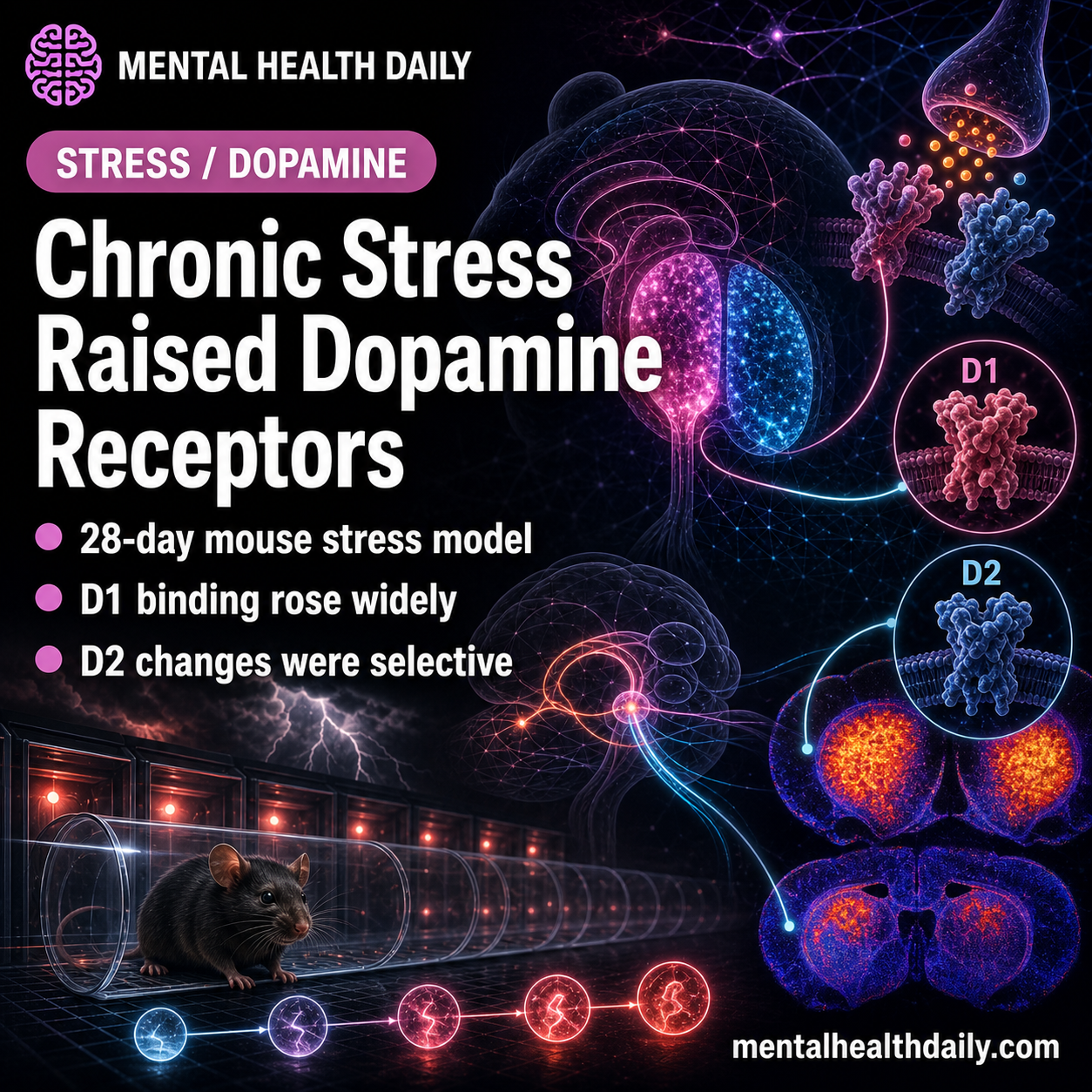
Chronic stress is a candidate mechanism for both depression and addiction risk. A 2026 mouse study found that 28 days of unpredictable chronic mild stress increased striatal dopamine D1 receptor binding by 22–48% across nearly every region examined, plus more selective D2 receptor increases — pointing to a stress-driven shift in reward signaling that may help explain why depression and substance use disorders so often co-occur.1
Research Highlights
- 28-day unpredictable chronic mild stress raised D1 receptor binding across the entire mouse striatum. Lu et al. exposed FABP7+/+ and FABP7−/− male mice (n = 9–10 per cell) to 28 days of UCMS, then measured dopamine D1 and D2 receptor density via in vitro autoradiography with [3H]SCH23390 and [3H]Spiperone.1
- D1 receptor binding increased by 22–48% across all striatal subregions, substantia nigra, and olfactory tract. Largest increase: substantia nigra (+43.3%), olfactory tract (+34.2%). Increases held in nucleus accumbens core, shell, and all 6 caudate-putamen subdivisions.1
- D2 receptor changes were narrower. Significant D2 increases in dorsal CPu (+33.9%), ventral CPu (+37.9%), and olfactory tract (+24.8%); other regions showed no change.1
- FABP7 deletion didn’t blunt the stress effect. Knocking out fatty acid-binding protein 7, which traffics endocannabinoids and was hypothesized to buffer stress responses, did not significantly change the D1 or D2 upregulation pattern. Other FABP isoforms (FABP3, FABP5) likely compensate.1
- Mouse model, male only, 28 days. The findings support a mechanistic hypothesis about how chronic stress might shift the dopamine system in directions relevant to depression and addiction; they do not directly demonstrate the same shifts in human patients or in females.
The unpredictable chronic mild stress (UCMS) paradigm has been a workhorse model of depressive-like states in rodents since the early 1990s. Mice are exposed to a rotating menu of mild, unpredictable stressors over weeks — cage tilt, moist bedding, brief food deprivation, light/dark cycle disruption — and reliably develop reduced sucrose preference, increased forced-swim immobility, and other anhedonia-like behaviors that respond to chronic antidepressant treatment.2
UCMS effects on the dopamine system at the receptor level have been less clear. Mild acute stress activates dopamine release and is implicated in addiction-like behaviors; chronic unpredictable stress tends to suppress dopamine release and is associated with anhedonia.3
Receptor-level changes have been reported inconsistently across studies, partly because methods differ and partly because compensatory feedback can run either way: more receptors when there is less ligand around, fewer receptors when there is more.
28 Days of Unpredictable Stress Tested D1/D2 Binding in Male Mice
Lu et al. used a 2 × 2 factorial: stress (UCMS vs. home-cage control) crossed with genotype (FABP7+/+ wild-type vs. FABP7−/− knockout). Adult male mice (n = 9–10 per cell, 38 total) were single-housed and exposed to UCMS over 28 days.
Brains were extracted, sectioned, and quantified for D1 and D2 receptor binding using tritiated antagonist autoradiography — a method that measures receptor density on tissue sections by radioactive ligand binding to receptors.1
FABP7 (fatty acid-binding protein 7) is one of the brain’s lipid-trafficking proteins, expressed primarily in astrocytes and neural stem cells. It transports endocannabinoids (the brain’s natural cannabis-like signaling molecules), polyunsaturated fatty acids, and docosahexaenoic acid.
Prior work suggested FABP7 deletion modulates stress responses, including reductions in stress-induced cocaine-seeking and corticosterone elevation.4 The hypothesis tested here was that FABP7 knockout might buffer the dopamine system from chronic stress; the result was that it didn’t.
Regions of interest were anatomically subdivided to capture functionally distinct dopaminergic territories:
- Caudate-putamen (CPu) subdivisions — dorsal medial (goal-directed behavior), dorsal lateral (habit formation), dorsal (sensory/novelty), ventral medial (motivation/reward), ventral lateral (sensorimotor), and ventral (aversive learning).
- Nucleus accumbens core and shell — central reward-processing nodes.
- Olfactory tract and substantia nigra reticular — broader dopaminergic projections.
D1 Receptor Binding Went Up Almost Everywhere
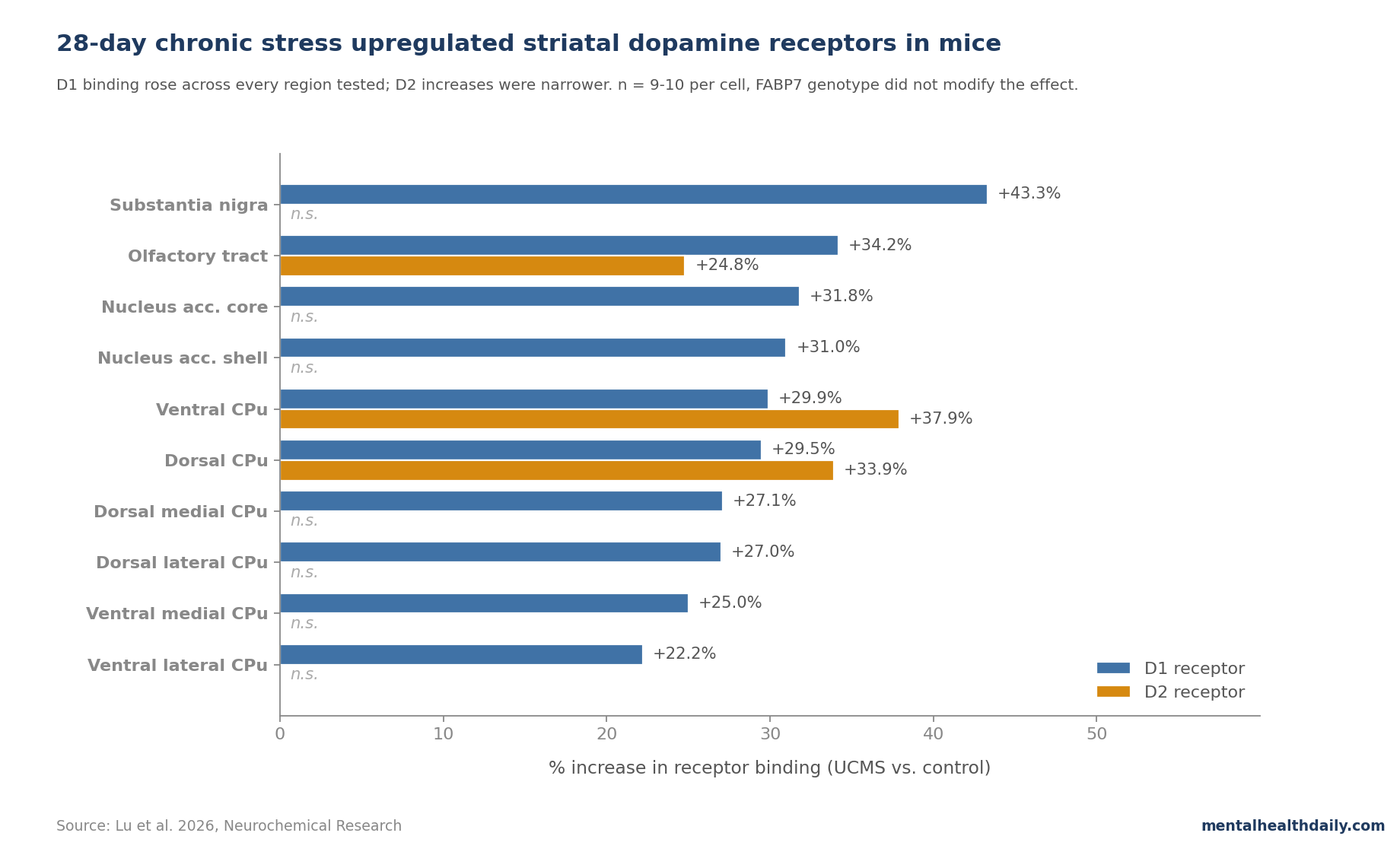
The D1 receptor finding was the most striking. Two-way ANOVA showed a significant main effect of stress on D1 binding in all 10 regions tested, with no significant genotype effect or genotype-by-stress interaction. Increases by region (UCMS vs. control):
- Substantia nigra reticular: +43.3% (p = 0.0376).
- Olfactory tract: +34.2% (p = 0.0080).
- Nucleus accumbens core: +31.8% (p = 0.0163).
- Nucleus accumbens shell: +31.0% (p = 0.0064).
- Ventral CPu: +29.9% (p = 0.0102); dorsal CPu: +29.5% (p = 0.0225).
- Dorsal medial CPu: +27.1% (p = 0.0084); dorsal lateral CPu: +27.0% (p = 0.0070).
- Ventral medial CPu: +25.0% (p = 0.0105); ventral lateral CPu: +22.2% (p = 0.0070).
The directional consistency across 10 anatomically distinct regions is what makes the finding hard to dismiss. A single-region increase could be noise; a uniform 22–48% bump across every region of the dopaminergic projection system from substantia nigra to nucleus accumbens points to a system-level shift.1
D2 Receptor Increases Were More Selective
D2 receptor binding rose significantly only in 3 regions: dorsal CPu (+33.9%, p = 0.0456), ventral CPu (+37.9%, p = 0.0443), and olfactory tract (+24.8%, p = 0.0480). Other regions, including the nucleus accumbens core and shell, showed no significant D2 change.1
The asymmetry between D1 (broadly upregulated) and D2 (selectively upregulated) changes how the result reads. D1 and D2 receptors have opposing functions in striatal microcircuits.
Pathway direction: D1 receptors couple to Gs and drive an excitatory direct pathway associated with action initiation and reward seeking. D2 receptors couple to Gi/o and drive an inhibitory indirect pathway associated with action suppression and response inhibition.
A stress-induced shift toward more D1 than D2 receptors, particularly in the nucleus accumbens, would tilt the system toward reward-seeking and against response-inhibition control — a configuration consistent with both addiction vulnerability and certain depression phenotypes.5
FABP7 Deletion Did Not Alter the Stress Response
The original hypothesis was that FABP7−/− mice would show blunted dopaminergic responses to UCMS, given prior work showing FABP7 deletion attenuates anxiety-like behavior, reduces stress-induced cocaine reinstatement, and lowers stress-induced corticosterone.4 The dopamine receptor data did not support that prediction: knockouts and wild-types responded to UCMS the same way.
The most parsimonious explanation, the authors note, is functional redundancy among FABP isoforms. FABP3, FABP5, and FABP7 all participate in lipid trafficking in the brain, and prior work has shown that compound FABP5/FABP7 knockouts produce stronger behavioral phenotypes than single knockouts — consistent with compensation by the remaining isoform when one is deleted.6 Whether a triple-isoform manipulation would prevent the dopamine receptor upregulation is a question for future work.
Dopamine Receptor Upregulation Links Stress to Reward-Circuit Vulnerability
Depression and substance use disorders co-occur at much higher rates than chance: roughly 30–50% of patients with major depression have a comorbid substance use disorder over their lifetime, and vice versa.7 A long-running hypothesis is that chronic stress is the shared upstream cause — producing dopaminergic dysregulation that manifests as anhedonia in some patients, drug-seeking in others, and both in many.
The Lu finding fits this picture in a specific way:
- D1 upregulation across the striatum may reflect a compensatory response to reduced dopamine release under chronic stress — the system tries to extract more signal from less neurotransmitter.
- D2 upregulation in dorsal CPu and ventral CPu aligns with a hyperdopaminergic compensatory shift in habit-related (DL CPu) and reward-related (ventral) territories.
- The shift in the D1:D2 ratio, particularly in the nucleus accumbens, may underlie altered reward sensitivity that bridges anhedonia and addiction vulnerability.
None of this was directly measured in the study — the readout was receptor binding density, not behavior. But the receptor-level changes are a plausible mechanism for the behavioral phenotypes seen in chronic stress paradigms.
Male Mouse Autoradiography Supports Mechanism, Not Human Diagnosis
This is a preclinical mouse study with n = 9–10 per cell. It supports a mechanistic hypothesis about how chronic stress alters striatal dopamine receptor density; it does not establish that the same receptor-level changes occur in humans with chronic stress, depression, or substance use disorder.
What this design can support: a directional hypothesis about D1 receptor upregulation under chronic stress, suitable for testing in human PET imaging studies with [11C]SCH23390 and similar tracers; a target for pharmacological tests in rodent models of depression and addiction comorbidity; and a contributor to the broader literature suggesting chronic stress shifts the dopamine system in ways relevant to mood and reward.
What this design cannot support: claims about clinical efficacy, individual diagnosis, female-mouse generalizability (this study was male-only), or whether human chronic stress produces a similar pattern.
Male-Only Mouse Data Leave Sex and Human Translation Open
Male mice only. Sex differences in stress responses, dopamine system organization, and depression epidemiology are well-documented. The all-male design means we don’t know whether females show the same D1 upregulation pattern.
Single-housed. Single housing is itself a chronic stressor in social species and may have interacted with UCMS. The control group was also single-housed, which controls for the comparison but limits the ecological generalization.
Receptor binding, not function. Autoradiography measures how many receptors are present, not how well they signal. Increased binding could reflect more receptors, more accessible receptors, or differential ligand affinity. Functional assays (cAMP, behavioral pharmacology) would be needed to confirm signaling consequences.
No behavioral data in this paper. The receptor changes are reported without parallel behavioral readouts (sucrose preference, forced swim, social interaction). The behavioral relevance of the receptor changes is inferred, not measured.
FABP7 single knockout may not fully test the hypothesis. Compensation from FABP3 and FABP5 likely masks the FABP7-specific contribution. A compound knockout (FABP5−/−/FABP7−/−) would be a stronger test of endocannabinoid-trafficking involvement.
Stress Models Should Track Receptor Density Alongside Dopamine Release
- Chronic stress produced receptor-level dopamine changes. 28 days of mild unpredictable stress produced sweeping receptor-level changes in the dopamine system, even in healthy young adult mice. The hypothalamic-pituitary-adrenal (HPA) axis story is the headline; the dopamine receptor changes are the underrated downstream effect.
- Depression-and-addiction comorbidity has plausible shared mechanisms. Stress-induced dopamine dysregulation is a candidate shared cause for the high co-occurrence of these disorders. The Lu data add receptor-density evidence to the existing release-and-signaling literature.
- Single-pathway pharmacological targets may be insufficient. If chronic stress affects D1 receptors broadly and D2 receptors selectively, antidepressants that work through monoamine reuptake alone may not fully address the system-level shift. The clinical benefit of newer agents that hit multiple targets (esketamine, brexanolone, psychedelics in trial) may partly come from broader system-level effects.
- Don’t over-extrapolate to clinical care. First-line treatments for depression (SSRIs, SNRIs, CBT) and substance use disorder (buprenorphine, naltrexone, methadone, contingency management, motivational interviewing) remain the evidence-based standards. This study is mechanism-strengthening, not treatment-changing.
Questions About Chronic Stress, Dopamine Receptors, and Mood
What is the dopamine system and why does stress affect it?
The dopamine system is a network of neurons, mostly originating in the midbrain (ventral tegmental area, substantia nigra), that send signals throughout the brain to regulate motivation, reward, motor control, and learning. Chronic stress affects this system at multiple levels — neurotransmitter release, receptor density, and downstream signaling.3
The Lu study focused on D1 and D2 receptor density, finding that 28 days of mild unpredictable stress shifts the system toward higher receptor counts — possibly a compensatory response to reduced dopamine release.
Does this mean my brain is changed by everyday stress?
The UCMS paradigm uses sustained, unpredictable mild stressors over 4 weeks — analogous in some ways to chronic life stress in humans, but not directly equivalent to 1 stressful day or week.2
Acute stress activates dopamine release transiently; chronic, sustained stress is the regime that appears to produce structural receptor-level changes in animal models. Whether everyday work or relationship stress reaches that threshold depends on duration, severity, and individual differences.
What is the difference between D1 and D2 receptors?
Both bind dopamine, but they have opposite intracellular effects.
D1 vs. D2: D1 receptors activate cAMP signaling (excitatory, action-promoting) and are densely expressed on direct-pathway neurons in the striatum. D2 receptors inhibit cAMP signaling (inhibitory, action-suppressing) and are expressed on indirect-pathway neurons and on dopamine neurons themselves as autoreceptors.5
The balance between D1 and D2 activity helps regulate which actions get initiated and which get suppressed. A stress-induced shift in this balance is one mechanism by which chronic stress could affect motivation, reward sensitivity, and impulsivity.
Why does this matter for depression and addiction?
Depression and substance use disorder co-occur at much higher rates than chance, and chronic stress is a shared risk factor for both.7 If chronic stress reliably shifts the dopamine system in directions that affect reward sensitivity and impulse control, that provides a partial mechanistic explanation for why the 2 conditions cluster together.
Practical implication: addressing chronic stress through evidence-based approaches (CBT, exercise, structural life changes, sleep, social support) may be upstream of mood and addiction outcomes — consistent with what stress-management trials have shown clinically.
Is FABP7 a drug target?
FABP inhibitors are an active area of research, primarily for analgesia (FABP5/FABP7 inhibitors raise endocannabinoid tone) and for some psychiatric indications. They are not yet clinically used for depression or addiction.
The Lu finding that single-isoform deletion did not blunt the stress response suggests that effective FABP-targeted therapeutics may need to hit multiple isoforms simultaneously, complicating drug development.
References
- Unpredictable chronic mild stress upregulates dopamine receptor expression independent of fatty acid-binding protein 7 gene deletion. Lu H et al. Neurochemical Research. 2026;51:143. doi:10.1007/s11064-026-04753-3
- The chronic mild stress (CMS) model of depression: history, evaluation and usage. Willner P. Neurobiology of Stress. 2017;6:78-93. doi:10.1016/j.ynstr.2016.08.002
- Dopamine system dysregulation by the hippocampus: implications for the pathophysiology and treatment of schizophrenia. Belujon P & Grace AA. International Journal of Neuropsychopharmacology. 2017;20(12):1036-1046. doi:10.1093/ijnp/pyx056
- Genetic deletion of fatty acid-binding protein-5 attenuates stress-induced reinstatement of cocaine seeking. Hamilton J et al. Frontiers in Behavioral Neuroscience. 2018;12:113. doi:10.3389/fnbeh.2018.00113
- Functional anatomy of dopaminergic systems and dopamine signaling. Tritsch NX & Sabatini BL. Neuron. 2012;76(1):33-50. doi:10.1016/j.neuron.2012.09.023
- Brain fatty acid-binding proteins and behavior: insights from genetic models. Owada Y et al. Behavioural Brain Research. 2012;238:1-8. doi:10.1016/j.bbr.2012.10.003
- Comorbidity of mental disorders with alcohol and other drug abuse: results from the Epidemiologic Catchment Area (ECA) study. Regier DA et al. JAMA. 1990;264(19):2511-2518. doi:10.1001/jama.1990.03450190043026
Leave a Reply