
⏱ 2 min read
- Comment
- Published:
Subjects
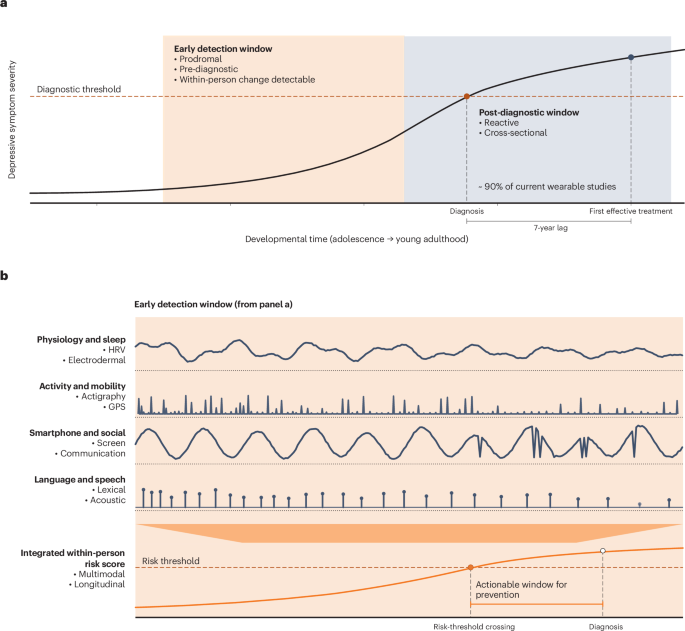
Advances in consumer wearables and machine learning enable the continuous detection of depression risk through behavioral and physiological data. In this Comment, we emphasize the crucial need to apply these technologies to adolescents, highlighting the potential for early detection and prevention of depression during this pivotal developmental stage.
This is a preview of subscription content, access via your institution
Access options
Subscribe to this journal
Receive 12 digital issues and online access to articles
79,00 € per year
only 6,58 € per issue
Buy this article
- Purchase on SpringerLink
- Instant access to the full article PDF.
39,95 €
Prices may be subject to local taxes which are calculated during checkout
References
-
Liu, Z. & Kuai, M. BMC Psychiatry 25, 767 (2025).
-
Proudman, D., Greenberg, P. & Nellesen, D. Pharmacoeconomics 39, 619–625 (2021).
-
Wang, P. S. et al. Lancet 370, 841–850 (2007).
-
Luttinen, J. et al. J. Affect. Disord. 376, 189–205 (2025).
-
McGorry, P., Gunasiri, H., Mei, C., Rice, S. & Gao, C. X. Front. Psychiatry 15, 1517533 (2025).
-
Mohr, D. C., Lyon, A. R., Lattie, E. G., Reddy, M. & Schueller, S. M. J. Med. Internet Res. 19, e153 (2017).
-
Mullick, T., Radovic, A., Shaaban, S. & Doryab, A. JMIR Form. Res. 6, e35807 (2022).
-
Chen, W. et al. BMC Psychiatry 25, 497 (2025).
-
Kandola, A., Lewis, G., Osborn, D. P. J., Stubbs, B. & Hayes, J. F. Lancet Psychiatry 7, 262–271 (2020).
-
Fisher, H. et al. npj Digit. Med. 9, 273 (2026).
-
Abd-Alrazaq, A. et al. npj Digit. Med. 6, 84 (2023).
-
Sequeira, L. et al. J. Affect. Disord. 265, 314–324 (2020).
-
McGorry, P. D., Nelson, B., Goldstone, S. & Yung, A. R. Can. J. Psychiatry 55, 486–497 (2010).
Funding
Preparation of this Comment was facilitated by National Institute of Mental Health grant R37MH101495 to I.H.G. and a National Science Foundation Graduate Research Fellowship to E.G.
Ethics declarations
Competing interests
The authors declare no competing interests.
Rights and permissions
About this article

Cite this article
Giampetruzzi, E., Antonacci, C. & Gotlib, I.H. The promise of digital phenotyping for the early detection of risk for depression in adolescents. Nat. Mental Health (2026). https://doi.org/10.1038/s44220-026-00679-5
-
Published:
-
Version of record:
-
DOI: https://doi.org/10.1038/s44220-026-00679-5
Leave a Reply