
⏱ 9 min read
Main
In recent years, online environments such as social media, video-sharing sites and other interactive spaces where young people create, share and consume content have become an increasingly complex phenomenon in their everyday lives. The digital landscape itself is rapidly expanding: platforms are more numerous, content is more abundant and access is easier and more personalized than ever, which collectively intensifies both the potential benefits and the risks to young people’s safety and well-being. These environments not only offer opportunities for connection, identity exploration and self-expression, but they also act as key routes through which young people may potentially encounter harmful online influences1,2,3.
Of these potentially harmful influences, exposure to self-harm content is a growing public health concern4,5,6. Self-harm, in this study, refers to any intentional self-poisoning or self-injury, regardless of suicidal intent or other motives7. The term can include both fatal and nonfatal acts of intentional self-poisoning or self-injury8. Research on self-harm portrayals in the media demonstrates that exposure can affect how individuals think about and respond to self-injury9,10, and the proliferation of such content on social media platforms is constantly evolving and difficult to regulate. Longitudinal and experimental studies indicate that repeated exposure to self-harm content may heighten short-term risk for self-injurious thoughts and behaviors11,12, especially among young people4. Adolescents may be particularly vulnerable to the effects of online self-harm content because adolescence is a period of heightened sensitivity to peer influence, identity formation and greater emotional reactivity13, increasing susceptibility to self-harm behaviors. Identifying emerging risk and protective factors to exposure to online self-harm content is therefore essential to understanding the experiences of young people, including whether and how they may be influenced by digital environments, platforms and forms of online content, particularly as the digital spaces they inhabit are increasingly tailored, adapting to individual users in ways that may not always promote positive online experiences.
We consider exposure to self-harm content online across four interrelated dimensions: (1) the pathways through which it is accessed, (2) the quantity of content encountered, (3) the nature of the content and (4) the level of engagement or interaction with it. Each dimension may influence adolescents differently, depending on their individual characteristics, pre-existing vulnerabilities and current mental state5,11,14,15.
Exposure pathways
Relatively little is known about how adolescents come to encounter self-harm content online and how different exposure pathways relate to demographic or psychosocial factors, as existing research has focused predominantly on the impact of exposure rather than the routes through which it occurs. For conceptual clarity, we frame exposure as two broad strands with distinct child protection and safeguarding implications: passive (unintentional) exposure, where content appears without being sought, and more deliberate, active (intentional) exposure, where young people either search for self-harm content themselves or receive it directly from others.
Passive exposure is probably shaped by complex and largely opaque algorithms that may tailor content on the basis of demographic characteristics, individual engagement patterns or peer network behavior16. Although platforms generate vast amounts of behavioral data, this information is rarely accessible to external stakeholders—including researchers, policymakers and the wider public. This opacity complicates efforts to study exposure pathways, undermines scientific rigor and reproducibility and constrains efforts to evaluate strategies for reducing potential digital harm. It also underscores broader concerns regarding transparency, accountability and policy relevance in digital harm research17. Active exposure, while intentional, is not entirely independent of algorithmic influences; search engines and platforms may shape the results and recommendations that follow self-harm-related searches, for example, through safe messaging interventions, content suppression or related content suggestions18. Those who intentionally seek out self-harm content online report a broad range of reasons for doing so, including searching for information, seeking advice or support, connecting with others with experience of self-harm or searching for methods or techniques—or, often, a mixture of these purposes5,6,19,20,21. Actively receiving self-harm content, although less studied, is also likely to reflect a range of motivations as well as relationships between the sender and receiver, with complex interactions with content type, mental state and pre-existing vulnerabilities. Overall, girls, older adolescents and those with poorer mental health are more likely to report exposure to self-harm content online22, though the distribution of risk across diverse community populations remains poorly characterized.
Recent findings from qualitative focus groups with young people, policymakers and social media industry professionals23 show that while online discussions of self-harm can help young people feel connected, understood and better able to seek support, they may also present important safeguarding concerns. Participants described limited confidence in existing platform safety tools, particularly reporting mechanisms and automated moderation systems, which they felt were opaque, inconsistently applied, and often ineffective. Across all groups interviewed, there was a clear call for renewed efforts to coordinate and improve cross-sector responses to online safety that recognize and support the shared responsibilities of platforms, governments, young people, parents, schools and health services.
Content nature, quantity and engagement
The nature of self-harm content encountered online varies widely, ranging from supportive resources and lived-experience narratives to graphic images, videos and method discussions. Some content is framed as supportive, educational or community-building, offering opportunities for connection24, while other material may glamorize self-harm, provide explicit methods, normalize self-harm behaviors or promote viral challenges that may encourage self-harm-related behaviors25. Among some vulnerable subgroups, repeated exposure may also contribute to contagion effects and increased risk of self-harm. For example, short-form video platforms such as TikTok and Instagram may simultaneously host graphic or method-focused self-harm content alongside recovery-oriented narratives and peer support communities, with algorithms, user networks and engagement patterns determining which content any given adolescent encounters. Evidence suggests that content type matters, with exposure to graphic imagery in particular linked to heightened distress and risk of contagion5. Exposure may be associated with a range of adverse outcomes beyond self-harm itself, including emotional distress, suicidal thoughts and reduced help-seeking, although findings are heterogeneous, and some positive outcomes have also been documented5,26.
This mirrors research on traditional media, where portrayals of self-harm and suicide can influence vulnerable individuals and have led to widely adopted safeguarding practices, such as limiting method detail9 and suicide coverage away from main pages. By contrast, comparable protections have been applied inconsistently in digital spaces which, by virtue of having content that is more immersive and engaging, may increase the impact of exposure. The frequency of exposure is also important. Repeated encounters are more likely than occasional exposure to reinforce maladaptive beliefs and contribute to normalization or emotional contagion, although the mechanisms underlying these effects are likely to be complex and may also reflect ‘homophilic peer selection’ and algorithmic reinforcement rather than contagion processes alone5. Algorithmic reinforcement can come from engagement behaviors such as viewing, sharing, commenting or participating in online communities that further amplify exposure and shape subsequent content delivery11,14.
The current digital environment
As user-generated content continues to grow, an ecosystem has been created in which young people are exposed to an ever-widening array of material. Alongside this, sophisticated algorithms tailor a curated digital environment that potentially reflect and reinforce their emotional and behavioral states. This combination of ease of access, dynamism, volume and personalization of content in digital platforms presents new challenges for safeguarding young people as it increases the likelihood of both passive and active exposure to potentially harmful content, including material related to self-harm. This trend has prompted growing interest from researchers and policymakers, as well as professionals and caregivers, in how to reduce potential harms while supporting adolescent well-being online27,28. Therefore, understanding the nature of young people’s exposures to and interactions with potentially harmful content is increasingly important, particularly as online environments evolve faster than regulatory responses. While legislation such as the UK Online Safety Act (2023) signals growing recognition of online risks, meaningful regulatory response will require robust empirical evidence to inform content moderation, risk assessment and child protection frameworks.
Study aims
Drawing on data from over 30,000 students in the 2025 OxWell Student Survey, this study examines adolescents’ self-reported exposure to online self-harm content in the past month, focusing on both pathways and frequency of exposure. The study further investigates how these pathways relate to key demographic characteristics, interpersonal experiences and mental health difficulties.
Research questions
- 1.
What proportion of students in the OxWell 2025 sample report exposure to online self-harm content in the past month, and how frequently does this occur?
- 2.
Among students who report past-month exposure, what proportions are exposed via passive and/or active pathways of exposure, and which demographic, interpersonal and mental health factors are associated with different exposure pathways?
Results
Frequency of online self-harm content exposure
Of the 32,102 secondary school/further education college (FEC) students who consented to participate in the OxWell 2025 survey, 29,236 reached the self-harm exposure item. Of these, 28,797 (98.5%) provided a response, while 439 (1.5%) chose not to answer. Among those who responded, 34.5% (9,940/28,797; 95% confidence interval (CI) 34.0–35.1%) reported encountering self-harm content online in the past month. Of the 9,940 students who reported past-month exposure, 54.9% (5,464) had encountered such content once or twice, 26.5% (2,638) a few times and 18.5% (1,838) several times. Sample characteristics with subgroup breakdowns are presented in Table 1 and Supplementary Figs. 1–10. A full version of this table is provided in Supplementary Table 1.
Pathways of exposure
Among the 9,802 students who answered the exposure pathway item, the majority were classified as passive only (72.9%; 7,150/9,802). Much smaller proportions were categorized as active-search only (2.7%; 263/9,802) or active-receive only (3.0%; 292/9,802), while 12.1% (1,187/9,802) were mixed pathways and 9.3% (910/9,802) were classified as other only. The most common route of exposure was via feed suggestions (66.2%; 6,490/9,802), and embedded content (23.5%; 2,307/9,802), with fewer young people exposed via more active routes (Table 2). Notably, a substantial proportion (15.1%; 1,477/9,802) reported ‘other’ forms of exposure. Exposure frequency varied across pathways (Supplementary Table 2 and Supplementary Fig. 21). Most passive-only students (59.2%; 4,234/7,150) and active-receive-only students (61.6%; 180/292) reported seeing self-harm content only ‘once or twice’, compared with 30.4% (80/263) of active-search-only students and 29.6% (351/1,187) of mixed-exposure students. The combinations of exposure routes within the mixed-pathway group are presented in Supplementary Table 3. Full data visualizations by frequency are shown in Supplementary Figs. 11–20.
Predictors of exposure pathway
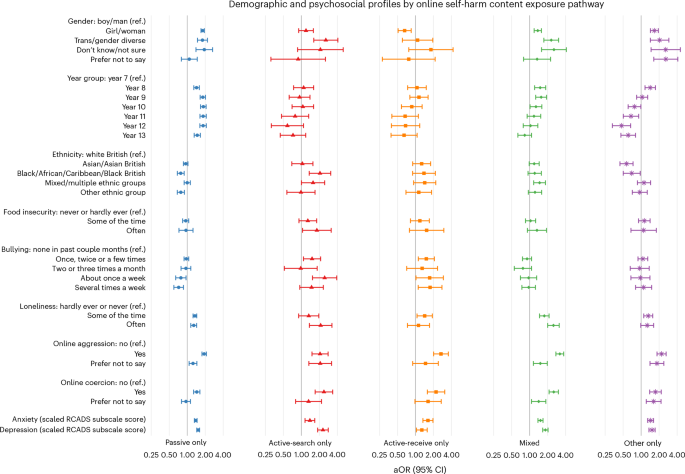
The analytic sample for the multinomial regression analyses included all 32,102 students. Figure 1 and Supplementary Table 4 present findings as adjusted odds ratios (aORs) (all presented as relative to no exposure), and Supplementary Table 5 presents predicted probabilities. Sensitivity analyses using complete cases (n = 25,113) produced largely consistent findings and are presented in Supplementary Tables 6 and 7 and Supplementary Fig. 22.
The estimates are presented as fully mutually aORs from a multinomial logistic regression (n = 32,102), shown as points with 95% CIs. aORs >1 indicate increased odds of belonging to that pathway relative to no exposure; aORs <1 indicate decreased odds. Exact P values for all estimates are reported in Supplementary Table 4. Ref., reference.
Passive only
Relative to boys, girls had higher odds of passive-only exposure (aOR 1.81, 95% CI 1.70–1.93; P < 0.001), as did trans/gender-diverse students (aOR 1.80, 95% CI 1.48–2.18; P < 0.001) and those who were unsure of their gender identity (aOR 1.93, 95% CI 1.40–2.66; P < 0.001). The odds of passive-only exposure generally increased with age—almost doubled by year 11 compared with year 7 (aOR 1.85, 95% CI 1.64–2.08; P < 0.001) before dipping slightly in years 12 and 13. White students were significantly more likely than Black students (aOR 0.78, 95% CI 0.68–0.89) and students from other ethnic groups (aOR 0.78, 95% CI 0.68–0.89) to be in this group. Students with higher levels of exposure to bullying were less likely to be in this group (for example, aOR for ‘weekly’ bullying of 0.78, 95% CI 0.64–0.96; P = 0.016). Greater loneliness (aOR for ‘often’ lonely of 1.29, 95% CI 1.15–1.44; P < 0.001), experiences of online aggression (aOR 1.92, 95% CI 1.77–2.09; P < 0.001) and online coercion (aOR 1.45, 95% CI 1.28–1.63; P < 0.001), as well as higher anxiety (aOR 1.39 per s.d., 95% CI 1.32–1.46; P < 0.001) and depression scores (aOR 1.53 per s.d., 95% CI 1.45–1.61; P < 0.001), were all associated with increased odds of passive-only exposure.
Active-search only
Relative to boys, trans/gender-diverse students had higher odds of active-search-only exposure (aOR 2.57, 95% CI 1.61–4.08; P < 0.001). Black students were significantly more likely than white students to be in this group (aOR 2.05, 95% CI 1.35–3.11; P = 0.001), as were students from mixed ethnic backgrounds (aOR 1.57, 95% CI 1.00–2.46; P = 0.048). Students who reported going to bed hungry often had elevated odds of active-search-only exposure (aOR 1.82, 95% CI 1.05–3.15; P = 0.033). Bullying was also associated with increased odds, particularly among those bullied about once a week (aOR 2.45, 95% CI 1.54–3.92) and those bullied once or twice (aOR = 1.51, 95% CI 1.08–2.11; P = .015). Greater loneliness was associated with increased odds (aOR for ‘often’ lonely of 2.10, 95% CI 1.36–3.25; P = 0.001). Online harms were particularly notable: those who had experienced online coercion had nearly two-and-a-half times the odds of active-search-only exposure (aOR 2.39, 95% CI 1.70–3.35; P < 0.001), and those who received aggressive or threatening messages had double the odds (aOR 2.05, 95% CI 1.51–2.80; P < 0.001). Higher depression (aOR 2.30 per s.d., 95% CI 1.88–2.81; P < 0.001) and anxiety scores (aOR 1.39 per s.d., 95% CI 1.15–1.68; P = 0.001) were each associated with increased odds of active-search-only exposure.
Active-receive only
Relative to boys, girls had lower odds of active-receive-only exposure (aOR 0.66, 95% CI 0.51–0.85; P = 0.001), but no other demographic factors reached statistical significance. Bullying was associated with increased odds of active-receive-only exposure, with those bullied once or twice having elevated odds relative to those not bullied (aOR 1.52, 95% CI 1.11–2.07; P = 0.008), as did those bullied about once a week (aOR 1.73, 95% CI 1.02–2.92; P = 0.042). Some loneliness was also associated with increased odds (aOR 1.42, 95% CI 1.06–1.91; P = 0.019). This pathway was strongly related to wider online harms. Students who had received aggressive or threatening messages online had over two-and-a-half times the odds of belonging to this group (aOR 2.67, 95% CI 2.01–3.54; P < 0.001), and those who had experienced online coercion also had substantially elevated odds (aOR 2.21, 95% CI 1.58–3.09; P < 0.001). Higher anxiety (aOR 1.62 per s.d., 95% CI 1.33–1.96; P < 0.001) and depression scores (aOR 1.28 per s.d., 95% CI 1.04–1.57; P = 0.021) were each associated with increased odds of active-receive-only exposure.
Mixed
Relative to boys, girls had higher odds of mixed exposure (aOR 1.37, 95% CI 1.19–1.57; P < 0.001), and odds were even higher among trans/gender-diverse students (aOR 2.30, 95% CI 1.73–3.05; P < 0.001) and students who were unsure of their gender (aOR 2.55, 95% CI 1.58–4.11; P < 0.001). Students from mixed ethnic backgrounds (aOR 1.47, 95% CI 1.17–1.84; P = 0.001) were also significantly more likely than white students to be in this group. Both loneliness ‘some of the time’ (aOR 1.76, 95% CI 1.47–2.11; P < 0.001) and ‘often’ lonely (aOR 2.50, 95% CI 2.01–3.12; P < 0.001) were associated with increased odds. Mixed exposure was strongly associated with online harms: students who had received aggressive messages had over three times the odds of mixed exposure (aOR 3.20, 95% CI 2.75–3.72; P < 0.001), and those who had experienced online coercion also had substantially elevated odds (aOR 2.53, 95% CI 2.12–3.03; P < 0.001). Higher anxiety (aOR 1.52 per s.d., 95% CI 1.38–1.67; P < 0.001) and depression scores (aOR 1.84 per s.d., 95% CI 1.66–2.03; P < 0.001) were each associated with increased odds of mixed exposure.
Other only
Relative to boys, girls (aOR 1.67, 95% CI 1.43–1.94; P < 0.001), trans/gender-diverse students (aOR 2.04, 95% CI 1.43–2.91; P < 0.001), students who were unsure of their gender identity (aOR 2.58, 95% CI 1.47–4.53; P = 0.001) and those who preferred not to disclose their gender (aOR 2.59, 95% CI 1.63–4.11; P < 0.001) all had elevated odds of other-only exposure. Associations with year group were inconsistent: compared with year 7, year 8 students had higher odds (aOR 1.42, 95% CI 1.16–1.73; P = 0.001), while odds then generally declined progressively across older year groups, reaching their lowest in year 12 (aOR 0.47, 95% CI 0.33–0.67; P < 0.001). Asian/Asian British (aOR 0.57, 95% CI 0.44–0.73; P < 0.001) and Black students (aOR 0.70, 95% CI 0.50–0.96; P = 0.029) were less likely than white students to be in this group. Some loneliness was associated with increased odds (aOR for ‘some of the time’ of 1.32, 95% CI 1.11–1.56; P = 0.002). Online aggression (aOR 2.20, 95% CI 1.85–2.62; P < 0.001) and online coercion (aOR 1.74, 95% CI 1.39–2.17; P < 0.001) were each associated with substantially elevated odds. Higher anxiety (aOR 1.44 per s.d., 95% CI 1.29–1.61; P < 0.001) and depression scores (aOR 1.52 per s.d., 95% CI 1.35–1.71; P < 0.001) were also each associated with increased odds of other-only exposure.
Discussion
This study provides one of the largest examinations so far of adolescent exposure to self-harm content online, drawing on data from over 30,000 students in the 2025 OxWell Student Survey. Around one-third of adolescents (34.5%) reported encountering self-harm content online in the past month, with exposure occurring predominantly without being sought. Among exposed students, the most common routes were feed suggestion (66.2%) and embedded content (23.5%), reflecting the role of algorithmic curation in driving unintentional encounters (Table 2). However, 7.5% of exposed students reported having actively searched for self-harm content, and 8.1% reported having had such content shared with them by others, underscoring that intentional and peer-mediated exposure affects a meaningful proportion of young people. Drawing on these modes of exposure, we identified five mutually exclusive pathway groups: passive only (72.9%), active-search only (2.7%), active-receive only (3.0%), mixed (12.1%) and other only (9.3%). Each pathway group showed higher psychosocial vulnerability relative to unexposed students, though the nature and magnitude of associations differed markedly across groups, as discussed below.
Passive-only exposure, the largest pathway group, typically encountered self-harm online content infrequently, with most reporting exposure only once or twice in the past month (59.2%; Supplementary Table 2). Nevertheless, even this form of unintentional exposure was associated with higher loneliness, greater symptoms of anxiety and depression, and increased exposure to online aggression and coercion relative to adolescents who reported no exposure. These findings align with previous research showing how exposure to self-harm content in adults frequently occurs without being sought29; we extend this evidence to adolescents. Given the nascent state of research in this area, plausible mechanisms remain largely theoretical but may include algorithmically driven content delivery in which interacting with adjacent or loosely related content such as posts about mental health, body image or emotional distress, signals to platforms to show increasingly targeted material, a process whose internal workings, while probably well understood by platforms, are not publicly disclosed and therefore remain opaque to researchers and users alike. Whether these associations reflect pre-existing vulnerabilities that increase susceptibility to passive exposure, consequences of exposure itself, or reciprocal processes cannot be determined from cross-sectional data, but the findings underscore passive exposure as a widespread and substantial child protection concern.
Mixed exposure pathways, which captured adolescents reporting multiple routes of exposure, was the second largest pathway group among exposed students. The composition of this group was heterogeneous (Supplementary Table 3), with around 70% of the mixed group having some element of intentional exposure. Along with the active-search-only group, this pathway was associated with particularly frequent exposure, with over 40% of students in each group reporting several encounters in the past month (Supplementary Table 2). This group also showed a broad clustering of vulnerability, characterized by high levels of loneliness and elevated anxiety and depression scores, and demonstrated particularly strong associations with online aggression and coercion. These findings suggest that mixed exposure pathways may reflect a convergence of risk processes, in which adolescents encounter self-harm across multiple routes within digital environments already marked by interpersonal risk and harm. Rather than representing a simple midpoint between passive and active exposure, mixed pathways may signal cumulative vulnerability within adolescents’ wider digital ecosystems3,14,17. This is consistent with a bidirectional feedback loop in which intentional engagement with self-harm content shapes subsequent algorithmic curation, which in turn increases passive exposure, potentially creating a self-reinforcing cycle of encounters with potentially harmful material, reflected in the notably higher frequency of exposure among active-search-only and mixed pathway students relative to passive-only students (Supplementary Fig. 21).
Active-only exposure pathways, comprising students who exclusively actively searched for or exclusively actively received self-harm content, were comparatively uncommon, each accounting for around 3% of exposed students. Adolescents in the active-search-only pathway were also more likely to report frequent exposure, suggesting that intentional exposure may contribute to sustained or repeated encounters with self-harm content rather than isolated experiences. Despite being less common, both pathways were associated with markedly elevated psychosocial risk, though their profiles differed in notable ways. Active-search only was characterized by a particularly strong depression signal, while active-receive only showed stronger associations with online aggression, suggesting that receipt of self-harm content from others may be more closely tied to interpersonal harm and peer-directed risk (including cyberbullying) than to individual vulnerability alone. These findings are consistent with emerging experimental and longitudinal evidence linking engagement with self-harm-related online content to heightened short-term risk among vulnerable individuals4,11,12. It is worth noting that the active-search-only and active-receive-only pathways represent only those whose exposure was exclusively self-directed or exclusively peer mediated; a larger proportion of students reported these behaviors as part of multiple exposure routes, all of whom are captured within the mixed pathway. Taken together, these findings suggest that elevated psychosocial vulnerability may be important across active exposure pathways, even where the specific interpersonal or behavioral correlates differ.
The other-only group, comprising around one in ten exposed adolescents, showed elevated psychosocial risk broadly intermediate between the passive-only and active pathways, with notably strong associations with online aggression and coercion and a distinctive demographic profile characterized by elevated odds across all gender minority groups. The nature of exposure within this group remains unclear, though plausible routes may include gaming platforms, private messaging applications or other digital spaces not captured by the response options offered. Further research is needed to characterize what these routes represent in (rapidly evolving) patterns of use.
The demographic patterns observed across exposure pathways add important nuance to the existing literature. Girls had elevated odds of exposure across most pathways relative to boys, with the notable exception of active-receive only where odds were lower, consistent with evidence that girls are more likely than boys to report online self-harm content exposure22. Trans and gender-diverse students showed elevated odds across most pathways, with particularly strong associations for active-search-only and mixed exposure, suggesting that this group may warrant targeted attention in digital safeguarding efforts. Passive-only exposure increased with age, peaking around years 10–12. Ethnicity patterns were pathway-specific: Black students were less likely than white students to be classified as passive-only but more likely to be in the active-search-only group, and students from mixed ethnic backgrounds were more likely to be in the active-search-only and mixed pathway groups. These patterns have not previously been documented and may reflect differences in platform use, peer networks, help-seeking behavior or platform curation practices.
In contextualizing these findings and their potential implications, there are two caveats worth noting. First, we did not collect information on what type of self-harm content adolescents saw, which is notable given the diversity of material they may encounter in their digital environments. There is likely to be heterogeneity within exposure groups in terms of meaning and impact. Actively searching for self-harm content, for example, may reflect acute distress, curiosity or a desire for validation, but may also represent attempts to seek support, information or connection with others who share similar experiences5,25,30. In Supplementary Note 1, we present responses to an extended question asking about adolescents’ motivations for actively seeking self-harm content online included in the previous OxWell 2023 survey. Around two-thirds indicated potentially positive or adaptive motivations, most notably in terms of finding support for themselves or connecting with others who had similar experiences. These findings are consistent with research suggesting that active exposure may, in some circumstances, offer opportunities for positive support and highlight how digital environments can function as complex ecosystems in which harmful, neutral and potentially beneficial exposures may coexist, sometimes within the same content stream5,30,31.
Second, the potential impact that encountering self-harm content online may have for adolescents was not tested directly in this study. While there is some evidence to suggest that exposure can be associated with short-term increases in distress and risk4,11,12, research examining exposures in digital environments remains relatively limited. Our own findings indicate that every exposure pathway was associated with higher anxiety and depression relative to no exposure, and while these associations cannot be interpreted causally in isolation, there is little reason to assume that exposure to self-harm content online is less influential than portrayals of self-harm in traditional media, for which a more established evidence base exists9,10.
These caveats notwithstanding, this study provides novel, timely and policy-relevant evidence regarding the widespread exposure of young people to digital harm. Taken together, the findings indicate the need for a multipronged public health approach, with a combination of targeted and universal interventions to tackle both intentional and unintentional exposures to self-harm content online. In particular, the findings underscore the need for better content moderation and regulation, greater algorithmic transparency, and education, especially on algorithm modification for young people and their parents and caregivers—all of which are valuable and widely-recognized levers that may be used in tandem to create safer online environments32 (Box 1). The study further highlights the importance of contextualizing exposure within adolescents’ wider digital ecosystem. Contemporary digital platforms operate within what can be described for adolescents as growing up in an ‘age of influence’, characterized by algorithmic curation, continuous content flow and personalized feedback loops3,14,17, where even brief or incidental engagement with distressing material may shape subsequent content delivery. Furthermore, our finding that intentional exposure pathways were strongly associated with other online harms reinforces the notion that exposure to self-harm content often occurs within broader patterns of vulnerability and digital risk rather than as isolated events14.
Limitations
Several additional limitations should be noted. First, levels and types of engagement with content were not measured, such as whether adolescents were observing passively, endorsing content or seeking connection, and the exposure categories may not fully capture the complexity or subjective impact of online experiences. Second, limited information was available for the sizeable ‘other-only’ exposure group. Third, the cross-sectional design precludes conclusions regarding causal pathways between psychosocial risk factors and exposure frequency or pathways. Furthermore, the pathways we describe may reflect influences with in-person (offline) peer groups, and our data cannot separate these from online influences. Fourth, the self-report nature of the survey may have introduced reporting or recall bias, while the exclusion of those who left the survey before reaching the question on self-harm content exposure may have introduced attrition bias. In addition, findings may not fully generalize to adolescents outside UK mainstream education, including those who are home educated or not currently in school, who may differ in their patterns of online engagement and exposure to self-harm content. Fifth, the wording of the exposure item, which asked whether students had ‘come across’ self-harm content online, could imply accidental encounter and may have led some who actively sought such content to underreport, potentially underestimating the true proportion with past-month exposure. Finally, although analyses adjusted for multiple confounders, unmeasured factors such as offline exposure to self-harm, adverse childhood experiences, substance use, digital or mental health literacy, and broader patterns of digital engagement (for example, screen time) may also have contributed to the observed associations.
Conclusion
Exposure to online self-harm content is widespread and shaped by distinct pathways that differ according to adolescents’ wider vulnerabilities, social environments and digital behaviors. Around one-third of our large community sample reported recent exposure, underscoring the need for interventions that account for diverse exposure experiences, from passive, algorithmically driven delivery to more intentional searches and peer sharing. Policies such as the UK Online Safety Act (2023) create a legislative imperative to mitigate harmful exposures; however, to be effective and proportionate, they must be guided by high-quality, real-world evidence, reflecting how young people encounter content and engage with platforms. Interventions that reflect the diversity of exposures, protecting against inadvertent, algorithm-driven exposure while supporting those who actively seek help or connection, are likely to be most effective in mitigating risk while preserving potential benefits. Addressing these risks will benefit from greater algorithmic transparency and moderation, safe and recovery-oriented responses for adolescents who actively search for or receive self-harm content, and education that supports informed, adaptive engagement with digital environments. Moving forward, cross-sector collaboration that includes the voices of young people will be essential to ensure that evolving policies and platform strategies reflect the lived realities of adolescents growing up in a digital age.
Methods
Ethics
This research complies with all relevant ethical regulations. The OxWell Student Survey was approved by the University of Oxford Research Ethics Committee (reference R62366/RE0017). Schools were recruited through local authority partners. Students aged 16 years and above provided informed consent to participate, and students under 16 years provided assent after parents had been given the opportunity to opt their child out of participation. Consent and assent were recorded electronically within the online survey before proceeding. No incentives or other compensation were offered for participation.
Design and procedure
The OxWell Student Survey is a repeated cross-sectional survey of young people in schools and FECs in England, designed to assess self-reported mental health, well-being, life experiences and behaviors33. Survey completion was estimated to take approximately 15 min.
Data were collected between February and March 2025, with a small number of schools completing in April and May 202534. Questions regarding online behavior were only asked to those in school years 7–13 (ages 11–18 years), and so the analysis presented here draws on a total sample of 32,102 participants from 49 secondary schools and FECs primarily located in two regions of England: Liverpool and Oxfordshire. As some students did not reach or answer these questions in the survey, analyses were restricted to participants who answered the self-harm content exposure items.
Measures
Self-harm content exposure: frequency and pathways
Past-month exposure to self-harm content online was assessed using two items. First, participants were asked about frequency with the question, “In the past month, have you come across content about self-harm on online platforms?” with response options: “No, I haven’t come across self-harm content in the past month”, “Yes, once or twice”, “Yes, a few times” and “Yes, several times”. This measure was intentionally broad with regard to defining self-harm, as we were interested in students’ interpretations of what they were seeing online rather than whether content encountered met stringent clinical or academic definitions of self-harm. The precise question was coproduced with OxWell Study Youth Advisors, who when consulted about how best to ask about exposure to self-harm content online advised that, as such exposure is common-place for adolescents, restricting our question to a recent time frame—such as the last month—might give a better indication of current experiences. Participants who reported any exposure in the last month were then asked about exposure pathways with the question, “How did you come across content about self-harm? (Tick all that apply)” with response options: “I searched for it”, “Someone shared it with me”, “It appeared in my feed or was suggested while I was browsing”, “I accidentally encountered it (for example, clicked on a misleading link)”, “It was embedded within unrelated content” and “Other”.
On the basis of these responses, participants were classified into mutually exclusive exposure pathway groups. The no-exposure group included those who reported no exposure in the past month. The passive-only exposure group included those who only selected one or more of the following responses: “It appeared in my feed”, “I accidentally encountered it” or “It was embedded within unrelated content”. The active-search-only exposure group included participants who only selected “I searched for it”. The active-receive-only exposure group included those who only selected “Someone shared it with me”. The mixed exposure group included participants who selected any combination of passive, active or other exposures. Finally, participants who selected “Other” only were classified into an other-only group.
Demographic characteristics
Gender was measured using the following categories, derived from one question on gender and a second on transgender identity34: “girl/woman”, “boy/man”, “trans/gender diverse”, “don’t know/not sure” and “prefer not to say”. Sex assigned at birth was not collected. Ethnicity was grouped according to the Office for National Statistics 6a classification: “White”, “Mixed/Multiple Ethnic Groups”, “Asian/Asian British”, “Black/African/Caribbean/Black British” and “Other Ethnic Group (including Arab)”. Food insecurity (“going to bed hungry”) was assessed using a single-item question asking how often participants went to bed hungry due to not having enough food in the house, with response options:“Never or hardly ever”, “Some of the time” and “Often”. Participants also indicated their current school year group, ranging from year 7 to 13.
Interpersonal experiences
Loneliness was assessed using a single-item question from the Office for National Statistics Children and Young People’s Mental Health questionnaire suite: “How often do you feel lonely?”, with response options: “Hardly ever or never”, “Some of the time”, and “Often”35. Bullying was assessed using an adapted item from the Olweus Bully/Victim Questionnaire (OBVQ): “How often have you been bullied at school in the past couple of months?” with response options: “I have not been bullied in the past couple of months”; “Once, twice or a few times”; “2 or 3 times a month”; “About once a week”; and “Several times a week”36. Online aggression and coercion were assessed using two single items developed by the OxWell study team: “I have received threatening or aggressive messages online” and “I have been pressured to do something online that I didn’t want to do” with binary “Yes”/“No” response options.
Mental health
Symptoms of anxiety and depression were assessed using the Revised Children’s Anxiety and Depression Scale (RCADS) 25-item version, which comprises two subscales: anxiety (15 items) and depression (10 items). Items are rated on a 4-point Likert scale ranging from 0 (never) to 3 (always)37. Raw scores were converted into age- and gender-standardized T-scores using the official RCADS scoring tools, with higher T-scores indicating greater symptom severity. Internal consistency was excellent for both subscales in the current sample (depression: Cronbach’s α = 0.92; anxiety: α = 0.91).
Statistical analysis
Descriptive statistics were used to summarize the frequency of (1) self-harm content exposure and (2) exposure pathways across key demographic, interpersonal and mental health variables. Multinomial regression analyses were performed to examine associations of demographic, interpersonal and mental health variables with self-harm content exposure pathways. Results are reported as aORs and 95% CIs. The ‘no exposure’ group served as the reference category for all models; all aORs therefore reflect the odds of belonging to each exposure pathway group relative to reporting no past-month exposure to self-harm content online. All models were adjusted simultaneously for gender, year group, ethnicity, food insecurity, bullying, loneliness, aggression online, coercion online, anxiety and depression. To aid interpretation, coefficients were visually summarized through use of forest plots, and predicted probabilities of group membership were estimated using marginal effects at representative levels of categorical variables, holding all other predictors constant.
Our primary analyses were conducted with multiply imputed data. Missing data were handled using multiple imputation by chained equations (mice; Van Buuren & Groothuis-Oudshoorn38), with a predictor matrix including all variables included in the main analyses alongside five additional auxiliary variables hypothesized to be informative. Continuous data were imputed using predictive mean matching and categorical data using polytomous regression. Analyses were conducted across 500 imputed datasets and estimates pooled across imputations according to Rubin’s rule39. A complete-case analysis was conducted as a sensitivity analysis.
Analyses were conducted in R version 4.5.3 using Release 13 of the 2025 OxWell data.
Reporting summary
Further information on research design is available in the Nature Portfolio Reporting Summary linked to this article.
Data availability
The data are individual-level adolescent survey responses containing sensitive information on mental health and self-harm. Owing to their sensitive nature and the privacy and ethical terms under which they were collected, they cannot be deposited publicly. De-identified extracts of the minimum dataset can be made available to academic researchers on reasonable request, following review by the research team. Requests should be directed to oxwell@psych.ox.ac.uk.
Code availability
The R code used for all analyses in this study is available via GitHub at https://github.com/OxWellStudy/SelfHarm-Content-2025.
References
-
Fassi, L. et al. Social media use and internalizing symptoms in clinical and community adolescent samples: a systematic review and meta-analysis. JAMA Pediatr. 178, 814–822 (2024).
-
Orben, A., Przybylski, A. K., Blakemore, S. J. & Kievit, R. A. Windows of developmental sensitivity to social media. Nat. Commun. 13, 1649 (2022).
-
Orben, A., Meier, A., Dalgleish, T. & Blakemore, S. J. Mechanisms linking social media use to adolescent mental health vulnerability. Nat. Rev. Psychol. 3, 407–423 (2024).
-
Robinson, J. et al. How do Australian social media users experience self-harm and suicide-related content? A national cross-sectional survey comparing young people and adults. BMC Public Health 26, 384 (2026).
-
Susi, K., Glover-Ford, F., Stewart, A., Knowles Bevis, R. & Hawton, K. Research review: viewing self-harm images on the internet and social media platforms: systematic review of the impact and associated psychological mechanisms. J. Child Psychol. Psychiatry 64, 1115–1139 (2023).
-
Marchant, A., Hawton, K., Burns, L., Stewart, A. & John, A. Impact of web-based sharing and viewing of self-harm–related videos and photographs on young people: systematic review. J. Med. Internet Res. 23, e18048 (2021).
-
Self-harm: assessment, management and preventing recurrence. NICE https://www.nice.org.uk/guidance/ng225 (2022).
-
Hawton, K. et al. Deliberate self-harm in Oxford, 1990–2000: a time of change in patient characteristics. Psychol. Med. 33, 987–995 (2003).
-
Niederkrotenthaler, T. et al. Association between suicide reporting in the media and suicide: systematic review and meta-analysis. BMJ 368, m575 (2020).
-
Niederkrotenthaler, T. et al. Systematic review and meta-analyses of suicidal outcomes following fictional portrayals of suicide and suicide attempt in entertainment media. eClinicalMedicine 36, 100922 (2021).
-
Hamilton, J. L. et al. Self-harm content on social media and proximal risk for self-injurious thoughts and behaviors among adolescents. J. Am. Acad. Child Adolesc. Psychiatry https://doi.org/10.1016/j.jaacop.2024.11.008 (2025).
-
Arendt, F., Scherr, S. & Romer, D. Effects of exposure to self-harm on social media: evidence from a two-wave panel study among young adults. New Media Soc. 21, 2422–2442 (2019).
-
Blakemore, S.-J. Adolescence and mental health. Lancet 393, 2030–2031 (2019).
-
Bear, H., Fazel, M. & Skripkauskaite, S. Isolation despite hyper-connectivity? The association between adolescents’ mental health and online behaviours in a large study of school-aged students. Curr. Psychol. 44, 7124–7137 (2025).
-
Orben, A. Digital diet: a 21st century approach to understanding digital technologies and development. Infant Child Dev. 31, e2228 (2022).
-
Hilbert, M. et al. #BigTech @Minors: social media algorithms have actionable knowledge about child users and at-risk teens. Telemat. Inform. 102341 (2025).
-
Orben, A. & Matias, J. N. Fixing the science of digital technology harms technology development outpaces scientific assessment of impacts. Science 388, 152–155 (2025).
-
Haime, Z. & Biddle, L. Exploring mental health content moderation and well-being tools on social media platforms: walkthrough analysis. JMIR Hum. Factors 12, e69817 (2025).
-
Jacob, N., Evans, R. & Scourfield, J. The influence of online images on self-harm: a qualitative study of young people aged 16–24. J. Adolesc. 60, 140–147 (2017).
-
Mars, B. et al. Exposure to, and searching for, information about suicide and self-harm on the Internet: prevalence and predictors in a population based cohort of young adults. J. Affect. Disord. 185, 239–245 (2015).
-
Thorn, P. et al. Motivations and perceived harms and benefits of online communication about self-harm: an interview study with young people. Digit. Health 9, 20552076231176690 (2023).
-
Gámez-Guadix, M., Mateos, E., Wachs, S. & Blanco, M. Self-harm on the internet among adolescents: prevalence and association with depression, anxiety, family cohesion, and social resources. Psicothema 34, 233–239 (2022).
-
La Sala, L. et al. Online safety when considering self-harm and suicide-related content: qualitative focus group study with young people, policy makers, and social media industry professionals. J. Med. Internet Res. 27, e66321 (2025).
-
Teens, screens and mental health: new report reveals how young people’s digital lives shape their well-being. World Health Organization https://www.who.int/europe/news/item/25-09-2024-teens–screens-and-mental-health (2024).
-
Scherr, S. Social media, self-harm, and suicide. Curr. Opin. Psychol. 46, 101311 (2022).
-
Picardo, J., McKenzie, S. K., Collings, S. & Jenkin, G. Suicide and self-harm content on Instagram: a systematic scoping review. PLoS ONE 15, e0238603 (2020).
-
Hartwell, G., Gill, M., Zenone, M. & McKee, M. Smartphones, social media, and teenage mental health. BMJ 385, e079828 (2024).
-
Health advisory on social media use in adolescence. American Psychological Association https://www.apa.org/topics/social-media-internet/health-advisory-adolescent-social-media-use.pdf (2023).
-
John, A., Marchant, A., Siddiqi, M. & Lewis, F. How social media users experience self-harm and suicide content. Samaritans https://media.samaritans.org/documents/Samaritans_How_social_media_users_experience_self-harm_and_suicide_content_WEB_v3.pdf (2025).
-
Brennan, C. et al. Self-harm and suicidal content online, harmful or helpful? A systematic review of the recent evidence. J. Public Ment. Health 21, 57–69 (2022).
-
Biernesser, C. et al. Social media use and deliberate self-harm among youth: a systematized narrative review. Child. Youth Serv. Rev. 116, 105054 (2020).
-
Robinson, J. et al. The steps that young people and suicide prevention professionals think the social media industry and policymakers should take to improve online safety. A nested cross-sectional study within a Delphi consensus approach. Front. Child Adolesc. Psychiatry 2, 1274263 (2023).
-
Mansfield, K. L. et al. Study protocol: the OxWell school survey investigating social, emotional and behavioural factors associated with mental health and well-being. BMJ Open 11, e052717 (2021).
-
White, S., Patel, S. & Fazel, M. The OxWell Student Survey 2025—study description. Oxford University Research Archive https://doi.org/10.5287/ora-aeybjkwk2 (2025).
-
Children’s and young people’s experiences of loneliness: 2018. Office for National Statistics https://www.ons.gov.uk/peoplepopulationandcommunity/wellbeing/articles/childrensandyoungpeoplesexperiencesofloneliness/2018 (2018).
-
Olweus, D. Revised Olweus bully/victim questionnaire. J. Psychopathol. Behav. Assess. (1996).
-
Chorpita, B. F., Ebesutani, C., & Spence, S. H. Revised Children’s Anxiety and Depression Scale. UCLA Child First https://www.childfirst.ucla.edu/wp-content/uploads/sites/163/2020/12/RCADSUsersGuide20201201.pdf (2015).
-
Van Buuren, S. & Groothuis-Oudshoorn, K. mice: multivariate imputation by chained equations in R. J. Stat. Softw. 45, 1–67 (2011).
-
van Buuren, S. in Flexible Imputation of Missing Data 2nd edn 29–62 (Chapman and Hall/CRC, 2018).
Acknowledgments
We thank all the students who took the time to participate in the OxWell Student Survey, and the many staff at participating schools for the considerable time and planning they put into conducting the survey during school hours. We thank J. Fullwood from Brighter Futures Together for her invaluable contribution to the overall OxWell study strategy. We thank many colleagues in local authorities and clinical commissioning groups, including D. Husband, C. Price and Z. Heywood. We are grateful to the wider OxWell Study Team for their support and insight throughout the design and delivery of the study, and extend special thanks to S. White for his preparation of the dataset and advice.
Funding
This research was funded by the NIHR Applied Research Collaboration Oxford and Thames Valley at Oxford Health NHS Foundation Trust, with support from Liverpool City Council and Oxfordshire County Council. E.S. was additionally supported by an NIHR Development and Skills Enhancement Award (grant number NIHR304151). The views expressed are those of the author(s) and not necessarily those of the NIHR or the Department of Health and Social Care.
Ethics declarations
Competing interests
H.B. has undertaken paid consultancy for Girl Effect, a nongovernmental organization focused on improving the health, education and livelihoods of girls, arranged through Oxford University Innovation. The other authors declare no competing interests.
Peer review
Peer review information
Nature Mental Health thanks Massimo Apicella, Lana Bojanić and the other, anonymous, reviewer(s) for their contribution to the peer review of this work.
Additional information
Publisher’s note Springer Nature remains neutral with regard to jurisdictional claims in published maps and institutional affiliations.
Supplementary information
Rights and permissions
Open Access This article is licensed under a Creative Commons Attribution 4.0 International License, which permits use, sharing, adaptation, distribution and reproduction in any medium or format, as long as you give appropriate credit to the original author(s) and the source, provide a link to the Creative Commons licence, and indicate if changes were made. The images or other third party material in this article are included in the article’s Creative Commons licence, unless indicated otherwise in a credit line to the material. If material is not included in the article’s Creative Commons licence and your intended use is not permitted by statutory regulation or exceeds the permitted use, you will need to obtain permission directly from the copyright holder. To view a copy of this licence, visit http://creativecommons.org/licenses/by/4.0/.
About this article

Cite this article
Bear, H., Soneson, E., Geulayov, G. et al. Algorithmically driven exposure to online self-harm content and its association with broader psychosocial risk in 32,000 adolescents. Nat. Mental Health (2026). https://doi.org/10.1038/s44220-026-00682-w
-
Received:
-
Accepted:
-
Published:
-
Version of record:
-
DOI: https://doi.org/10.1038/s44220-026-00682-w
Leave a Reply