
⏱ 5 min read
Climate Change 2021: The Physical Science Basis. Contribution of Working Group 1 to the Sixth Assessment Report of the Intergovernmental Panel on Climate Change; Technical Summary (IPCC, 2021).
Lawrance, E. L. et al. The impact of climate change on mental health and emotional wellbeing: a narrative review of current evidence, and its implications. Int. Rev. Psychiatry 34, 443–498 (2022).
Hayes, K. et al. Climate change and mental health: risks, impacts and priority actions. Int. J. Ment. Health Syst. 12, 28 (2018).
Hwong, A. R. et al. Climate change and mental health research methods, gaps, and priorities: a scoping review. Lancet Planet. Health 6, e281–e291 (2022).
Cosh, S. M. et al. The relationship between climate change and mental health: a systematic review of the association between eco-anxiety, psychological distress, and symptoms of major affective disorders. BMC Psychiatry 24, 833 (2024).
Ramadan, A. M. H. & Ataallah, A. G. Are climate change and mental health correlated?. Gen. Psychiatry 34, e100648 (2021).
White, B. P. et al. Mental health impacts of climate change among vulnerable populations globally: an integrative review. Ann. Glob. Health 89, 66 (2023).
Li, A., Toll, M. & Bentley, R. Mapping social vulnerability indicators to understand the health impacts of climate change: a scoping review. Lancet Planet. Health 7, e925–e937 (2023).
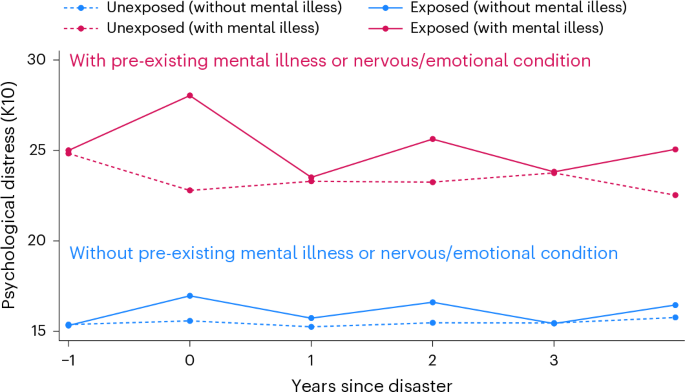
Li, A. et al. Vulnerability and recovery: long-term mental and physical health trajectories following climate-related disasters. Soc. Sci. Med. 320, 115681 (2023).
Woodland, L. et al. Investigating the health impacts of climate change among people with pre-existing mental health problems: a scoping review. Int. J. Environ. Res. Public Health 20, 5563 (2023).
Massazza, A. et al. Quantitative methods for climate change and mental health research: current trends and future directions. Lancet Planet. Health 6, e613–e627 (2022).
Isaac, F. et al. Pre-existing depression, anxiety and trauma as risk factors for the development of post-traumatic stress disorder symptoms following wildfires. Psychiatry Res. Commun. 4, 100161 (2024).
Lowe, S. R. et al. Predisaster predictors of posttraumatic stress symptom trajectories: an analysis of low-income women in the aftermath of Hurricane Katrina. PLoS ONE 15, e0240038 (2020).
Dückers, M. L. et al. The long-term mental health impact of disasters: a systematic review and multilevel meta-analysis of longitudinal epidemiological studies. Harv. Rev. Psychiatry 34, 59–72 (2026).
Berry, H. L., Bowen, K. & Kjellstrom, T. Climate change and mental health: a causal pathways framework. Int. J. Public Health 55, 123–132 (2010).
Li, A., Toll, M. & Bentley, R. Health and housing consequences of climate-related disasters: a matched case-control study using population-based longitudinal data in Australia. Lancet Planet. Health 7, e490–e500 (2023).
Rose-Clarke, K. et al. Rethinking research on the social determinants of global mental health. Lancet Psychiatry 7, 659–662 (2020).
Goldmann, E. & Galea, S. Mental health consequences of disasters. Ann. Rev. Public Health 35, 169–183 (2014).
World Health Organization & Calouste Gulbenkian Foundation. Social Determinants of Mental Health (World Health Organization, 2014).
Nicholas, P. K. et al. Mental health impacts of climate change: perspectives for the ED clinician. J. Emerg. Nurs. 46, 590–599 (2020).
Chen, S. et al. Anxiety and resilience in the face of natural disasters associated with climate change: a review and methodological critique. J. Anxiety Disord. 76, 102297 (2020).
Meadows, J. et al. Mental illness and increased vulnerability to negative health effects from extreme heat events: a systematic review. Psychiatry Res. 332, 115678 (2024).
Funayama, M. & Mizushima, J. Severity of pre-existing psychiatric illness and response to the Great East Japan Earthquake. J. Psychiatr. Res. 47, 1479–1482 (2013).
Li, A. et al. Housing at the intersection of health and climate change. The Lancet Public Health 10, e865–e873 (2025).
Guilaran, J. et al. Psychological outcomes in disaster responders: a systematic review and meta-analysis on the effect of social support. Int. J. Disaster Risk Sci. 9, 344–358 (2018).
Li, A. & McNaught, R. Effects of cumulative exposures to climate-related disasters on social capital. Int. J. Disaster Risk Reduct. 142, 106210 (2026).
Sharpe, I. & Davison, C. M. Climate change, climate-related disasters and mental disorder in low-and middle-income countries: a scoping review. BMJ Open 11, e051908 (2021).
Li, A. & Leppold, C. Long-term mental health trajectories across multiple exposures to climate disasters in Australia: a population-based cohort study. Lancet Public Health 10, e391–e400 (2025).
Lowe, S. R. et al. Cumulative disaster exposure and mental and physical health symptoms among a large sample of Gulf Coast residents. J. Trauma. Stress 32, 196–205 (2019).
Summerfield, M. et al. HILDA User Manual – Release 21 (Melbourne Institute: Applied Economic and Social Research, Univ. Melbourne, 2021).
Kessler, R. C. et al. Short screening scales to monitor population prevalences and trends in non-specific psychological distress. Psychol. Med. 32, 959–976 (2002).
Andrews, G. & Slade, T. Interpreting scores on the Kessler psychological distress scale (K10). Aust. N. Z. J. Public Health 25, 494–497 (2001).
Use of the Kessler Psychological Distress Scale in ABS Health Surveys, Australia Cat. No. 4817.0.55.001 (Australian Bureau of Statistics, 2012).
Cohen, J. Statistical Power Analysis for the Behavioral Sciences (Routledge, 2013).
Jacobson, N. S. & Truax, P. Clinical significance: a statistical approach to defining meaningful change in psychotherapy research. J. Consult. Clin. Psychol. 59, 12–19 (1991).
Gonda, T., Deane, F. P. & Murugesan, G. Predicting clinically significant change in an inpatient program for people with severe mental illness. Aust. N. Z. J. Psychiatry 46, 651–658 (2012).
Information Paper: Use of the Kessler Psychological Distress Scale in ABS Health Surveys Cat. No. 4817.0.55.001 (Australian Bureau of Statistics, 2001).
Climate Change Knowledge Portal (Word Bank, 2025).
Correia, S. & Constantine, N. REGHDFE: Stata Module to Perform Linear or Instrumental-Variable Regression Absorbing Any Number of High-Dimensional Fixed Effects Statistical Software Components S457874 (Boston College Department of Economics, 2014).
Melbourne Institute. The Household, Income and Labour Dynamics in Australia (HILDA) Survey Restricted Release 19. Australian Data Archive Dataverse https://doi.org/10.26193/24EJST (2020).
Leave a Reply