
⏱ 7 min read
Main
The primary eating disorders—anorexia nervosa (AN), bulimia nervosa and binge-eating (BE) disorder—are diagnostically distinct yet show considerable overlap and diagnostic migration over time1,2,3. AN, characterized by low weight, fear of weight gain and an inability to recognize the seriousness of the low weight, has two subtypes: restricting (AN-R) and BE/purging (AN-BP), featuring BE and/or purging behaviors. Bulimia nervosa occurs in individuals with a normal or high weight and is characterized by BE and compensatory behaviors (for example, fasting, self-induced vomiting, laxative use and diuretic use). BE disorder also includes BE at normal or high weights but without recurrent compensatory behaviors1.
Genome-wide association studies (GWASs) of eating disorders have focused primarily on AN4,5,6,7, with few GWASs of other eating disorder-related phenotypes8,9. The most recent AN GWAS6 included 16,992 cases and identified eight genome-wide significant loci. Single-nucleotide polymorphism-based genetic correlations (SNP-rgs) with other psychiatric disorders were high and also suggested that metabolic and anthropometric factors might underlie AN pathophysiology6,7. The metabolic aspect of AN is reflected by a positive SNP-rg with high-density lipoprotein cholesterol and negative SNP-rgs with insulin resistance, leptin and type 2 diabetes. Importantly, these SNP-rgs were independent of body mass index (BMI), which is relevant given that a low BMI is pathognomonic of AN.
Here, we expand the genetic landscape of eating disorders beyond AN. AN and bulimia nervosa show moderate family- and twin-based genetic correlations10,11, suggesting shared genetic risk. This may partially reflect BE, a transdiagnostic symptom common to both bulimia nervosa and AN-BP. Psychiatric diagnoses defined by the Diagnostic and Statistical Manual of Mental Disorders (DSM) and International Classification of Diseases (ICD) may not capture biological realities or patient experiences, given that disorders often exist on a continuum, overlap, co-occur, present heterogeneously and morph over time12. Focusing on diagnostic thresholds can bias research towards severe cases and exclude those with substantial pathology and impairment. Symptom-based approaches can complement diagnostic approaches and advance the science of eating disorders13. We present a GWAS of the transdiagnostic symptom of BE behavior, an augmented AN GWAS and GWASs of explicitly defined AN-R and AN-BP.
Results
Summary of phenotypes
The genetic ancestry and genetically derived sex of the participants are presented in Supplementary Table 1. We operationalized five phenotypes (Table 1): broadly defined BE (BE-BROAD), narrowly defined BE (BE-NARROW), AN, AN-R and AN-BP. We focus on BE-BROAD (owing to greater statistical power than BE-NARROW; Supplementary Results 1) and AN. Analyses of other phenotypes are presented in Supplementary Results 2. We contrast BE-BROAD with GWAS of a model-derived proxy BE disorder phenotype from the Million Veteran Program9 (Supplementary Results 3).
GWAS meta-analyses
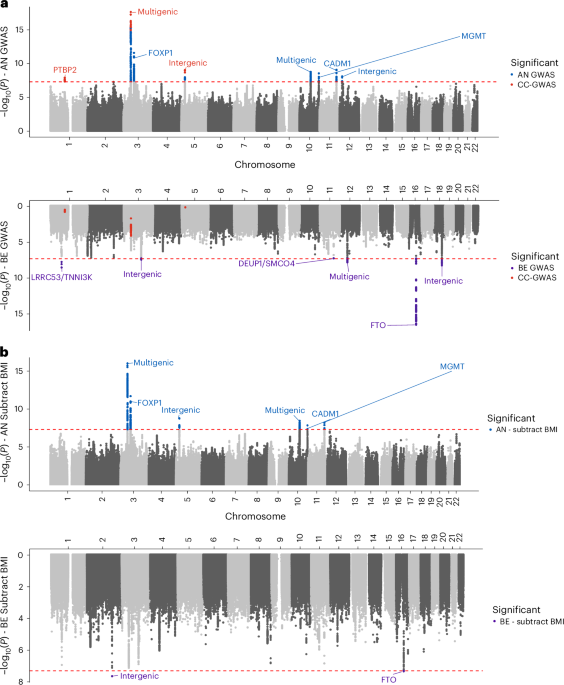
For BE-BROAD (17 European-ancestry datasets, 39,279 cases, 1,227,436 controls), we identified six independently associated loci (Fig. 1, Table 2, Supplementary Figs. 1–6 and Supplementary Tables 1 and 2). The liability-scale SNP-based heritability (h2SNP) was 5% (standard error (SE) of 0.4%, assuming population prevalence of 4.5%14) with a linkage disequilibrium score regression (LDSC) intercept of 1.03 and an attenuation ratio of 0.14 (SE of 0.04; Supplementary Table 3), suggesting that inflation was primarily due to polygenicity15.
a,b, Miami plots showing results from the AN (top; 24,223 cases, 1,243,971 controls) and BE-BROAD (bottom; 39,279 cases, 1,227,436 controls) meta-analyses. The dotted red line indicates the genome-wide significance threshold (P ≤ 5 × 10⁻⁸). We performed association analyses using two-sided logistic regression (PLINK2, SAIGE or REGENIE, depending on study characteristics) followed by fixed-effects meta-analysis. Main GWAS analyses, with variants reaching genome-wide significance colored in blue if significant in the AN GWAS and in purple if significant in the BE-BROAD GWAS. Variants reaching genome-wide significance in the case–case GWAS of BE-BROAD versus AN are colored in red (a). GWAS-by-subtraction analyses, showing results from the non-BMI genetic component. Variants reaching genome-wide significance are colored in blue for the AN non-BMI component and in purple for the BE-BROAD non-BMI component (b).
For AN (26 European-ancestry datasets, 24,223 cases, 1,243,971 controls) we identified eight independently associated loci—six known6 and two additional (Fig. 1, Table 2, Supplementary Figs. 7–14 and Supplementary Tables 1 and 2). Three previously significant loci (on chromosome 2 and 3 (ref. 6), and on chromosome 12 (ref. 7)) did not reach genome-wide significance (P = 2 × 10⁻⁷–6 × 10⁻⁷). The liability-scale h2SNP was 13% (SE of 0.7%, assuming a population prevalence of 1.5%16), the intercept was 1.02, significantly >1, and the attenuation ratio was 0.07 (SE of 0.03), suggesting polygenicity (Supplementary Table 3).
Analyses of chromosome X yielded no genome-wide significant loci for BE-BROAD nor AN, although one genome-wide significant locus was identified for BE-NARROW (Supplementary Results 2, Supplementary Fig. 15 and Supplementary Tables 4 and 5).
Given known sex differences in eating disorders, and mostly female cases in our data (96% in BE-BROAD, 94% in AN), we conducted female-only GWASs as sensitivity analyses. Results mirrored the main analyses, with differences attributable to reduced sample size (Supplementary Results 4 and Supplementary Table 6).
Genetic relationship between eating phenotypes and other traits
We assessed the genetic similarity of BE-BROAD and AN via bivariate causal mixture modeling (‘MiXeR’), via case–case GWAS and through examining their SNP-rg with each other and with other traits17,18. The SNP-rg between BE-BROAD and AN was 0.46 (SE of 0.04, P = 3.44 × 10⁻³⁰), indicating moderate genetic overlap (Supplementary Table 7). Bivariate MiXeR yielded similar SNP-rg (0.49, SE of 0.01) and indicated 2,654 overlapping causal variants (83% of all BE-BROAD causal variants) with highly concordant effects (95%; Fig. 2a). This was not distinguishable from the minimum plausible overlap given the genetic correlation observed—an overlap of >2,450 fully concordant causal variants (Supplementary Results 5 and Supplementary Table 8). Case–case GWAS uses genetic distance, the average squared difference in allele frequency at causal SNPs17. This was higher between individuals with AN and controls (0.46) and between case groups (0.40), than between individuals with BE-BROAD and controls (0.25, Fig. 2b). We identified case-divergent loci on chromosomes 1, 3 and 5, overlapping with loci from the AN GWAS (Fig. 1), suggesting that some loci differentiate AN from controls and from BE-BROAD.
a, Bivariate causal mixture modeling results from MiXeR (AN: 24,223 cases, 1,243,971 controls; BE-BROAD: 39,279 cases, 1,227,436 controls). Left: venn diagram showing overlap of putative causal variants in AN (blue) and BE-BROAD (orange), demonstrating high overlap (gray) and moderate genetic correlation (bar beneath). Middle: Q–Q plots of variant effects for AN conditional on BE-BROAD (left) and BE-BROAD conditional on AN (right), demonstrating enrichment for associations with each trait conditional on the other. Right: log-likelihood plot of model fit under differing models, from the minimal overlap model (leftmost) to the full overlap model (rightmost), showing that the best model fit (lowest y axis value) is not distinguishable from the minimal overlap. b, Genetic distance between cases and controls of BE-BROAD and AN estimated by case–case GWAS. The genetic distance is the square root of the average squared difference in allele frequency at causal SNPs.
We used LDSC to calculate pairwise SNP-rg for BE-BROAD and AN with 225 psychiatric, personality, metabolic and anthropometric traits (Table 3 and Supplementary Table 9). We generally observed positive SNP-rg of BE-BROAD with psychiatric and anthropometric phenotypes, except for persistent thinness and pubertal growth, which were negative. No SNP-rg between metabolic traits and BE-BROAD were significant except for BMI-adjusted fasting insulin. We validated and extended previously observed SNP-rg patterns with AN6: positive SNP-rg with psychiatric disorders, neuroticism, educational attainment and physical activity; negative SNP-rg with metabolic and anthropometric traits (except for total cholesterol in high-density lipoprotein); and, notably, nonsignificant SNP-rg with persistent thinness (Table 3 and Supplementary Table 9).
We tested for significant differences between the SNP-rg of BE-BROAD and SNP-rg of AN with other traits (Fig. 3, Supplementary Fig. 16 and Supplementary Table 10). Most psychiatric and behavioral phenotypes showed similar SNP-rg with BE-BROAD and AN except attention deficit hyperactivity disorder (ADHD; higher with BE-BROAD, difference P = 1.06 × 10⁻⁷) and obsessive–compulsive disorder (higher with AN, P = 4.79 × 10⁻⁵). BE-BROAD, but not AN, was positively correlated with Alcohol Use Disorder Identification Test (AUDIT-P) problem items, four smoking-related phenotypes and general risk tolerance (P ≤ 4.83 × 10⁻⁷). AN, but not BE-BROAD, was negatively correlated with automobile speeding propensity (P = 1.21 × 10⁻⁴).
Point estimates represent rgs as estimated by LDSC, with error bars indicating ±1 SE. Filled dots indicate traits with a significant rg with BE-BROAD and/or AN after Bonferroni correction (P < 2 × 10⁻4, on the basis of 225 traits tested); open/unfilled dots indicate nonsignificant rg estimates. Information about the summary statistics used in our analysis is presented in Supplementary Table 9. PGC, Psychiatric Genomics Consortium; FFM, fat-free mass. Left: genetic correlations differing significantly between BE-BROAD (39,279 cases, 1,227,436 controls) and AN (24,223 cases, 1,243,971 controls). Right: genetic correlations not differing between BE-BROAD and AN.
BE-BROAD and AN diverged in their associations with anthropometric and metabolic traits. For example, BE-BROAD was positively correlated, and AN negatively, with waist-to-hip ratio (P = 2.05 × 10⁻³¹). BE-BROAD showed a stronger pattern of SNP-rg with certain sociodemographic traits (P < 2 × 10⁻⁴), displaying negative SNP-rgs with age at menarche and age at first birth in females and positive SNP-rgs with social deprivation and loneliness. AN showed no significant SNP-rg with these traits but was more strongly positively associated than BE-BROAD with educational traits such as college/university completion.
As 18% of BE-BROAD cases had (known) AN (and 30% of AN cases met the criteria for BE-BROAD), BE-BROAD results may include AN-related effects (Supplementary Table 11). To test this, we repeated the BE-BROAD GWAS, excluding studies that focused on AN recruitment (Supplementary Results 6). The SNP-rg between BE-BROAD and the reduced GWAS did not differ from unity (0.96, SE of 0.07) but SNP-rgs with anthropometric traits were stronger in the reduced GWAS, suggesting that AN cases with BE may mask BE–anthropometric genetic associations (Supplementary Fig. 17 and Supplementary Table 12).
Role of BMI genetics
We applied GWAS-by-subtraction to assess the complex role of BMI in eating disorders by removing BMI-related genetic variance19. We modeled a factor shared between each eating phenotype and BMI and a non-BMI factor capturing the eating phenotype only. The shared factor explained 12% (SE of 2.7%) of genetic variance in BE-BROAD, leaving 88% (SE of 7.9%) accounted for by the non-BMI factor. In AN, the shared factor accounted for 10% (SE 1.4%) of genetic variance and the non-BMI factor, 90% (SE 5.5%). GWASs of the non-BMI factor for both phenotypes generally yielded larger P values for lead SNPs but consistent effect sizes (Fig. 1 and Supplementary Table 13). The non-BMI factors showed stable or slightly increased SNP-rg with psychiatric disorders compared with the full GWASs, whereas SNP-rg with anthropometric and metabolic traits were typically attenuated (Supplementary Fig. 18 and Supplementary Table 14).
Mendelian randomization analyses supported causal effects in both directions between a higher BMI risk and higher BE-BROAD/lower AN risk. The BE-BROAD non-BMI component was associated with a higher BMI, while the AN non-BMI component was not. Associations of BMI with both non-BMI components were inconsistent across methods (Supplementary Results 7 and Supplementary Table 15).
Genetically regulated gene expression
We used S-PrediXcan20 to identify predicted genetically regulated gene expression associated with our phenotypes (Supplementary Fig. 19 and Supplementary Table 16). Within-tissue significant results are described in Supplementary Results 8. For BE-BROAD, two gene–tissue associations were experiment-wide significant (PRKAR2A–sigmoid colon and KLHDC8B–heart, atrial appendage; P < 8.32 × 10⁻⁸). In AN, 300 gene–tissue associations were experiment-wide significant (P < 8.32 × 10⁻⁸) across 29 unique genes, predominantly from the gene-dense locus on chromosome 3: 47–52 Mb.
We calculated cross-tissue-predicted genetically regulated gene expression using S-MultiXcan21 to identify apparent tissue-specific associations that are better interpreted as cross-tissue (Supplementary Results 9, Supplementary Fig. 20 and Supplementary Table 17). Ten genes had significant (P < 2.25 × 10⁻⁶) cross-tissue expression in BE-BROAD, including four tissue-level associations (including KLHDC8B but not PRKAR2A). A total of 43 genes showed significant cross-tissue expression in AN, including 23 tissue-level associations.
Gene-level associations
We conducted gene-wise (Supplementary Table 18), gene-set (Supplementary Table 19), drug-set (Supplementary Table 20) and drug-class analyses using MAGMA v1.10 (ref. 22) (Supplementary Table 21 and Supplementary Results 10). For BE-BROAD, we identified 22 Bonferroni-significant genes (P < 2.59 × 10⁻⁶), nine of which (43%) were linked to the gene-dense locus on chromosome 3: 47–52 Mb. FTO had the strongest association (P = 2.8 × 10⁻²²). Gene-set, drug-set and drug-class analysis yielded no significant results. For AN, we identified 76 significant genes (P < 2.58 × 10⁻⁶), mostly (54/76, 71%) from chromosome 3: 47–52 Mb. Gene-set analysis implicated targets of RBFOX1-3 (RNA-binding proteins that regulate neuronal alternative splicing23) and mutation-constrained genes with a probability of loss-of-function intolerance (pLI) >0.9. No significant drug sets emerged, but antimigraine preparations as a class were significantly associated with AN, consistent with previous associations between AN and migraine polygenic risk scores (PRSs)24.
Combined evidence from proximity and expression suggests greater functional relevance than proximity alone25. Restricting MAGMA gene-wise results to S-PrediXcan tissue-level significant genes prioritized 7 genes across four loci in BE-BROAD and 38 genes across eight loci in AN (Supplementary Table 22).
Tissue and cell-type analyses
We used stratified LDSC26 to estimate h2SNP enrichment for BE-BROAD and AN among genes specifically expressed in GTEx human tissues (Supplementary Results 11, Supplementary Fig. 21 and Supplementary Table 23) and cell types from the Human Brain Atlas27,28 (Supplementary Fig. 22 and Supplementary Table 24). After accounting for multiple testing, no associations were significant.
Polygenic prediction
In leave-one-study-out (LOO) PRS analyses, BE-BROAD PRSs were significantly associated with a higher risk of BE-BROAD (average liability-scale variance of 0.32%) and AN PRSs were significantly associated with a higher risk of AN (average liability-scale variance of 2.32%; Supplementary Results 12, Supplementary Fig. 23 and Supplementary Table 25). PRSs from the European ancestry AN GWAS were positively associated with a higher risk of AN in East Asian ancestry studies from Korea and Japan (odds ratio (OR) 1.36, 95% confidence interval (CI) 1.09–1.70, P = 0.0066), explaining 1.3% of the variance (assuming a population prevalence of 1.5%). In cross-sex analyses, PRSs from females were positively associated with risk in males (BE-BROAD: OR 1.06–1.20, AN: 1.07–1.41), but the results were not consistently significant across studies owing to variable power (Supplementary Results 12, Supplementary Fig. 24 and Supplementary Table 26). BE-BROAD and AN PRS were elevated in BE-BROAD only, AN-only and combined BE-BROAD and AN case groups compared with controls (P ≤ 0.019). Both BE-BROAD groups typically had a significantly higher BE-BROAD PRS than the AN-only group, while both AN groups had a significantly higher AN PRS than the BE-BROAD only in one study but not in another (Supplementary Results 12, Supplementary Fig. 25 and Supplementary Table 27).
Discussion
In this BE GWAS, we implicate six genomic loci. These have been previously associated with smoking29, risk-taking behavior30 and age at menarche31. An overlap between BE and impulse-control behaviors was further observed in positive SNP-rg with smoking, general risk tolerance and problematic alcohol use. Loss of control is a key component of BE, and impulse-control behaviors have been associated with binge-type eating disorders clinically32,33,34. Our findings imply that BE shares genetic underpinnings with psychiatric disorders and impulse-control behaviors.
Loci associated with BE-BROAD have also been implicated in anthropometric traits, including a BMI-related signal near FTO35,36 that was not associated with AN or its subtypes. The FTO locus has been studied extensively, but the causal mechanism contributing to high BMI remains unclear37. Our results imply that the relationship between FTO and a high BMI could result partly from BE, consistent with previous findings that BE was related to FTO independent of BMI and could mediate the pathway between FTO and a high BMI38. Genetic correlations of BE with anthropometric traits and impulse-control behaviors mirror clinical observations in individuals with BE and suggest that the relationship of BE to these traits and behaviors partly reflects pleiotropy rather than being purely environmental or a consequence of BE itself.
For AN, we validated six previously identified loci, identified two additional loci and identified one locus for AN-R. The four single-gene loci identified by Watson et al.6 remained genome-wide significant, suggesting that genes located in these regions—CADM1, MGMT, FOXP1, PTBP2—may warrant further investigation in the etiology of AN39. The AN-R-identified locus narrowly missed genome-wide significance in AN (P = 5.89 × 10⁻⁸) and has previously been implicated in schizophrenia40. The locus contains several genes, but only DLX1 was indicated by both proximity-based and expression-based gene mapping. The product of DLX1 is differentially expressed in the brain and may be involved in several processes of neural development41. Further studies are needed to confirm that DLX1 is implicated in AN-R, given the multigenic locus. Our gene-level results should be viewed cautiously, as greater power is needed to effectively fine-map associated loci and link causal variants to genes.
Despite increasing our effective sample size for AN by 64% since our previous freeze6, we identified only two additional loci and two previously implicated loci were no longer significant. Several added studies were population based and used more lenient case criteria compared with previous clinical diagnoses and targeted AN-specific recruitment42. Consistent with this, AN PRSs typically captured less variance in AN in new studies (Supplementary Results 12 and Supplementary Table 25). Genetic signal becomes more heterogeneous as GWAS sample sizes increase43,44, as our data reflect: although the lead AN-associated SNPs showed no evidence of heterogeneity (Supplementary Figs. 7–14), variant heterogeneity statistics (I2) were higher in our AN GWAS than in that by Watson et al.6 (Supplementary Results 13 and Supplementary Table 28). Nonetheless, our AN GWAS measured variants with greater precision (average variant SE of 0.0199 versus SE of 0.0255 in Watson et al.), indicating increased power despite increased heterogeneity (Supplementary Results 13).
Previously, we hypothesized that AN is a metabo-psychiatric disorder6—here, we investigated shared and distinct metabolic/anthropometric and psychiatric components across multiple eating disorder-related phenotypes. BE-BROAD shares genetic features with other psychiatric phenotypes, including significant SNP-rg with psychiatric traits6,7,24,45. Notably, BE-BROAD showed no significant association with obsessive–compulsive disorder, whereas AN had a positive SNP-rg. BE-BROAD was positively genetically correlated with ADHD, while AN showed no significant association; however, this may result from an underlying positive SNP-rg between ADHD and the psychiatric component of AN being nullified by negative SNP-rg between ADHD and the component of AN shared with BMI.
We observed key differences for SNP-rgs with nonpsychiatric traits. We validated our previous finding of significant SNP-rgs between AN and metabolic-related traits6 but not with BE-BROAD. BE-BROAD displayed a negative SNP-rg with age at menarche, while AN showed no genetic overlap. Observational studies find that a later age of menarche is associated with AN46,47; however, disentangling this from the effects of starvation and a low BMI is difficult. In previous research, early-onset AN was negatively associated with age at menarche but typical-onset AN was not48. An earlier age at menarche is associated with impulsive traits, such as substance use and risky behavior46, and with BMI49. Both impulsivity and BMI are often higher in those with BE1,32,33.
Striking differences were observed in anthropometric traits: eating disorders and their component features share genetic factors with anthropometric traits but these effects act in opposite directions depending on the presentation. Significant SNP-rgs between BE-BROAD and anthropometric traits were positive compared with the negative SNP-rgs observed in AN, consistent with previous research24,45. To investigate this further, we assessed BE-BROAD and AN after subtracting the genetic component each shares with BMI. The BMI component accounted for 12% of the genetic variance of BE-BROAD and 10% of AN, despite a low BMI being central to AN diagnosis. The low variance explained by the BMI component argues that neither our AN nor BE-BROAD GWAS is BMI GWAS by proxy. This is further supported by the FTO locus association with BE-BROAD, which is observed in AN-ascertained studies where affected individuals are likely to have a lower BMI than unaffected individuals. Consistent with previous literature50, we found no evidence for genetic overlap between persistent thinness and AN, indicating that the cognitive–behavioral component of AN distinguishes these low-BMI phenotypes genetically.
BMI is a blunt measure of body composition, with a partly behavioral etiology26,51 and a complicated relationship with eating disorders. The negative SNP-rg between AN and BMI may be driven by genetic enrichment for AN risk in females with a lower BMI, rather than a uniform linear relationship across BMI52. Both BE and AN are heterogeneous, and subtypes may have differing relationships with BMI. More sophisticated analyses with a wider range of body composition measurements and eating disorder presentations (including atypical AN in the normal- or high-BMI range) will improve understanding.
We present a GWAS of BE, a large-scale investigation of AN and AN subtypes and chromosome X analyses for all phenotypes. We extend eating disorder genetic research beyond AN alone and demonstrate that BE is a psychiatric phenotype with distinctive genetic relationships with external traits. Individuals with AN were as genetically distant from individuals with BE as they were from unaffected individuals, emphasizing the distinct nature of these eating disorder-related phenotypes. Nonetheless, we highlight the following limitations. We focused on individuals of European genetically inferred ancestry, limiting generalizability. The analysis of PRSs in two small East Asian studies used European prevalence estimates, potentially introducing bias. Differences in population structure, genetic architecture and environmental factors, such as a lower average BMI in East Asia53, could influence cross-ancestry prediction of AN. Global populations need to be included in GWAS to strengthen genetic risk prediction and our understanding of eating disorders13.
Given the known diagnostic crossover between eating disorders, cross-sectional studies cannot account for later symptom emergence; for example, an individual with AN-R could develop AN-BP2. It is not possible to fully mitigate this limitation. However, (1) many studies included individuals well beyond the typical age of diagnosis, making new diagnoses or diagnostic crossover less likely; (2) hidden diagnostic crossover probably contributes to false negatives and underestimation of differences between GWAS, rather than introducing false positives54; and (3) our previous work shows that extremely high rates of diagnostic contamination (a similar effect to hidden diagnostic crossover) are needed to affect locus discovery55.
Despite our best efforts at harmonization, heterogeneity might exist within the phenotypes owing to factors such as distinct ascertainment methods. Ideally, a single approach such as clinic-based recruitment with structured diagnostic interviews would be used but is untenable given the need for large sample sizes. Also, our sample is mostly female and results may not generalize to those who are not female. Finally, although strongly associated with BE-BROAD and AN risk, PRSs remain weak predictors of BE-BROAD and AN status. Improving prediction accuracy will require combining PRSs with other risk factors.
We redress the historical focus on AN in genetic studies of eating disorders by identifying six genetic loci relating to BE-BROAD, validating six loci related to AN, reporting two additional loci and finding one locus related to AN-R. We demonstrate that BE is genetically related to other psychiatric phenotypes, with both shared and distinct patterns from AN, providing genetic substantiation of clinically observed comorbidity. The number of loci we implicate in BE-BROAD and AN is typical of early-phase GWAS studies56, motivating GWAS meta-analyses of all eating disorders (AN, bulimia nervosa, BE disorder and avoidant/restrictive food intake disorder) and transdiagnostic behaviors (for example, BE and restriction) to drive variant discovery and further refine our understanding of shared and unique genetic features that distinguish presentations and inform a genetically informed nosology of eating disorders12.
Methods
Ethics
This work is a secondary analysis of data from individual studies. We provide ethics and statements of informed consent (or exclusion from informed consent) and institutional review board approval for each study as a Supplementary Note. Data access information is presented in Supplementary Table 1.
Summary of studies
Details of the ascertainment and definition of cases and controls for each study are presented in Supplementary Table 1. Broadly, we identified cases and controls on the basis of clinical diagnoses, diagnostic algorithms and/or self-report questionnaires42. AN (and its subtypes) is a diagnostic phenotype, requiring case participants to meet clinical or research diagnostic definitions. BE-BROAD is a symptom phenotype: cases either explicitly endorsed BE as a symptom or had a diagnosis requiring BE (specifically bulimia nervosa or BE disorder; Table 1). The BE/purging subtype of AN can be diagnosed without BE and so is not sufficient for inclusion as a BE-BROAD case. Controls had no history of BE nor of an eating disorder, where possible. If this information was unavailable, unscreened controls were included assuming minimal misclassified individuals in the control groups, given that the collective lifetime prevalence of eating disorders is ~5%16.
We included data from 14 previously analyzed6 studies from the Eating Disorders Working Group of the Psychiatric Genomics Consortium (PGC-ED) and 13 additional studies (Supplementary Table 1). These data were restricted to individuals of European ancestry owing to few non-European ancestry studies being available at the time of analysis—we included two studies with individuals of East Asian ancestry for follow-up cross-ancestry PRS analyses. Details on genetic ancestry definition are provided in the Supplementary Methods.
Data from studies providing individual-level data (n = 11) were combined with studies that contributed summary statistics (n = 16; Supplementary Table 1). Detailed descriptions of each of the studies are provided in the Supplementary Note. We included data if the total number of cases for any phenotype before quality control was >100. If cases for an individual phenotype were <50, we excluded that phenotype from analyses.
Genotype quality control and imputation
Approaches to quality control and imputation differed between studies and are described in detail in the Supplementary Methods.
Association analyses
For case–control studies of unrelated individuals, we used PLINK2 to conduct logistic regression using a study-appropriate number of genomic principal components to account for ancestry (Supplementary Table 4). For studies with related individuals or unbalanced case–control ratios, we used SAIGE57 or REGENIE58. Further details on study-specific aspects of association analysis are provided in the Supplementary Methods. All analyses were two-tailed. Post-GWAS processing and quality control is described in the Supplementary Methods.
Meta-analysis and quality control
Using the postimputation module of Ricopili59, we performed inverse-variance weighted fixed-effect meta-analyses in METAL60, including assessing variant heterogeneity as I2 values (a comparison of variant heterogeneity between our AN GWAS and that of Watson et al.6 is included in the Supplementary Methods). We included all variants but primarily report results for variants with an imputation INFO score >0.6 and a minor allele frequency (MAF) ≥0.01. We defined independent significant SNPs as those with a genome-wide significant P value (P < 5 × 10⁻⁸) that were independent (r2 < 0.6) from each other. We defined significant genomic loci by merging linkage disequilibrium (LD) blocks of neighboring independent significant SNPs (<250 kb). We defined independent lead SNPs as independent significant SNPs independent of each other at r2 < 0.1. We defined independently associated SNPs (conditional on lead SNPs) at each locus using a stepwise conditional analysis performed using the Genome-wide Complex Trait Analysis software conditional and joint association analysis tool (GCTA-COJO)61, using one of our largest studies (usa2) as our LD reference.
Female-only analyses and female-to-male polygenic risk scoring
We conducted a supplementary female-only GWAS for BE-BROAD and AN and generated female-only PRS using PRS-CS, which we applied on male-only datasets with sufficient data (that is, n case and n control >100). For the BE-BROAD female-only meta-analysis, all studies except usa1 and biov were included, and alsp, moba and ukd2 were included as male-only target studies. For the AN female-only meta-analysis, all studies except itgr, spa1, ukd1 and net2 were included, and ipsy, fngn and ukb2 were included as male-only target studies.
SNP-based heritability and distinguishing polygenicity from other sources of inflation
We used LDSC62 to estimate SNP-based heritability (h2SNP). These estimates were transformed to the liability scale, assuming population prevalences as follows: BE-BROAD 4.5%14, BE-NARROW 3.5%14, AN 1.5%16, AN-R 0.8%16,63 and AN-BP 0.7%16,63. For all analyses using LDSC, we applied an LD reference panel from the European subset of the 1000 Genomes Project (1kGP), restricted to SNPs present in the HapMap 3 panel64. For N, we calculated the sum of effective N across all studies and specified 0.5 for sample prevalence65. All LDSC analyses, including tests of the difference of h2SNP and SNP-rg from 0 and from 1, were two-tailed tests of deviation from a chi-squared distribution with jack-knifed standard errors.
Test statistics from GWAS of a polygenic trait are expected to be inflated, but inflation may also be due to spurious SNP associations caused by population stratification and cryptic relatedness of study participants. We used statistics from LDSC62 to determine the source of inflation. Although the LDSC intercept is commonly used to distinguish polygenicity from spuriously inflated statistics, we calculated the attenuation ratio statistic, defined as (LDSC intercept − 1)/(mean of association chi-squares statistics − 1), which may be a less biased metric compared with the LDSC intercept15. We included variants with MAF ≥0.01 and INFO ≥0.6.
Genetic relationship between traits
We used LDSC to calculate SNP-rg with several aims. First, we assessed the genetic relationships among the five eating disorder-related phenotypes. Second, we calculated SNP-rg between BE-BROAD/AN and 225 traits covering eight categories: (1) psychiatric trait or disorder, (2) substance use, (3) psychological/personality/behavioral, (4) anthropometric, (5) metabolism, (6) blood, (7) sociodemographic and (8) somatic trait or disease. We selected these traits from an internal catalog on the basis of their power (h2SNP Z-score >4)66. We tested whether SNP-rg differed from zero and applied a Bonferroni-corrected P value threshold of 2.20 × 10⁻⁴ on the basis of 225 traits. For significant SNP-rg with BE-BROAD and/or AN, we compared the SNP-rg between BE-BROAD and AN using the LDSC block-jackknife procedure (Bonferroni-corrected P value threshold of 2.20 × 10⁻⁴)67.
We used MiXeR v1.2.0 to conduct univariate and bivariate causal mixture modeling of BE-BROAD and AN, limited to autosomal variants with INFO ≥0.6 and MAF ≥0.01, and with the major histocompatibility complex (MHC) region (chromosome 6: 26–34 Mb) excluded18. MiXeR refines the interpretation of heritability and genetic correlation by extending LDSC, using GWAS summary statistics to model the number of causal variants underlying a trait (polygenicity) and the average contribution of each causal variant to heritability (discoverability). Bivariate MiXeR enables the number of shared causal variants between traits to be estimated and the extent to which they have the same direction of effect. We followed protocols and used LD reference files provided by the authors of MiXeR (https://github.com/precimed/mixer).
We used case–case GWAS (CC-GWAS) to test for allele frequency differences between BE-BROAD and AN cases (as opposed to traditional GWAS, which compares cases with controls)17. We included nonambiguous SNPs from HapMap 3 with INFO ≥0.6 and MAF ≥0.01. CC-GWAS calculates genetic distances between cases and controls of the two traits using equation (1),
$$sqrt{m,times {F}_{rm{ST},{rm{causal}}}}.$$
(1)
In equation (1), m is the number of independent causal variants and FST,causal is the average normalized squared differences in allele frequencies based on liability-scale h2SNP, SNP-rg and population prevalence. We assumed m = 10,000, consistent with psychiatric disorder polygenicity17 and set the BE-BROAD population prevalence to 4.5% (range 0.1–10%) and AN to 1.5% (range 0.1–4.3%). We defined independent CC-GWAS loci with PLINK 1.9 (–clump-p1 5e-8 –clump-p2 5e-8 –clump-r2 0.1 –clump-kb 3000) and defined a genome-wide significant SNP if P < 5 × 10⁻⁸ in the CC-GWAS ordinary least squares test and P < 10−4 in the CC-GWAS exact test.
Influence of BMI
We used GWAS-by-subtraction19, an application of genomic structural equation modeling (genomic SEM)68, in R v4.3.1 (ref. 69) to estimate the proportion of variance in BE-BROAD and AN independent of BMI (Supplementary Methods). Latent genomic SEM factors model shared genomic covariance across traits, making results less influenced by spurious biases than would conditioning on phenotypic traits in a GWAS70. We used GWAS summary statistics from BE-BROAD, AN and BMI35.
We specified two latent variables as a function of BMI and (for example) BE-BROAD: a shared variable (‘BMI’) as ‘BMI = ~NA × BE-BROAD + start(0.4) × BMI’ and a non-BMI variable (‘non-BMI’) as ‘non-BMI = ~NA × BE-BROAD’ (Supplementary Fig. 26). In line with previous applications of GWAS-by-subtraction19, we set latent variable variance to 1 and covariance to 0 and constrained the model such that all (co)variance in BMI and BE-BROAD was captured by BMI and non-BMI. We used the diagonally weighted least squares estimator68. Additional computational settings are presented in Supplementary Table 30.
We regressed the two latent factors on individual SNPs, yielding a GWAS of the BMI and non-BMI factors. We used LDSC62 to calculate SNP-rg of the non-BMI factor with all traits identified in initial SNP-rgs. As a sensitivity analysis, we restricted BE-BROAD to studies that were not ascertained for AN, reasoning that this might better capture BE behavior outside of AN. We applied the same GWAS-by-subtraction model on that selection of studies (Supplementary Table 11).
We also conducted two-sample Mendelian randomization analyses of BE-BROAD/AN with BMI, testing causal effects in both directions with two-tailed tests. We used SNPs in linkage equilibrium as genetic instruments, with P < 5 × 10⁻⁶ for BE-BROAD and AN and P < 5 × 10⁻⁹ for BMI. The instrument used for BMI was that suggested by the authors of the BMI GWAS35. We repeated analyses using the non-BMI factor GWAS of BE-BROAD and of AN. To test robustness to potential violations of the assumptions of Mendelian randomization, we conducted analyses using inverse-variance weighted analysis, MR-Egger, mode-based estimation and median-based estimation, implemented in R 4.3.2, using the packages TwoSampleMR, MendelianRandomisation and MR-PRESSO69,71,72 (Supplementary Methods). We determined the strength of association of our genetic instruments using F statistics73. We used Cochran’s Q statistic to test for instrument heterogeneity, with P < 0.05 indicating heterogeneity74. To investigate potential confounding via horizontal pleiotropy, we assessed the deviation of the MR-Egger intercept from 0 and performed a global bias test in MR-PRESSO. We excluded from the analysis SNPs identified by MR-PRESSO as pleiotropic. We ran further methods robust to heterogeneity, including the penalized weighted median estimator, the contamination mixture method and MR-Lasso75. We assessed results visually (Supplementary Methods).
Identification of gene–tissue associations with eating phenotypes
We used S-PrediXcan20 to identify genetically regulated gene expression associated with our phenotypes. We tested the association of gene expression using available GTEx v8 MASHR20,76,77 and CommonMind DLPFC78,79 tissue models. MASHR-based PredictDB models use fine-mapping methods for selection of eQTLs included in the predictor models, improving prediction20,76,77. We included 45 GTEx v8 MASHR models, removing non-natural tissues (cell lines), tissues with N < 100 individuals (kidney cortex) and testis80. We performed liftover of our GWAS summary statistics to hg38, harmonization and imputation on the basis of recommended preprocessing by Barbeira et al.78 using GWAS tools (https://github.com/hakyimlab/MetaXcan/wiki/Best-practices-for-integrating-GWAS-and-GTEX-v8-transcriptome-prediction-models and https://github.com/hakyimlab/summary-gwas-imputation/wiki/GWAS-Harmonization-And-Imputation). We tested whether imputed differences in genetically regulated gene expression between cases and controls differed from 0 as a two-tailed Z test. We used two different Bonferroni significance thresholds: an experiment-wide threshold, correcting for 600,382–602,744 tests performed across all tissues (P < 0.05/TestsTotal = P < 8.32 × 10⁻⁸), and a tissue-specific threshold, correcting for varying numbers of tests performed within each tissue (P < 0.05/TestsTissue X; Supplementary Table 16). We performed two-tailed exact binomial tests for tissue enrichment using binom.test() in R for associations at three different significance thresholds: experiment-wide significance (P < 0.05/TestsTotal), tissue-specific significance (P < 0.05/TestsTissue X) and nominally significance (P < 0.05).
S-MultiXcan measures the joint association of genetically regulated gene expression across tissues with a phenotype of interest using summary statistics, leveraging shared eQTLs across tissues21. Using our GTEx v8 MASHR S-PrediXcan results as input, we ran S-MultiXcan on each of our phenotypes for all genes (N = 22,241). S-MultiXcan returns the P value for association of multi-tissue gene expression with the trait of interest (S-MultiXcan P), along with best single-tissue P value, both from two-tailed tests. To account for potential false positive associations, we removed any significant S-MultiXcan associations where the single best tissue P value was >1 × 10⁻⁴ and Bonferroni-corrected for all genes tested (P < 0.05/22,241 = 2.25 × 10⁻⁶)21.
Gene-wise and gene-set analysis, including drug-target and drug-class analyses
Following previous publications81, we used MAGMA v1.10 (ref. 22) to test the association between each phenotype and the aggregate effect of SNPs mapped to protein-coding genes (gene analysis); groups of genes with shared functional, biological or other characteristics (gene-set analysis); sets of genes targeted by drugs (drug-set analysis) and signal enrichment within drug classes. We used SNPs with MAF ≥0.01 and INFO ≥0.6 present in ≥80% of the total sample and ≥50% of studies. We mapped SNPs to protein-coding genes, including variants 35-kb upstream and 10-kb downstream of hg19 gene positions from Ensembl release 75 (ref. 82). We obtained gene-wise P values with the multi-SNP-wise model (Supplementary Methods). We tested 19,332–19,418 ENSEMBL genes across the five phenotypes and applied a Bonferroni correction of P < 2.60 × 10⁻⁶. We used the 1kGP reference panel for estimating between-SNP LD.
For gene-set analyses, we applied a competitive analysis (one-tailed test; Supplementary Methods). We defined biological pathways on the basis of Gene Ontology and canonical pathways from MSigDB v6.1 and psychiatric pathways identified from literature. We tested 7,324–7,325 pathways across the five phenotypes and applied a Bonferroni correction of P < 6.83 × 10⁻⁶.
For drug-set analyses, we defined drug sets on the basis of drug targets from the Drug–Gene Interaction database DGIdb v4.2.083, the Psychoactive Drug Screening Database Ki DB84, CheMBL v2785, the Target Central Resource Database v6.7.086 and DSigDB v1.087, all downloaded in October 2020. We applied a competitive analysis and subsequently grouped the results on the basis of the Anatomical Therapeutic Chemical class of the respective drugs88. For drug-class analysis, we determined statistical significance from one-tailed Wilcoxon Mann–Whitney tests of the area under the receiver operating characteristic curve of ranked drug–gene sets (Supplementary Methods). We applied a Bonferroni correction of P < 3.23 × 10⁻⁵ (on the basis of 1,546–1,547 drug sets) for the drug-set analysis and P < 3.08 × 10⁻⁴ (on the basis of 162 drug classes) for the drug-class analysis to account for multiple testing.
Tissue and cell-type specific analyses
Tissue and cell-type specific analyses are described in the Supplementary Methods.
Polygenic prediction
We used PRS-CS89 to generate PRS for BE-BROAD and AN. The inclusion of target studies for each phenotype was based on the effective sample size (Neff half >1,000), study characteristics and availability of individual-level data (more detailed information provided in the Supplementary Methods). We generated LOO GWAS summary statistics, excluding each target study, and used these as the base data to calculate individual-level PRS in each target study. We included nonambiguous SNPs with INFO ≥0.6 and MAF ≥0.01. We used the 1kGP Phase 3 EUR LD reference panel and provided median sample size per LOO meta-analysis as input for PRS-CS. Posterior SNP effect size estimates from PRS-CS were combined across chromosomes to calculate individual PRS via PLINK (–score 2 4 6 sum)90. We standardized individual PRSs in R (version 4.3.2)69. We performed two-tailed logistic regression of BE-BROAD and AN PRS on BE-BROAD and AN, adjusting for study-specific genetic principal components. ORs reflected one standard deviation increase in the PRS. We assessed the proportion of variance explained by the standardized PRS for each phenotype as the Nagelkerke’s pseudo-R2 of the full model minus that of the null model excluding the PRS91, converted to the liability scale using population prevalences of BE-BROAD and AN as used for LDSC92. We also divided individuals into PRS deciles and assessed their relative risk of BE-BROAD and AN compared with the lowest PRS decile. We examined the sensitivity, specificity and precision of each PRS to predict BE-BROAD and AN status using the pROC93 and pracma94 packages in R, comparing the area under the receiver operating characteristic curve and under the precision recall curve of the full model against the null model.
We used female-only GWAS summary statistics as base data in PRS-CS89 to assess whether female BE-BROAD PRS was associated with BE-BROAD risk in males in three studies (alsp, moba, ukd2, Ncase_male_total = 1,055, Ncontrol_male_total = 38,046). Parallel analysis of the association of female AN PRS with male AN risk was conducted in three studies (ukb2, fngn, ipsy, Ncase_male_total = 1,524, Ncontrol_male_total = 388,891).
We assessed whether BE-BROAD PRS and AN PRS differed across subgroups, including (1) those with BE-BROAD only, (2) those with both BE-BROAD and AN and (3) those with AN only. We selected aunz and sedk to assess individuals with both BE-BROAD and AN and to assess the AN only group. We selected ukb2 and ukd2 for assessing BE-BROAD and AN PRS levels in all subgroups (Supplementary Methods and Supplementary Table 1). We performed linear regression on each PRS for each subgroup compared with controls, adjusting for study-specific genetic principal components. We compared differences in BE-BROAD PRS and AN PRS between subgroups and controls and across different subgroups.
We applied AN PRS from our European genetic ancestry meta-analysis to two East Asian genetic ancestry studies (Japanese: Ncase = 77, Ncontrol = 117, Korean: Ncase = 75, Ncontrol = 109). Raw genetic data from both studies were merged, and pre-imputation quality control and imputation were conducted as for the European ancestry studies. We used the 1kGP Phase 3 EUR LD reference panel for PRS, which aligns with the ancestry of the base GWAS89. We used European AN prevalence estimates for liability scale conversion, as what sparse estimates exist from East Asia approximately align with estimates in countries with European genetic ancestry majorities95.
Sensitivity analyses using down-sampled BE-BROAD data
A considerable portion (13%) of BE-BROAD cases were recruited through studies ascertained for AN. To understand the influence of AN on this BE-BROAD phenotype, we conducted an additional BE-BROAD meta-analysis excluding studies ascertained for AN (Supplementary Table 11). We calculated SNP-rg to compare the genetic relationship of the ‘not-ascertained-for-AN’ BE-BROAD GWAS and the original BE-BROAD GWAS with traits significantly correlated with the original BE-BROAD GWAS or with the AN GWAS (hypothesizing that AN-related effects may mask or drive SNP-rgs between such traits and the original BE-BROAD GWAS).
Reporting summary
Further information on research design is available in the Nature Portfolio Reporting Summary linked to this article.
Data availability
Data access is described in Supplementary Table 1. Available individual-level genotype data (except in countries where sharing of individual-level data is prohibited by national law) and summary statistics from individual studies used in this study are available to researchers via collaboration with study principal investigators (PIs) or (for a subset of studies) via a secondary analysis proposal to the Eating Disorders Working Group of the Psychiatric Genomics Consortium (PGC) at https://pgc.unc.edu/for-researchers/data-access-committee/data-access-information/. Summary statistics of all GWAS meta-analyses reported in this work are available via Figshare and the PGC website, conditional on agreeing to terms and conditions of use, at https://pgc.unc.edu/for-researchers/download-results/.
Code availability
References
-
American Psychiatric Association. Diagnostic and Statistical Manual of Mental Disorders (DSM-5) (American Psychiatric Pub, 2013).
-
Abdulkadir, M. et al. Descriptives and genetic correlates of eating disorder diagnostic transitions and presumed remission in the Danish registry. Biol. Psychiatry https://doi.org/10.1016/j.biopsych.2025.01.008 (2025).
-
Solmi, M. et al. Outcomes in people with eating disorders: a transdiagnostic and disorder-specific systematic review, meta-analysis and multivariable meta-regression analysis. World Psychiatry 23, 124–138 (2024).
-
Wang, K. et al. A genome-wide association study on common SNPs and rare CNVs in anorexia nervosa. Mol. Psychiatry 16, 949–959 (2011).
-
Boraska, V. et al. A genome-wide association study of anorexia nervosa. Mol. Psychiatry 19, 1085–1094 (2014).
-
Watson, H. J. et al. Genome-wide association study identifies eight risk loci and implicates metabo-psychiatric origins for anorexia nervosa. Nat. Genet. 51, 1207–1214 (2019).
-
Duncan, L. et al. Significant locus and metabolic genetic correlations revealed in genome-wide association study of anorexia nervosa. Am. J. Psychiatry 174, 850–858 (2017).
-
Wade, T. D. et al. Genetic variants associated with disordered eating. Int. J. Eat. Disord. 46, 594–608 (2013).
-
Burstein, D. et al. Genome-wide analysis of a model-derived binge eating disorder phenotype identifies risk loci and implicates iron metabolism. Nat. Genet. 55, 1462–1470 (2023).
-
Bulik, C. M. et al. Understanding the relation between anorexia nervosa and bulimia nervosa in a Swedish national twin sample. Biol. Psychiatry 67, 71–77 (2010).
-
Yao, S. et al. Genetic and environmental contributions to diagnostic fluctuation in anorexia nervosa and bulimia nervosa. Psychol. Med. 51, 62–69 (2021).
-
Tiego, J. et al. Precision behavioral phenotyping as a strategy for uncovering the biological correlates of psychopathology. Nat. Ment. Health 1, 304–315 (2023).
-
Huckins, L. M. et al. What next for eating disorder genetics? Replacing myths with facts to sharpen our understanding. Mol. Psychiatry 27, 3929–3938 (2022).
-
Hudson, J. I., Hiripi, E., Pope, H. G. & Kessler, R. C. The prevalence and correlates of eating disorders in the National Comorbidity Survey Replication. Biol. Psychiatry 61, 348–358 (2007).
-
Loh, P.-R., Kichaev, G., Gazal, S., Schoech, A. P. & Price, A. L. Mixed-model association for biobank-scale datasets. Nat. Genet. 50, 906–908 (2018).
-
Galmiche, M., Déchelotte, P., Lambert, G. & Tavolacci, M. P. Prevalence of eating disorders over the 2000–2018 period: a systematic literature review. Am. J. Clin. Nutr. 109, 1402–1413 (2019).
-
Peyrot, W. J. & Price, A. L. Identifying loci with different allele frequencies among cases of eight psychiatric disorders using CC-GWAS. Nat. Genet. 53, 445–454 (2021).
-
Frei, O. et al. Bivariate causal mixture model quantifies polygenic overlap between complex traits beyond genetic correlation. Nat. Commun. 10, 2417 (2019).
-
Demange, P. et al. Investigating the genetic architecture of noncognitive skills using GWAS-by-subtraction. Nat. Genet. 53, 35–44 (2021).
-
Barbeira, A. N. et al. Exploring the phenotypic consequences of tissue specific gene expression variation inferred from GWAS summary statistics. Nat. Commun. 9, 1825 (2018).
-
Barbeira, A. N. et al. Integrating predicted transcriptome from multiple tissues improves association detection. PLoS Genet. 15, e1007889 (2019).
-
de Leeuw, C. A., Mooij, J. M., Heskes, T. & Posthuma, D. MAGMA: generalized gene-set analysis of GWAS data. PLoS Comput. Biol. 11, e1004219 (2015).
-
Fisher, E. & Feng, J. RNA splicing regulators play critical roles in neurogenesis. WIREs RNA 13, e1728 (2022).
-
Hübel, C. et al. One size does not fit all. Genomics differentiates among anorexia nervosa, bulimia nervosa, and binge-eating disorder. Int. J. Eat. Disord. 54, 785–793 (2021).
-
Forgetta, V. et al. An effector index to predict target genes at GWAS loci. Hum. Genet. 141, 1431–1447 (2022).
-
Finucane, H. K. et al. Partitioning heritability by functional annotation using genome-wide association summary statistics. Nat. Genet. 47, 1228–1235 (2015).
-
Siletti, K. et al. Transcriptomic diversity of cell types across the adult human brain. Science 382, eadd7046 (2023).
-
Yao, S. et al. Connecting genomic results for psychiatric disorders to human brain cell types and regions reveals convergence with functional connectivity. Nat. Commun. 16, 395 (2025).
-
Pasman, J. A. et al. Genetic risk for smoking: disentangling interplay between genes and socioeconomic status. Behav. Genet. 52, 92–107 (2022).
-
Baselmans, B. et al. The genetic and neural substrates of externalizing behavior. Biol. Psychiatry Glob. Open Sci. 2, 389–399 (2022).
-
Pickrell, J. K. et al. Detection and interpretation of shared genetic influences on 42 human traits. Nat. Genet. 48, 709–717 (2016).
-
Farstad, S. M. et al. The influence of impulsiveness on binge eating and problem gambling: a prospective study of gender differences in Canadian adults. Psychol. Addict. Behav. 29, 805–812 (2015).
-
Meule, A. & Platte, P. Facets of impulsivity interactively predict body fat and binge eating in young women. Appetite 87, 352–357 (2015).
-
Fernández-Aranda, F. et al. Impulse control disorders in women with eating disorders. Psychiatry Res. 157, 147–157 (2008).
-
Pulit, S. L. et al. Meta-analysis of genome-wide association studies for body fat distribution in 694 649 individuals of European ancestry. Hum. Mol. Genet. 28, 166–174 (2019).
-
Bradfield, J. P. et al. A trans-ancestral meta-analysis of genome-wide association studies reveals loci associated with childhood obesity. Hum. Mol. Genet. 28, 3327–3338 (2019).
-
Loos, R. J. F. & Yeo, G. S. H. The genetics of obesity: from discovery to biology. Nat. Rev. Genet. 23, 120–133 (2022).
-
Micali, N., Field, A. E., Treasure, J. L. & Evans, D. M. Are obesity risk genes associated with binge eating in adolescence?. Obesity 23, 1729–1736 (2015).
-
Zheng, Y. et al. PTBP2 – A gene with relevance for both anorexia nervosa and body weight regulation. Transl. Psychiatry 12, 241 (2022).
-
Trubetskoy, V. et al. Mapping genomic loci implicates genes and synaptic biology in schizophrenia. Nature 604, 502–508 (2022).
-
Letinic, K., Zoncu, R. & Rakic, P. Origin of GABAergic neurons in the human neocortex. Nature 417, 645–649 (2002).
-
Thornton, L. M. et al. The Anorexia Nervosa Genetics Initiative (ANGI): overview and methods. Contemp. Clin. Trials 74, 61–69 (2018).
-
de Vlaming, R. et al. Meta-GWAS Accuracy and Power (MetaGAP) calculator shows that hiding heritability is partially due to imperfect genetic correlations across studies. PLoS Genet. 13, e1006495 (2017).
-
Wang, X. et al. Polygenic risk prediction: why and when out-of-sample prediction R2 can exceed SNP-based heritability. Am. J. Hum. Genet. 110, 1207–1215 (2023).
-
Abdulkadir, M. et al. Eating disorder symptoms and their associations with anthropometric and psychiatric polygenic scores. Eur. Eat. Disord. Rev. 30, 221–236 (2022).
-
Padrutt, E. R. et al. Pubertal timing and adolescent outcomes: investigating explanations for associations with a genetically informed design. J. Child Psychol. Psychiatry 64, 1232–1241 (2023).
-
Klump, K. L. Puberty as a critical risk period for eating disorders: a review of human and animal studies. Horm. Behav. 64, 399–410 (2013).
-
Watson, H. J. et al. Common genetic variation and age of onset of anorexia nervosa. Biol. Psychiatry Glob. Open Sci. 2, 368–378 (2022).
-
Bralić, I. et al. Association of early menarche age and overweight/obesity. J. Pediatr. Endocrinol. Metab. 25, 57–62 (2012).
-
Hübel, C. et al. Persistent thinness and anorexia nervosa differ on a genomic level. Eur. J. Hum. Genet. 32, 117–124 (2024).
-
Müller, M. J. From BMI to functional body composition. Eur. J. Clin. Nutr. 67, 1119–1121 (2013).
-
Akingbuwa, W. A. & Nivard, M. G. Detecting non-linear dependence through genome wide analysis. Preprint at bioRxiv https://doi.org/10.1101/2025.02.12.637804 (2025).
-
NCD Risk Factor Collaboration (NCD-RisC).Rising rural body-mass index is the main driver of the global obesity epidemic in adults. Nature 569, 260–264 (2019).
-
Dueñas, H. R., Seah, C., Johnson, J. S. & Huckins, L. M. Implicit bias of encoded variables: frameworks for addressing structured bias in EHR-GWAS data. Hum. Mol. Genet. 29, R33–R41 (2020).
-
Johnson, J. S. et al. Mapping anorexia nervosa genes to clinical phenotypes. Psychol. Med. 53, 2619–2633 (2023).
-
Agrawal, A. et al. The Psychiatric Genomics Consortium: discoveries and directions. Lancet Psychiatry 12, 600–610 (2025).
-
Zhou, W. et al. Efficiently controlling for case-control imbalance and sample relatedness in large-scale genetic association studies. Nat. Genet. 50, 1335–1341 (2018).
-
Mbatchou, J. et al. Computationally efficient whole-genome regression for quantitative and binary traits. Nat. Genet. 53, 1097–1103 (2021).
-
Lam, M. et al. RICOPILI: rapid imputation for consortias pipeline. Bioinformatics 36, 930–933 (2020).
-
Willer, C. J., Li, Y. & Abecasis, G. R. METAL: fast and efficient meta-analysis of genomewide association scans. Bioinformatics 26, 2190–2191 (2010).
-
Yang, J. et al. Conditional and joint multiple-SNP analysis of GWAS summary statistics identifies additional variants influencing complex traits. Nat. Genet. 44, 369–375 (2012).
-
Bulik-Sullivan, B. et al. LD Score regression distinguishes confounding from polygenicity in genome-wide association studies. Nat. Genet. 47, 291–295 (2015).
-
Ekeroth, K., Clinton, D., Norring, C. & Birgegård, A. Clinical characteristics and distinctiveness of DSM-5 eating disorder diagnoses: findings from a large naturalistic clinical database. J. Eat. Disord. 1, 31 (2013).
-
International HapMap 3 Consortium Integrating common and rare genetic variation in diverse human populations. Nature 467, 52–58 (2010).
-
Grotzinger, A. D., Fuente, J., de la, Privé, F., Nivard, M. G. & Tucker-Drob, E. M. Pervasive downward bias in estimates of liability-scale heritability in genome-wide association study meta-analysis: a simple solution. Biol. Psychiatry 93, 29–36 (2023).
-
Zheng, J. et al. LD Hub: a centralized database and web interface to perform LD score regression that maximizes the potential of summary level GWAS data for SNP heritability and genetic correlation analysis. Bioinformatics 33, 272–279 (2017).
-
Hübel, C. et al. Genomics of body fat percentage may contribute to sex bias in anorexia nervosa. Am. J. Med. Genet. B 180, 428–438 (2019).
-
Grotzinger, A. D. et al. Genomic structural equation modelling provides insights into the multivariate genetic architecture of complex traits. Nat. Hum. Behav. 3, 513–525 (2019).
-
R Core Team. R: A Language and Environment for Statistical Computing (R Foundation for Statistical Computing, 2023).
-
Aschard, H., Vilhjálmsson, B. J., Joshi, A. D., Price, A. L. & Kraft, P. Adjusting for heritable covariates can bias effect estimates in genome-wide association studies. Am. J. Hum. Genet. 96, 329–339 (2015).
-
Hemani, G. et al. The MR-Base platform supports systematic causal inference across the human phenome. eLife 7, e34408 (2018).
-
Verbanck, M., Chen, C.-Y., Neale, B. & Do, R. Detection of widespread horizontal pleiotropy in causal relationships inferred from Mendelian randomization between complex traits and diseases. Nat. Genet. 50, 693–698 (2018).
-
Haycock, P. C. et al. Best (but oft-forgotten) practices: the design, analysis, and interpretation of Mendelian randomization studies. Am. J. Clin. Nutr. 103, 965–978 (2016).
-
Bowden, J., Davey Smith, G. & Burgess, S. Mendelian randomization with invalid instruments: effect estimation and bias detection through Egger regression. Int. J. Epidemiol. 44, 512–525 (2015).
-
Rees, J. M. B., Wood, A. M., Dudbridge, F. & Burgess, S. Robust methods in Mendelian randomization via penalization of heterogeneous causal estimates. PLoS ONE 14, e0222362 (2019).
-
Barbeira, A. N. et al. Exploiting the GTEx resources to decipher the mechanisms at GWAS loci. Genome Biol. 22, 49 (2021).
-
Gamazon, E. R. et al. A gene-based association method for mapping traits using reference transcriptome data. Nat. Genet. 47, 1091–1098 (2015).
-
Huckins, L. M. et al. Gene expression imputation across multiple brain regions provides insights into schizophrenia risk. Nat. Genet. 51, 659–674 (2019).
-
PredictDB Team. Brain Dorsolateral Prefrontal Cortex (CommonMind Consortium, 2019).
-
GTEx Consortium.The GTEx Consortium atlas of genetic regulatory effects across human tissues. Science 369, 1318–1330 (2020).
-
Gaspar, H. A. & Breen, G. Drug enrichment and discovery from schizophrenia genome-wide association results: an analysis and visualisation approach. Sci. Rep. 7, 12460 (2017).
-
Durinck, S., Spellman, P. T., Birney, E. & Huber, W. Mapping identifiers for the integration of genomic datasets with the R/Bioconductor package biomaRt. Nat. Protoc. 4, 1184–1191 (2009).
-
Freshour, S. L. et al. Integration of the Drug–Gene Interaction Database (DGIdb 4.0) with open crowdsource efforts. Nucleic Acids Res. 49, D1144–D1151 (2021).
-
Roth, B. L., Lopez, E., Patel, S. & Kroeze, W. K. The multiplicity of serotonin receptors: uselessly diverse molecules or an embarrassment of riches?. Neuroscientist 6, 252–262 (2000).
-
Mendez, D. et al. ChEMBL: towards direct deposition of bioassay data. Nucleic Acids Res. 47, D930–D940 (2019).
-
Sheils, T. K. et al. TCRD and Pharos 2021: mining the human proteome for disease biology. Nucleic Acids Res. 49, D1334–D1346 (2021).
-
Yoo, M. et al. DSigDB: drug signatures database for gene set analysis. Bioinformatics 31, 3069–3071 (2015).
-
WHO Collaborating Centre for Drug Statistics Methodology. ATC/DDD Index 2023 (NIPH, 2023); https://atcddd.fhi.no
-
Ge, T., Chen, C.-Y., Ni, Y., Feng, Y.-C. A. & Smoller, J. W. Polygenic prediction via Bayesian regression and continuous shrinkage priors. Nat. Commun. 10, 1776 (2019).
-
Purcell, S. et al. PLINK: a tool set for whole-genome association and population-based linkage analyses. Am. J. Hum. Genet. 81, 559–575 (2007).
-
Choi, S. W., Mak, T. S.-H. & O’Reilly, P. F. Tutorial: a guide to performing polygenic risk score analyses. Nat. Protoc. 15, 2759–2772 (2020).
-
Lee, S. H., Goddard, M. E., Wray, N. R. & Visscher, P. M. A better coefficient of determination for genetic profile analysis. Genet. Epidemiol. 36, 214–224 (2012).
-
Robin, X. et al. pROC: an open-source package for R and S+ to analyze and compare ROC curves. BMC Bioinformatics 12, 77 (2011).
-
Borchers, H. W. pracma: Practical numerical math functions. R package version 2.4.4 https://CRAN.Rproject.org/package=pracma (2023).
-
Nakai, Y., Nin, K. & Goel, N. J. The changing profile of eating disorders and related sociocultural factors in Japan between 1700 and 2020: a systematic scoping review. Int. J. Eat. Disord. 54, 40–53 (2021).
Funding
The Psychiatric Genomics Consortium is supported by National Institutes of Health (NIH) grant no. R01MH124871. Author and study-specific funding and ethics statements are provided in the Supplementary Note. The funders had no role in study design, data collection and analysis, decision to publish or preparation of the paper.
Ethics declarations
Competing interests
S.J.-M. and F.F.-A. have received consultancy and speaker honoraria from Novo Nordisk. O.A. is a consultant to Precision Health and Cortechs.ai and has received speaker’s honoraria from Lundbeck, Janssen, Lilly and Otsuka. J.K. is a member of the Scientific Advisory Board for Myriad Neuroscience. M.L. has received lecture honoraria from Lundbeck pharmaceuticals. Q.L. was an employee of Janssen Research & Development, LLC, when the work was completed and holds company equity. N.M. receives an honorarium as associate editor on the European Eating Disorders Review. D.R. served as consultant for Janssen; received honoraria from Boehringer-Ingelheim, Gerot Lannacher, Janssen and Pharmagenetix; received travel support from Angelini, Janssen and Schwabe; and served on advisory boards of AC Immune, Boehringer-Ingelheim, Roche and Rovi. P.S. is a shareholder in Neumora Therapeutics and serves on the advisory board. C.B. receives royalties from Pearson Education, Inc., and has served as a consultant for Orbimed. All other authors declare no competing interests.
Peer review
Peer review information
Nature Mental Health thanks Henry Kranzler and the other, anonymous, reviewer(s) for their contribution to the peer review of this work. Peer reviewer reports are available.
Additional information
Publisher’s note Springer Nature remains neutral with regard to jurisdictional claims in published maps and institutional affiliations.
Supplementary information
Rights and permissions
Open Access This article is licensed under a Creative Commons Attribution 4.0 International License, which permits use, sharing, adaptation, distribution and reproduction in any medium or format, as long as you give appropriate credit to the original author(s) and the source, provide a link to the Creative Commons licence, and indicate if changes were made. The images or other third party material in this article are included in the article’s Creative Commons licence, unless indicated otherwise in a credit line to the material. If material is not included in the article’s Creative Commons licence and your intended use is not permitted by statutory regulation or exceeds the permitted use, you will need to obtain permission directly from the copyright holder. To view a copy of this licence, visit http://creativecommons.org/licenses/by/4.0/.
About this article

Cite this article
Termorshuizen, J.D., Davies, H.L., Lee, SH. et al. Genomic meta-analyses of binge-eating behavior and anorexia nervosa yield insights into the unique and shared biology of eating disorder phenotypes. Nat. Mental Health (2026). https://doi.org/10.1038/s44220-026-00698-2
-
Received:
-
Accepted:
-
Published:
-
Version of record:
-
DOI: https://doi.org/10.1038/s44220-026-00698-2
Leave a Reply