
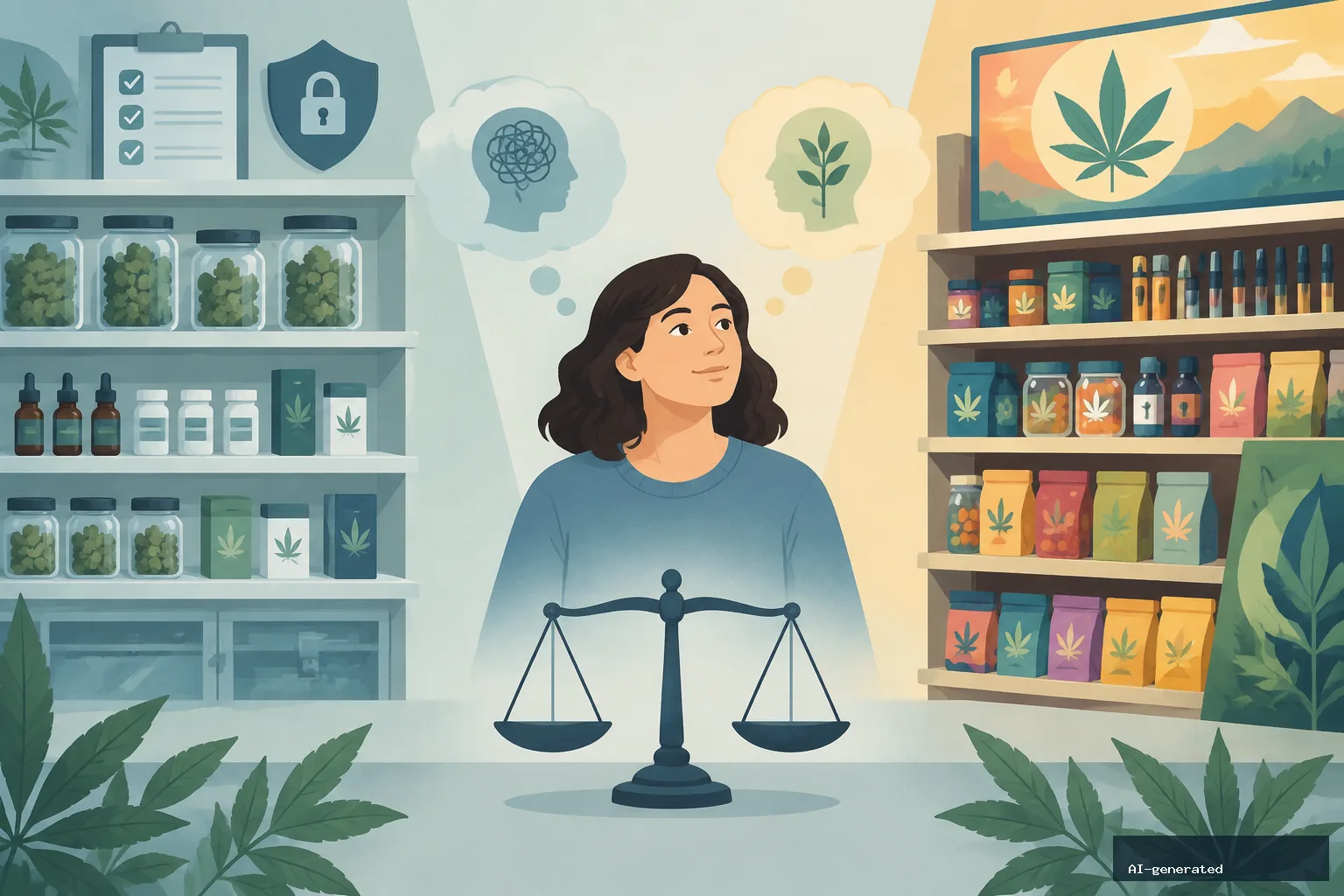
How cannabis is sold may matter—not only whether it is legal. Two 2026 evidence reviews examined the relationship between cannabis policy environments, patterns of use and mental-health outcomes, with particular attention to product strength and availability.
The findings do not show that every change in cannabis law causes mental-health problems. They do suggest that highly commercialised markets, more retailers and wider access to high-THC products may create a different risk environment from tightly controlled systems.
What the reviews examined
Hall and colleagues reviewed evidence on cannabis use and anxiety, depression, bipolar disorder, psychosis and suicidal behaviour. Their assessment drew on systematic reviews, meta-analyses and additional original research.
Freeman and colleagues examined international changes in cannabis policy and their associations with cannabis use, mental-health conditions and cannabis use disorder.
The evidence covered different policy models. Some countries have commercialised recreational markets, while some government-led systems restrict product availability and THC concentration. Cannabis remains criminalised in some countries.
Commercial markets and higher-THC products
Freeman and colleagues concluded that commercialised recreational cannabis markets in Canada and the United States were associated with increased cannabis use and cannabis use disorder among adults. They also found increases in THC concentration after commercialised legalisation in those countries.
Some commercialised environments were associated with more hospital visits for psychosis and psychotic conditions occurring alongside cannabis use disorder. These associations were often stronger in places with more retailers and greater availability of high-THC products.
However, the review found no consistent evidence that policy change was associated with the prevalence or incidence of psychotic disorders. This distinction matters: a rise in cannabis-related presentations is not the same as proof that a policy change caused more people to develop a psychotic disorder.
Why Ontario is difficult to interpret
In Ontario, cannabis-related anxiety emergency-department visits increased by 31.4% between 2020 and 2022. This occurred alongside an increase in cannabis retailers and a wider range of cannabis products.
But cannabis-related health-care presentations had already been increasing before legalisation. The increase therefore cannot be attributed entirely to the policy change. Changes in use, product availability and other factors may have overlapped.
Uruguay offers a different model
Uruguay legalised recreational cannabis nationally through a tightly controlled, state-regulated system involving pharmacies, home cultivation and not-for-profit cannabis clubs. The government controls the price, products and THC concentration of cannabis sold.
The limited evidence reviewed did not suggest increases in cannabis use among youth and young adults. Only two studies assessed the Uruguayan model, however, and follow-up was relatively short. The findings should therefore be treated as limited rather than conclusive evidence about tightly regulated legalisation.
What appears clearest about mental health
Hall and colleagues concluded that daily cannabis use is a contributory cause of psychosis, acting alongside other risk factors. The risk appears greater when cannabis use starts earlier, happens more often, involves higher-THC products or continues daily for longer.
The evidence connecting regular cannabis use with anxiety, bipolar disorder, depression and suicidal behaviour was less certain. Possible explanations include cannabis contributing to poorer mental health, people using cannabis to manage existing symptoms, shared risk factors, or relationships that work in both directions.
That uncertainty does not mean the associations can be ignored. It means that the relationship varies by condition and pattern of use, and should not be reduced to a simple claim that cannabis either causes or does not cause mental-health problems.
What this means for care and public health
The reviews point to two linked areas of attention: how products are regulated and how individual use is assessed. A policy environment with more retailers and stronger products may increase exposure to frequent use and high THC, while individual risk may also depend on age at first use, frequency and duration.
The commentary recommends that clinicians ask patients about cannabis use, how often they use it and the THC concentration of the products involved. It also recommends monitoring use patterns and possible adverse effects over time, and screening people with mental-health conditions for cannabis use disorder.
Hall and colleagues advocate stopping cannabis use for people with mental-health conditions. Where abstinence is not a patient-endorsed goal, they recommend reducing use frequency and choosing products with lower THC concentration.
Overall, the evidence supports a more careful question than whether cannabis is simply legal or illegal. The rules governing availability, commercialisation and product strength may influence patterns of use, while the mental-health implications depend on the condition and the person’s exposure. Much remains uncertain, especially outside the better-studied settings and for outcomes other than psychosis.
AI tools were used to assist with the preparation of this article.
Leave a Reply