
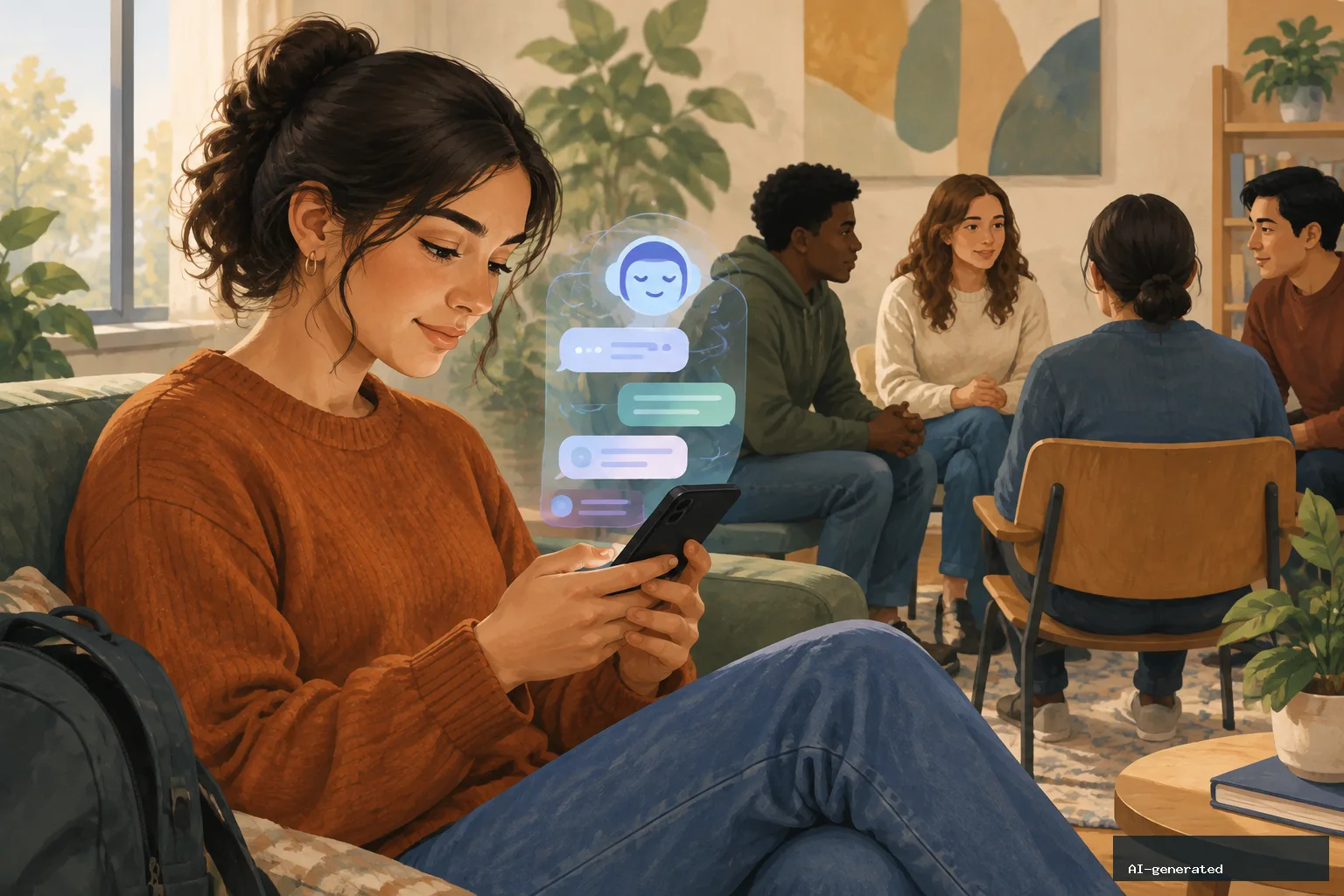
A randomized trial of 977 university students in Israel found that an AI emotional-support chatbot was linked to lower anxiety scores than weekly group therapy or a waitlist after 12 weeks. But the result is narrower than the headline might suggest: the students generally had mild symptoms, outcomes were self-reported, and anxiety fell only modestly among chatbot users.
The trial tested Kai, a commercial system from Kai.AI that operated through WhatsApp or iMessage. Students were assigned to use the chatbot, attend in-person group therapy, or remain on a waitlist. The intervention lasted 12 weeks, followed by an assessment three months later.
What the trial found
On the 21-point GAD-7 anxiety scale, chatbot users scored 2.10 points lower than the group-therapy arm and 2.08 points lower than the waitlist at the end of treatment. At the three-month follow-up, the chatbot remained ahead of group therapy by 1.58 points and the waitlist by 2.01 points.
Those differences were driven largely by changes in the comparison groups. Average anxiety fell by 0.9 points among chatbot users but rose by about 1.2 points in both the group-therapy and waitlist arms. The reason anxiety increased in those groups is not explained by the reported findings. Group therapy and the waitlist were statistically indistinguishable on anxiety after treatment.
Among students who began with GAD-7 scores of at least 10, 56.5% of chatbot users fell below that threshold by week 12, compared with 10.4% of group-therapy participants and 7.3% of students on the waitlist. At follow-up, the figures were 50.9%, 20.6% and 14.5%, respectively. However, about one-third of participants in each arm stopped answering surveys by that point. Also, moving from a score of 10 to 9 does not necessarily represent a large or clinically meaningful improvement.
Results beyond anxiety
The chatbot performed better than the waitlist on depression, but it did not clearly outperform group therapy. Its 0.65-point advantage over group therapy did not meet the paper’s stricter statistical threshold. No treatment arm differed on PTSD symptoms.
On well-being, the chatbot scored 5.6 points higher than group therapy after treatment and 6.3 points higher at follow-up. Its life-satisfaction advantage over group therapy was 1.0 points after treatment and 2.1 points at follow-up; the first result did not meet the paper’s corrected significance threshold.
How the interventions differed
Kai was available at any hour and encouraged users to complete at least three sessions per week. It combined open conversation with emotion detection, user-intent classification, structured and personalized exercises, daily prompts, reflections, reminders, progress summaries and an automatically generated journal. Its exercises drew on cognitive behavioral therapy, acceptance and commitment therapy, dialectical behavior therapy, mindfulness and positive psychology.
Students in the comparison treatment attended 12 weekly, 90-minute, in-person sessions, usually in groups of about 20. Licensed clinical psychologists led the sessions, which included thought challenging, coping skills, relaxation and breathing, gratitude exercises and open sharing. Participants attended an average of 10.3 of the 12 sessions.
Chatbot users spent an average of 82 minutes per week with Kai. Exploratory analyses found that lonelier students tended to use the chatbot more and showed greater benefits in some outcomes. Within the chatbot group, message count was associated with anxiety reduction, but that relationship was correlational and does not show that more messaging caused greater relief.
Why the findings cannot be generalized too far
Participants were 18 to 32 years old, with an average age of 23, and had mild average symptoms at baseline. The trial excluded people with psychosis, acute suicidality, severe psychiatric illness, current psychotherapy or current psychiatric medication. It therefore does not establish that the chatbot can replace therapy, treat severe mental-health conditions or work similarly for people already receiving care.
The study was unblinded, meaning participants knew whether they were using an AI system, attending therapy or waiting. All outcomes were self-reported, so expectations about the assigned intervention could have influenced questionnaire responses. The study also did not compare Kai with individual therapy, more intensive group treatment or a clinical diagnosis-based treatment program. It did not use an equivalence or noninferiority design, so the results cannot show that the chatbot is therapeutically equivalent to group therapy.
There are also disclosure and timing considerations. The first author was a paid consultant for Kai AI and held stock options, while a second author was a Kai employee. The report said there was no outside funding. Data collection began before the listed trial-registration date, and the paper was described as an unedited accepted manuscript, so some details could still change.
What users should take from the study
The trial suggests that an accessible, personalized chatbot may help some mildly distressed students report lower anxiety over a few months. Its availability and private, on-demand format may be important parts of that result, rather than the digital delivery alone.
It does not show that AI support can replace a clinician or human connection. The system reportedly screened for acute distress, provided crisis and referral information, blocked requests for diagnoses or clinical direction, and allowed clinicians to review flagged high-risk conversations. However, the report did not say how many conversations were flagged, how often clinicians intervened or whether adverse events occurred.
For now, the evidence supports viewing tools like Kai as a possible support option for a limited population—not as a substitute for professional care, particularly when symptoms are severe, persistent or urgent.
AI tools were used to assist with the preparation of this article.
Leave a Reply