
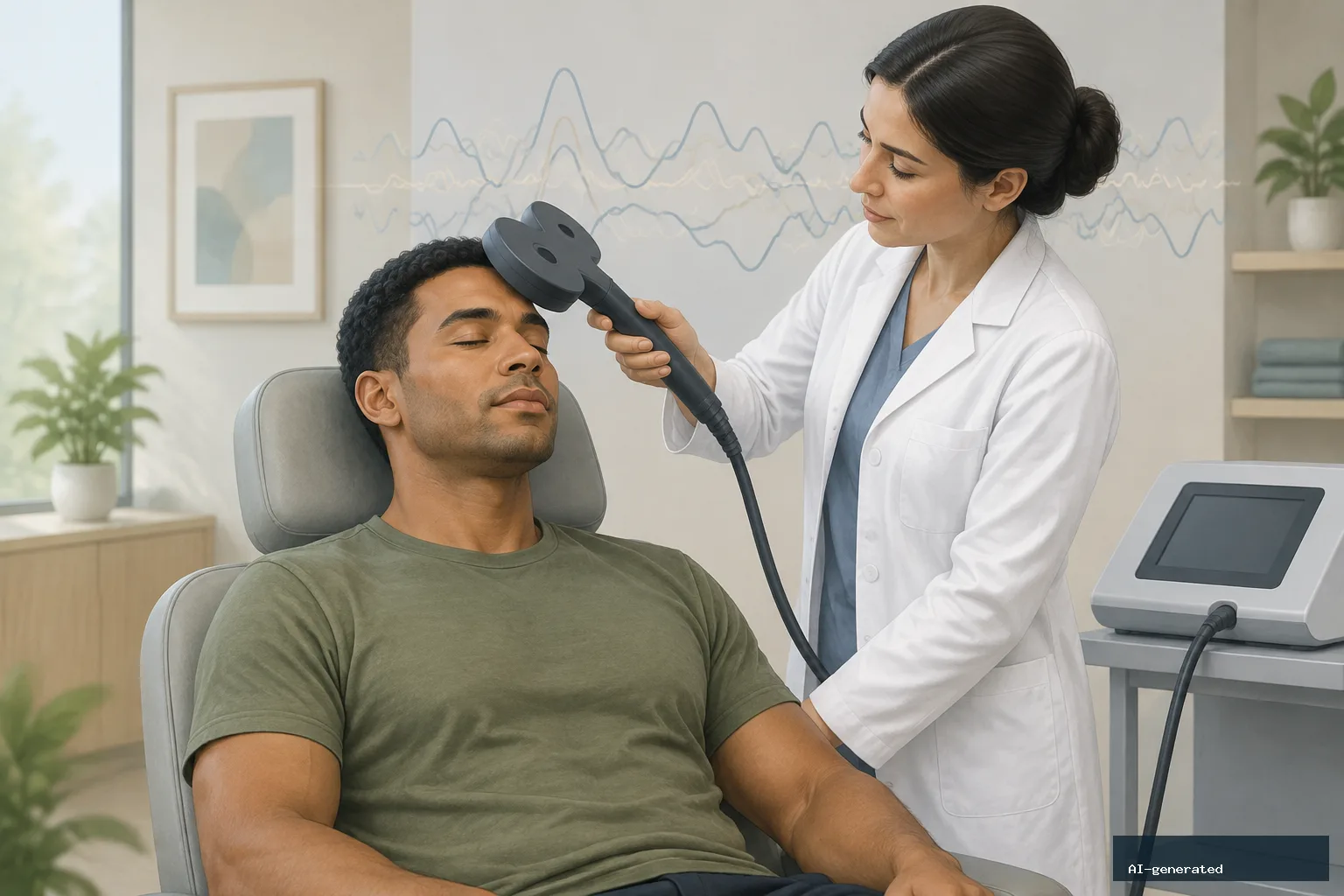
A four-week program of EEG-guided magnetic brain stimulation was associated with lower PTSD and depression questionnaire scores in a retrospective review of US servicemembers. The results are notable, but they do not show that the treatment itself caused the improvement.
The review examined records from Operation Synchrony, a wellness program funded by the Wounded Warrior Project and delivered at three outpatient clinics in Southern California. Records were collected from 2021 to 2023, and the chart review was published in 2026.
What the review found
The analysis included 94 people who completed the program. They were active-duty and retired servicemembers who had served since September 11, 2001, and had referred themselves for care after reporting PTSD symptoms. A formal PTSD diagnosis was not required. The group included 77 men and 17 women, with an average age of 39.
Participants received 20 sessions, each lasting about 30 minutes, five days a week for four weeks. The treatment, called alpha-rTMS, adjusted the magnetic pulse rate to each person’s alpha rhythm, measured by EEG. The average pulse rate was 10.9 Hz. Stimulation was delivered at the front-center of the forehead.
Among 91 participants with complete PTSD questionnaire data, average PCL-5 scores fell from 35.9 before treatment to 18.8 afterward. That represented a 48% reduction in the average score. The PCL-5 is a 20-item self-report checklist scored from 0 to 80; in this review, a score of 33 or higher was used to flag probable PTSD.
Of the 48 participants who started at or above that threshold, 36, or 75%, were below it by week four. This result describes questionnaire scores, however, rather than confirming that participants no longer had PTSD.
Depression scores showed a similar pattern. Among 89 participants, average PHQ-9 scores declined from 12.5 to 6.0, a 52% reduction. Of 36 people who began with scores of at least 15, 28, or 78%, ended below that level.
Most of the change in both measures occurred during the first two weeks. The review also reported a 46% fall in average concussion-symptom scores among 88 participants, from 26.8 to 14.5. Average resilience scores rose from 3.0 to 3.4 on a five-point scale among 87 participants.
Why the findings cannot prove effectiveness
This was an uncontrolled retrospective chart review. There was no sham-treatment group or other comparison group, so the study cannot determine how much of the change came from alpha-rTMS.
Other explanations include treatment expectations, placebo effects, regression to the mean, other care or natural changes over time. The charts also did not record participants’ medications or therapy. Because all outcomes were completed by participants themselves, the results reflect reported symptoms rather than an independent clinical assessment.
Ten people who withdrew or stopped early were excluded from the outcome analysis. The source reports that they were similar to completers in age, gender and starting scores, but excluding people who did not finish can still affect how results are interpreted. There was also no assessment beyond week four, so the review does not show whether the reported gains lasted.
How alpha-rTMS fits into the evidence
Standard repetitive transcranial magnetic stimulation, or rTMS, uses a magnetic coil against the scalp to produce rapid pulses that induce small electrical currents in the outer cortex. Standard approaches commonly use a fixed pulse rate, often 10 Hz, directed at the prefrontal cortex.
Alpha-rTMS instead sets the pulse rate to an individual’s 8–13 Hz alpha rhythm, measured with EEG. The commercial version used in the program is called MeRT, or Magnetic EEG/EKG-guided Resonance Therapy. The rationale is considered plausible but remains largely untested for PTSD.
Evidence from other forms of rTMS does not resolve the question. A cited 2024 Cochrane review found that active standard rTMS probably made little to no difference in PTSD severity immediately after treatment compared with sham, based on moderate-certainty evidence from three trials. Results varied widely, and serious side effects were rare. The cited review and a 2021 network meta-analysis did not report results specifically for alpha-guided stimulation.
The source also describes trauma-focused therapies, including cognitive processing therapy and prolonged exposure, as the best-supported first-line treatments. The current chart review cannot establish that alpha-rTMS should replace or outperform those approaches.
Side effects and the next research step
Reported side effects included fatigue in 23 people, or 24%; headache in 12, or 13%; and nausea or dizziness in five, or 5%. Most occurred during the first two weeks and had resolved by the end of treatment. No serious adverse events were recorded.
Controlled research with a sham group, independent clinical assessments, complete accounting for other treatments and longer follow-up would help clarify whether the early score reductions reflect a lasting treatment effect. Until then, the study is best viewed as an encouraging but preliminary observation—not proof that alpha-rTMS treats PTSD.
AI tools were used to assist with the preparation of this article.
Leave a Reply