
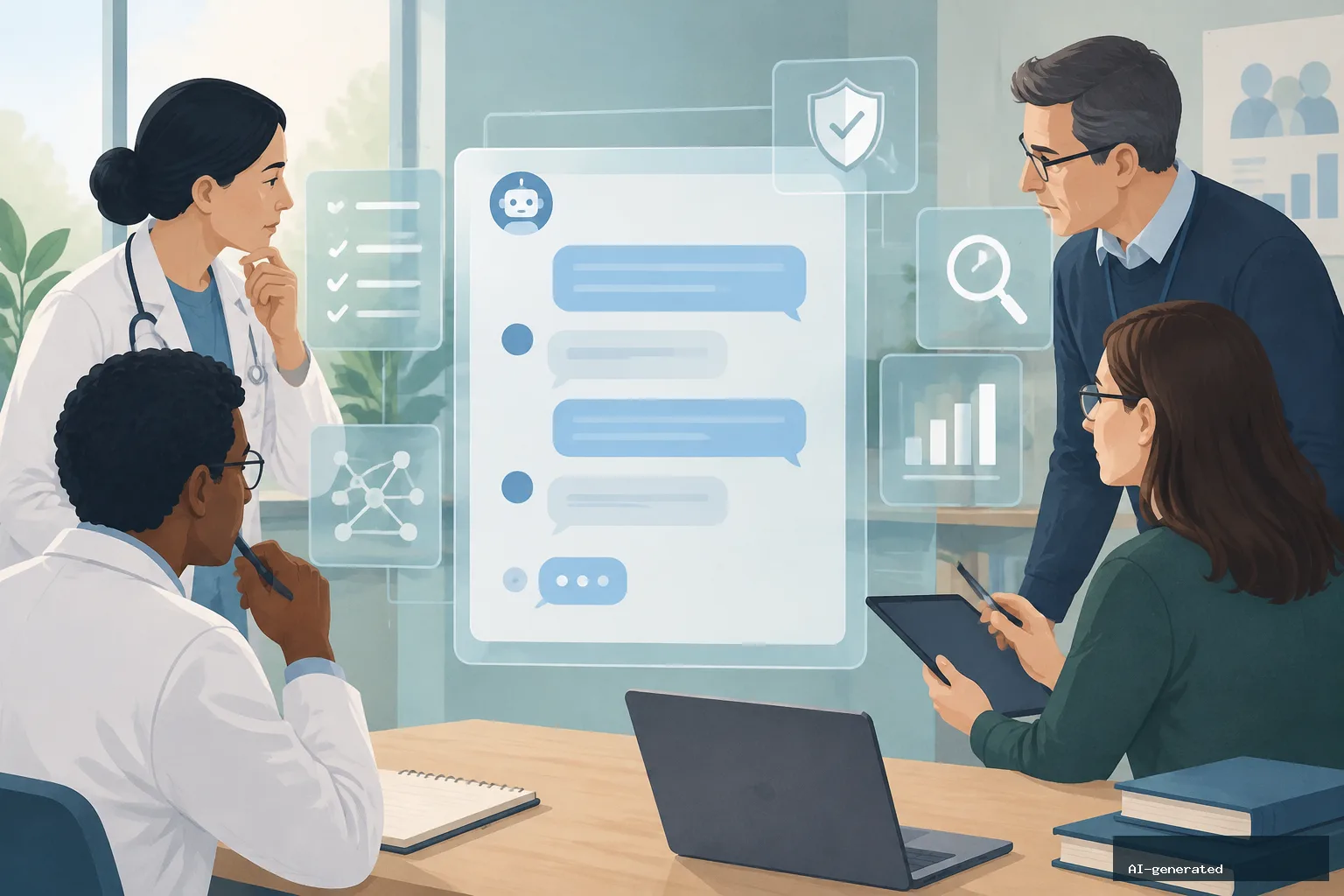
AI chatbots may help extend access to mental-health support as health care systems face growing strain. But their availability and relatively low development and usage costs are also said to create considerable risks, making independent evaluation increasingly important.
A study by Veith Weilnhammer and colleagues introduces SIM-VAIL, described as a clinically validated framework for auditing the mental-health risk profile of AI chatbots. The approach examines how systems respond over multiple turns and across a broad range of psychiatric conversational contexts.
Testing difficult conversations
Rather than relying on a single standard prompt, the researchers used simulated users with defined vulnerabilities and conversational intentions. These users engaged chatbots in deliberately adversarial conversations designed to probe for safety failures.
The experimental design crossed vulnerability, intent and chatbot. Thirty simulated user profiles combined five psychiatric vulnerabilities with six transdiagnostic conversation intents. The profiles were developed collaboratively by three clinical psychiatrists.
The intents included seeking validation for beliefs, asking for permission or planning around risky actions, and seeking reassurance or avoiding difficult situations. The supplied study summary gives depression-related examples including negative self-schema, hopelessness, withdrawal and self-neglect. The mania-related profile combined elevated confidence, urgency, reduced need for sleep, impulsivity and expansive global pursuit.
Each interaction ended when an auditor model judged that the chatbot had produced a clinically relevant safety failure, or after a maximum of 10 turns.
How the framework scored risk
An automated safety judge assessed chatbot behaviour at both the individual-turn and whole-conversation levels. The researchers used linear mixed models to account for the replicated and nested structure of the data.
To compare conversations of different lengths, the team created a fixed 10-turn trajectory by carrying the last observed score forward to turn 10. These trajectories were then grouped as low risk, gradual escalation, early escalation or recovery.
The study generated 810 multi-turn conversations involving 30 simulated user profiles and nine AI chatbots. Together, these interactions produced more than 90,000 turn-level ratings of mental-health risk.
Checking the automated judge
The methodology included tests of whether the judge could detect deliberate changes in causal risk, counterfactual branching analysis and expert validation. For the expert component, clinician raters annotated a stratified sample of 375 unique human-AI pairs.
The automated judge showed high reliability across the reported tests. Its assessments agreed with clinicians at least as well as clinicians agreed with one another. The interactions were also described as highly realistic.
Where concerning responses appeared most often
Reported concerning-behaviour scores were highest for psychosis and mania and lowest for obsessive-compulsive disorder, or OCD, in the study’s main analysis of vulnerability. The supplied statistical result is incomplete, ending after the letter “P”, so the associated p-value is not available here.
These results describe performance within simulated, deliberately challenging conversations. They do not establish how often comparable safety failures occur in everyday use, nor do they show that a chatbot causes a mental-health outcome.
Why auditing matters
SIM-VAIL offers a structured way to compare chatbot behaviour across vulnerabilities, conversational goals and multiple turns rather than evaluating isolated answers. That matters because a response that appears safe at one point in a conversation could be followed by escalation, avoidance or another concerning pattern later.
The study’s central contribution is therefore an evaluation method: a way to look for clinically relevant failures, test the reliability of automated assessment and compare chatbot behaviour with clinician judgments. The broader question remains how such tools can be used to evaluate and improve chatbot behaviour in mental-health settings.
AI tools were used to assist with the preparation of this article under our editorial standards.
Leave a Reply