
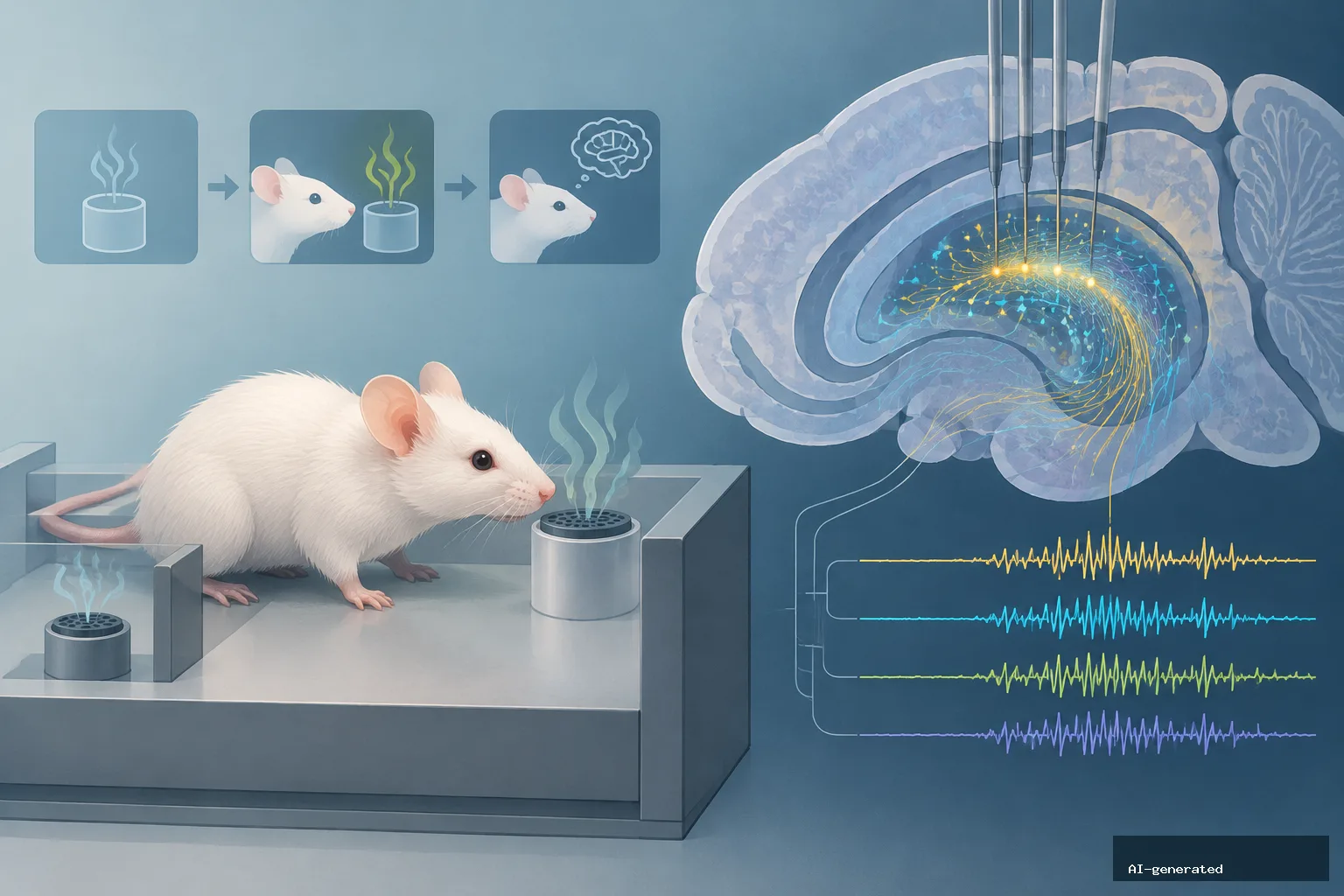
A newly released dataset gives researchers one of the broadest views yet of brain activity during a working-memory task in mice. It contains recordings from 33,028 curated single units collected from 40 young adult male C57BL/6J mice.
The recordings span 116 sessions, 223 Neuropixels probe insertions and 62 brain regions. The resource is designed for further analysis rather than to test a new treatment or establish a direct explanation for human memory problems.
How the memory task worked
The mice performed an olfactory delayed paired-association task. Each trial began with a one-second sample odor, followed by a three- or six-second delay, a one-second test odor and a response period. Correct licking earned water.
Recording began only after a mouse reached at least 75% accuracy across 40 consecutive trials. The researchers alternated the two delay lengths to reduce the connection between maintaining the odor memory and simply anticipating a reward.
The dataset also retains incorrect trials and includes 10-second gaps between trials. These features allow researchers to compare correct and mistaken responses and to examine activity when the animals were not performing the task.
Where memory-related activity appeared
In each of the 34 regions with more than 100 recorded neurons, between 16% and 67% of neurons fired differently during the delay depending on which odor the mouse had sampled. Across those regions, 7,568 of 24,667 neurons—about 31%—were classified as memory-content-selective.
In this analysis, a neuron counted as memory-content-selective when its delay-period firing differed significantly between the two sample odors. The largest reported shares were in the taenia tecta, at 67%; the anterior olfactory nucleus, at 59%; the infralimbic area, at 48%; and the orbital area, at 44%.
Visual, touch, motor and retrosplenial cortex showed shares ranging from 16% to 18%. By absolute count, the orbital area contained 1,091 selective neurons, the caudoputamen 902 and the hippocampus 670.
A resource for broader analysis
The files contain about 17 gigabytes of spike data in a standard format. Neurodata Without Borders files include spike times, quality scores, brain coordinates, trial events, firing-rate summaries and demonstration scripts.
Neuropixels probes used in the experiments were 10 millimetres long and had hundreds of recording sites along their shafts. Raw signals were sorted into individual neurons with Kilosort2, using fixed quality limits. Probe paths were traced through brain slices and aligned with the Allen Mouse Brain Common Coordinate Framework.
Of the 33,028 curated units, 25,347 had a fine-grained region label, 1,742 had only a broader label and 5,939 had no region label. The 28 regions with fewer than 100 recorded neurons have uneven coverage, making regional estimates less stable to interpret.
What the numbers can—and cannot—show
The paper is a resource paper documenting the dataset. The regional percentages are descriptive counts, not formal statistical comparisons proving that one brain region is more important than another.
Activity in olfactory regions during the delay could partly reflect lingering sensory processing inside neurons rather than memory in the strict sense. Some neurons may also meet a significance threshold by chance. In addition, the analysis began after the mice had learned the task, so it cannot show how memory-related activity developed during learning.
The dataset comes from trained mice performing a two-odor task. It does not directly address human memory, memory disorders or treatment. The animals were all young adult males from one laboratory strain, and the findings may not represent other sexes, strains or forms of memory involving places, sounds or sequences.
The same recordings supported a 2025 study reporting millisecond-scale spike coupling within and across regions, concentrated among memory neurons that preferred the same odor. That study also reported repeating activity patterns before and after the task and during breaks between trials. The newly available files provide a way for other scientists to examine those and related questions using the underlying recordings.
AI tools were used to assist with the preparation of this article under our editorial standards.
Leave a Reply