
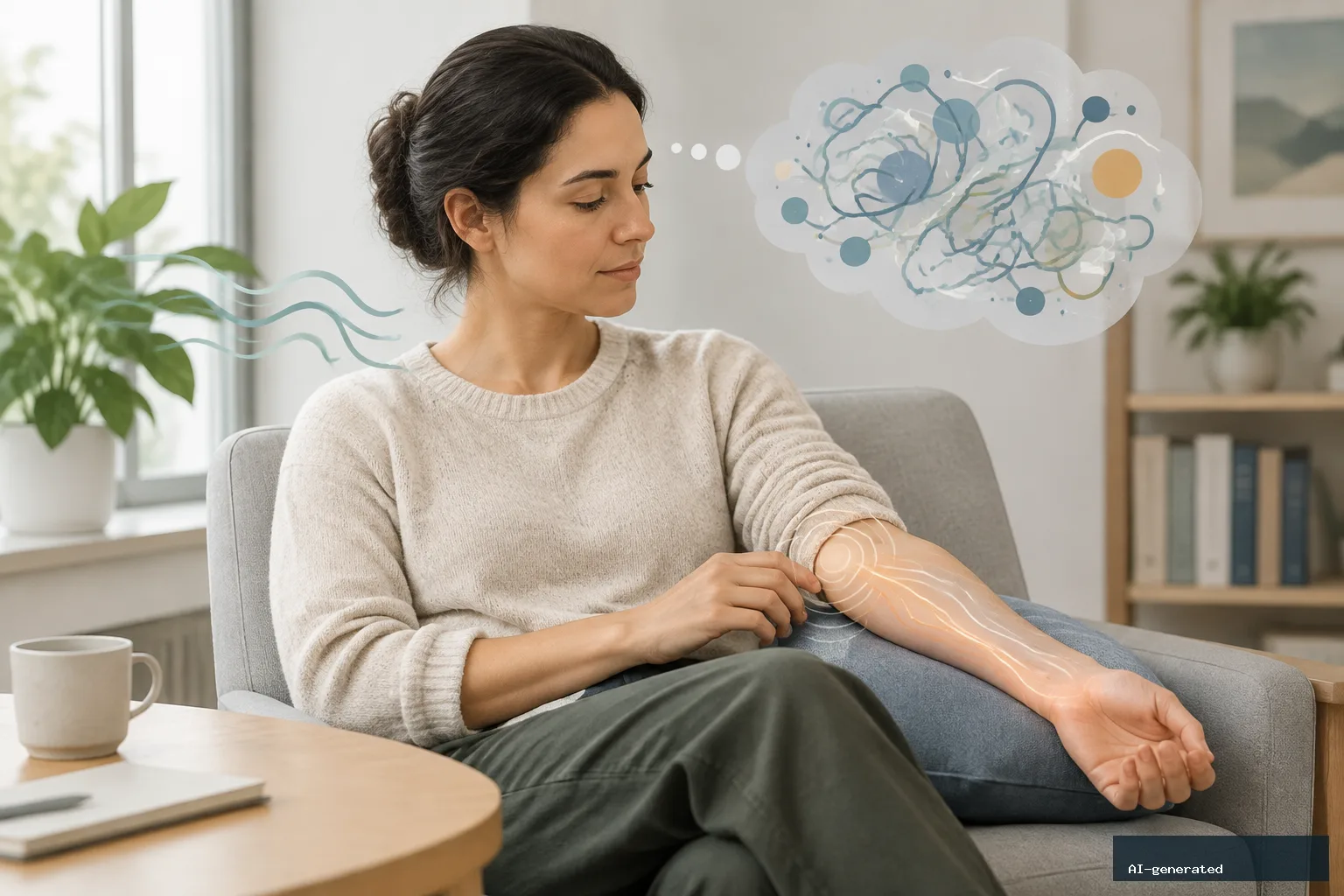
A brief experiment has added to a growing question in mind-body research: can where attention goes influence what happens in the body?
In three preregistered experiments, researchers tested whether healthy adults had a different response to a histamine skin-prick test when they focused on sensations at the test site or were distracted by videos and visual tasks. The participants generally showed smaller local skin reactions during internal attention.
The finding is specific. It concerns a short-lived reaction in the skin after direct histamine exposure, not inflammation throughout the body or immune activity more broadly.
What the researchers measured
The study included 57 healthy adults. Each participant experienced both attention conditions, with the order counterbalanced so that people served as their own controls.
A histamine test on the forearm produces two visible responses: a raised area called a wheal and surrounding redness called a flare. Researchers measured these reactions alongside heart rate, skin conductance, skin temperature, heart-rate variability and state anxiety.
The primary experiment included 37 participants. In one condition, they focused on sensations at the test site. In the other, they watched video clips as a distraction.
Smaller measured reactions during internal attention
After 20 minutes in the first experiment, the wheal measured approximately 3.5 millimetres during internal attention and 5.0 millimetres during distraction. The flare measured 10.6 millimetres with internal attention and 14.0 millimetres with distraction.
About 90% of participants showed a larger wheal or flare when distracted. Differences appeared within approximately three minutes and became larger over time.
In an exploratory analysis of the later phase, 89% of participants had a stable or declining wheal between 15 and 20 minutes during internal attention, compared with 46% during distraction.
A second experiment involved 20 new participants. They viewed abstract shapes that either reminded them to focus on their hand or asked them to judge whether the shapes could plausibly exist in real life. The skin responses were again approximately 1.6 times smaller during internal attention, with 90% of participants showing the same overall pattern.
More noticeable sensations, not fewer
The smaller measured reaction did not mean the sensations felt weaker. Participants rated itch and burning as stronger when they attended to their hand, suggesting that attention made the sensations more noticeable even as the physical skin response was smaller.
In a third experiment, 17 returning participants focused on the test site after lidocaine cream had reduced sensory signals from the skin. At 20 minutes, the wheal was 4.0 millimetres with lidocaine and 3.1 millimetres during internal attention without lidocaine. The lidocaine response remained smaller than the distraction response, which measured 4.9 millimetres.
Heart-rate variability was higher during internal attention than distraction and stayed higher when sensory input was reduced by lidocaine. The authors suggest this pattern may be consistent with top-down autonomic regulation, but the study does not establish that vagal activity caused the change in the skin response.
What the study does not show
The researchers did not include a neutral resting condition. As a result, the comparison cannot show whether internal attention reduced the reaction, distraction increased it, or both contributed to the difference.
The study measured wheal and flare after direct histamine exposure. It did not measure cytokines, immune-cell activity or systemic inflammation. The authors therefore caution that broader claims about immune regulation go beyond the findings.
There were also limits to the design. Participants were healthy, young adults and mostly women. People could not be blinded to where they directed their attention, and 14% guessed the study aim. The later lidocaine session took place among returning participants, so habituation or session-order effects cannot be ruled out.
The study was published online in Nature Human Behaviour on 17 August 2026. Its results may help guide further research, but they cannot be assumed to apply to people with anxiety, depression, trauma, chronic pain, autoimmune illness or acute infection.
Why the finding matters
The results offer a measurable example of how attention and bodily sensation may interact. They also show why subjective experience and physiological measurement should not be treated as interchangeable: participants noticed itch and burning more clearly while the measured skin reaction was smaller.
The findings do not mean distraction is unhelpful, or that people should monitor every ache or sensation. Mindfulness-based programmes can help some people with stress, anxiety, depression and chronic pain, but effects vary, and evidence for effects on inflammation remains tentative.
Future studies will need a neutral rest condition, direct inflammatory measurements and tests of whether changes in heart-rate variability explain the skin-response findings. Researchers will also need to establish whether the effect extends beyond a brief histamine reaction.
AI tools were used to assist with the preparation of this article under our editorial standards.
Leave a Reply