
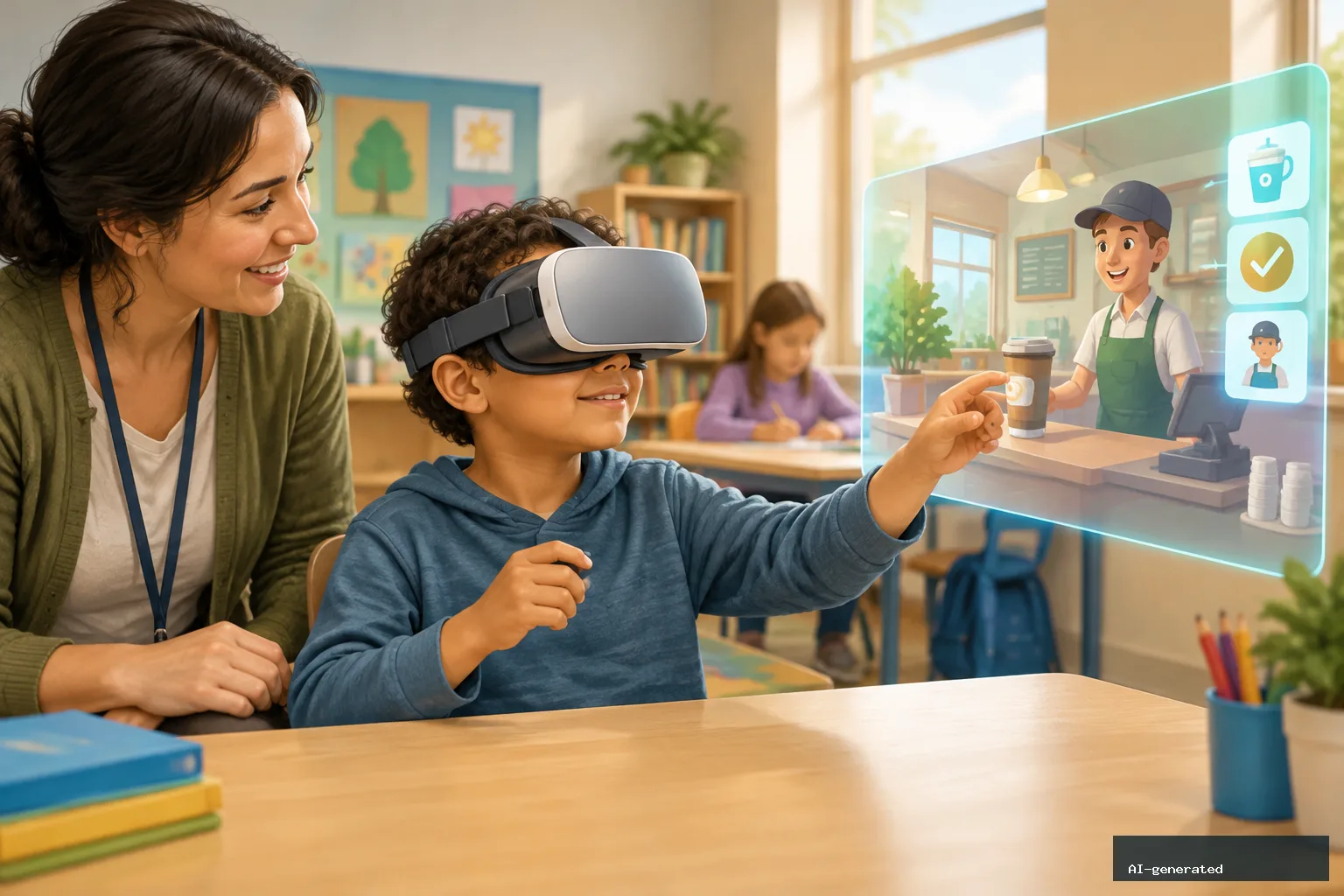
An eight-week virtual reality program was associated with improved teacher-rated school participation-related outcomes among children with ADHD in a randomized trial conducted in Turkey.
The study included 92 children aged 7 to 12 whose ADHD had been diagnosed by a child psychiatrist. Half completed 16 supervised sessions using the commercial Job Simulator game on an Oculus Quest 2 headset. The other 46 children were placed on a waiting list and received no additional therapy during the eight-week study period.
What the trial measured
Teachers completed the School Participation Questionnaire before and after the program. The questionnaire has 44 items, with scores ranging from 44 to 176; higher scores indicate better results. It assesses factors that support participation across four areas: Doing, Being, Symptoms and Environment.
The VR group’s total score increased from 136.6 to 150.0. The waiting-list group’s score changed from 134.9 to 132.2, a decrease that was not statistically significant. The VR group improved in all four questionnaire areas and scored higher than the waiting-list group at the end of the study. Reported between-group effect sizes ranged from 0.88 to 1.17, with all p values below 0.001.
Teachers did not know which group the children were in. All 92 children were included in the analysis, and there were no dropouts.
How the VR sessions worked
The game simulated four jobs: office worker, gourmet chef, store clerk and auto mechanic. Tasks became more difficult as the game progressed. Sessions lasted 45 minutes and took place twice a week for eight weeks.
The program was delivered in a therapy setting as a structured, supervised addition to care. It was not tested as a replacement for medication, behavioral therapy or school supports. About one in three children in each group was taking medication.
Why the findings need careful interpretation
The questionnaire measures factors that make participation possible; it does not measure how often a child joins activities. The trial therefore does not show that the children attended school more often, took part in more activities, earned higher grades or improved on executive-function tests.
Because the comparison group received no additional activity, the study cannot establish whether the gains came from VR itself, adult attention, a new routine or another engaging supervised activity. The researchers also did not compare the program with an equally engaging non-VR intervention.
The improvement in the Environment area is another example of a result that requires context: nothing about the schools changed during the study. The researchers interpreted the result as children making better use of existing classroom resources.
The trial took place at one university pediatric occupational therapy unit and involved children attending mainstream primary schools. Children with other neurodevelopmental conditions such as autism, those receiving other therapies during the study and those with a VR headset at home were excluded. The study reported no follow-up beyond the eight weeks.
Some children experienced brief motion sickness, and headsets occasionally overheated; two sessions ended in shutdowns. The groups were compared on final scores without confidence intervals or adjustment for starting scores. The paper reportedly had no trial registration or sample-size calculation.
Where this study fits
Earlier research points in related but distinct directions. A 2025 Turkish study of 365 children, including 175 with ADHD, found lower participation and involvement in five types of school activities among children with ADHD. A 2021 meta-analysis of four studies involving 125 children found that VR interventions improved sustained attention but not impulsivity; evidence quality ranged from low to moderate depending on the outcome. In a 2024 trial of 90 children, both VR and traditional social-skills training improved psychologist-rated social skills and parent-rated self-control compared with participants’ starting scores.
Together, these findings suggest that supervised VR is being studied as one possible structured therapy activity, while leaving open which elements of the program account for changes and whether the results extend beyond teacher questionnaire scores.
AI tools were used to assist with the preparation of this article under our editorial standards.
Leave a Reply