
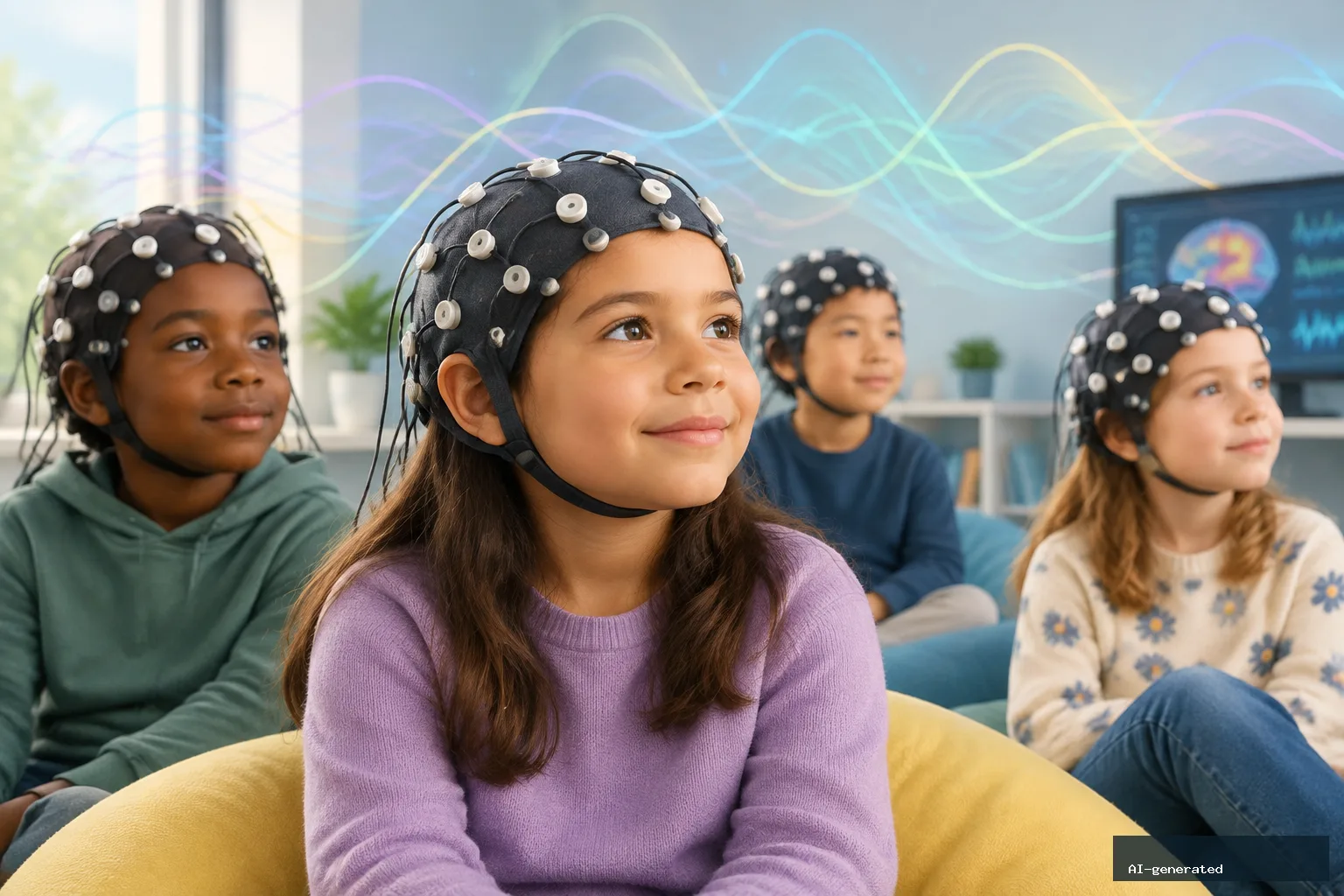
A study of 186 children in Beijing found that autistic children had more complex and irregular resting brain-wave signals than typically developing children. The findings came from about five minutes of eyes-open electroencephalography (EEG) recorded with a 128-sensor head net.
The study included 80 autistic children and 106 typically developing children between 3 and 11 years old. The groups were matched for age and sex, although most participants were boys. Researchers analyzed the recordings using multiscale entropy, a measure of how signal patterns vary across different timescales.
Higher complexity across six brain regions
Across the full sample, autistic children had higher multiscale entropy in all six tested regions: the frontal, central, parietal, occipital, left temporal and right temporal areas. All reported group comparisons had p values below 0.001.
Sensor-by-sensor analyses showed the same general pattern across nearly all sensors and timescales. The size of the difference varied by timescale in every region, while sex did not have a significant effect in any region.
Higher complexity is not automatically a sign of better brain function. The researchers interpreted the pattern as potentially reflecting noisier or less coordinated signaling, but the EEG measure does not identify the cell-level processes producing the signals.
Age groups showed different patterns
The clearest differences appeared among preschool-age children. In the group aged 3 to 6, which included 60 autistic and 76 typically developing children, autistic children had higher complexity in every tested region and across all examined timescales.
Among school-age children aged 6 to 11, the comparison included 20 autistic and 30 typically developing children. Differences were statistically significant in four of the six regions: frontal, parietal, occipital and right temporal. These differences were mainly seen at the fastest timescales and over the frontal region.
Typically developing older children had higher complexity at every timescale, with the strongest age association at slower timescales. The pattern among autistic children was less even: older children had higher complexity in the occipital region mainly at faster timescales, but lower complexity in both temporal regions mainly at middle timescales.
Because each child was recorded only once, these age comparisons describe differences between children of different ages. They do not show how an individual child’s EEG changed over time.
Links with parent-reported measures
The researchers also compared EEG complexity with parent-reported Autism Behavior Checklist and Social Responsiveness Scale scores. Complexity in the frontal and parietal regions was significantly linked to sensory, social-interaction and language scores on the Autism Behavior Checklist. Social-cognition scores on the Social Responsiveness Scale were positively correlated with complexity in central and parietal regions.
These associations were exploratory. The fact sheet does not provide correlation strengths, and it does not describe a correction for the many sensor-and-timescale comparisons. It also notes that the study’s interpretation of these relationships was mixed: higher complexity was discussed both in relation to better social thinking and to greater difficulties.
What the findings do—and do not—show
The results add to earlier EEG and MEG research reporting age-related differences in autistic people, but those studies did not all find the same pattern. Earlier work included studies of infants with a higher familial likelihood of autism, autistic children during silent-video viewing and autistic adults during a picture-matching task.
This study describes group averages rather than an individual biological profile. Resting EEG also does not show how complexity changes during social or attention tasks. Multiscale entropy measures the structure of an electrical signal, not the underlying biological cause, and the findings do not establish a diagnostic test or treatment implication.
AI tools were used to assist with the preparation of this article under our editorial standards.
Leave a Reply