
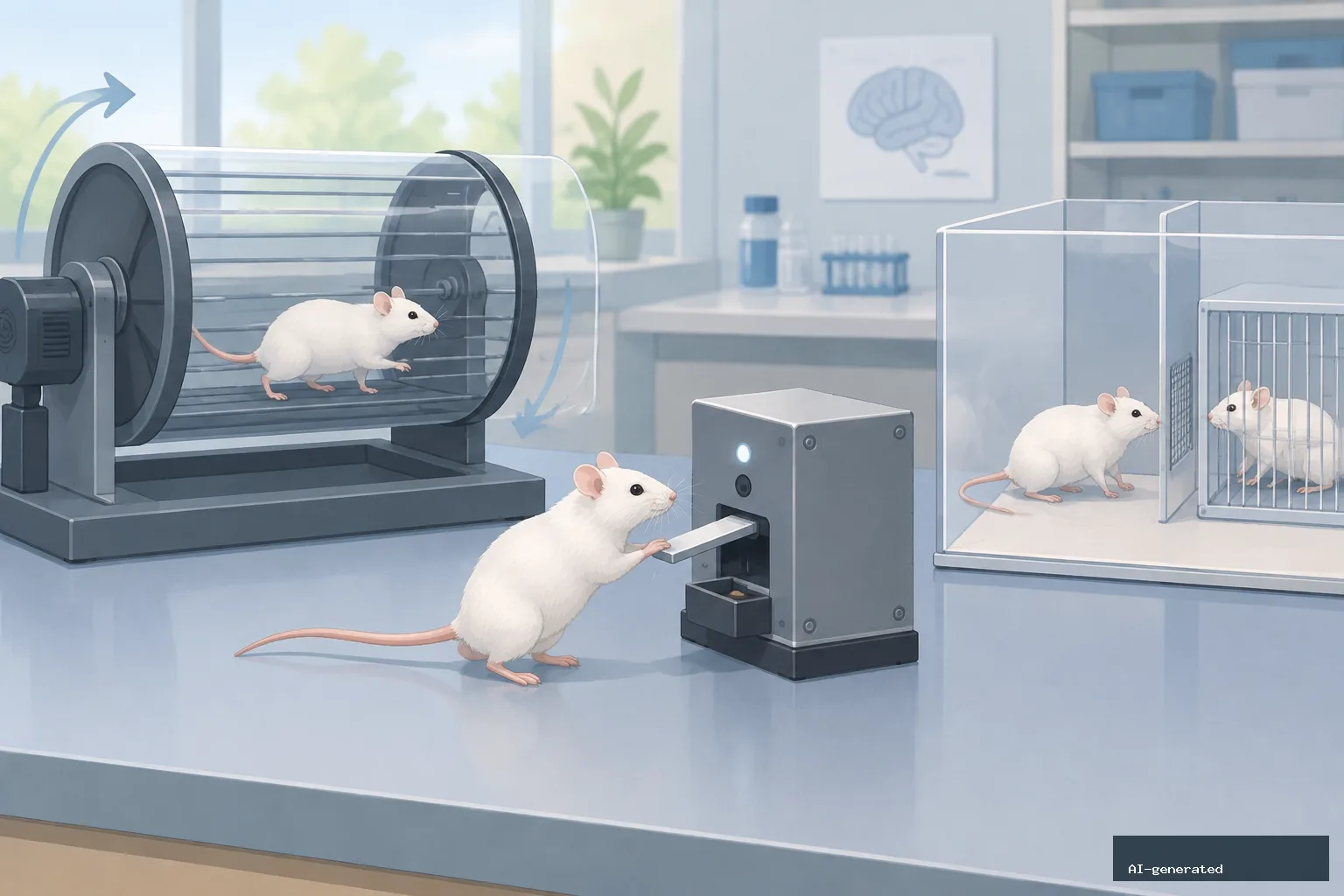
A 2026 study of BTBR mice found that males and females showed different patterns across tests of habit formation, motor learning, social approach and anxiety-related behavior.
BTBR T+ Itpr3tf/J mice are an inbred laboratory strain used to model behaviors resembling some core features of autism. The study compared 11 male and 11 female BTBR mice with 10 male and 10 female C57BL/6J mice, a standard comparison strain.
The results suggest that sex can shape how behaviors appear within this particular mouse model. They do not show how autism differs between men and women, and they do not establish treatment implications.
Different patterns in habit-related learning
In one task, the mice learned to press a lever for a food reward. After the reward was devalued, standard mice continued pressing more than BTBR mice. Across the BTBR group, pressing fell significantly compared with standard mice.
The clearest difference appeared among females. BTBR females reduced their lever pressing after the reward lost value, unlike standard females. The researchers interpreted this pattern as suggesting that the females remained more goal-directed after training that would usually promote a habit.
BTBR mice also reduced pressing more quickly in an omission test. BTBR females pressed substantially less than standard females during the first five minutes, while the male groups did not significantly differ.
However, six of the 22 BTBR mice did not learn the lever task and were excluded from the lever-pressing tests. The researchers did not directly measure the striatum, a brain region discussed in relation to habit learning.
Male BTBR mice struggled more with changing motor demands
The study used a speeding rotarod to test how the mice adapted as the motor challenge increased. Standard mice of both sexes stayed on the apparatus longer across four trials. BTBR mice, as a group, did not show the same improvement.
The difference was especially pronounced in males: standard males improved, while BTBR males did not. On a constant-speed rotarod, BTBR males also performed worse than standard males, but the female groups did not differ overall.
The researchers viewed these findings as difficulty adapting to rising motor demands rather than a broad problem with balance. BTBR females scored somewhat lower than standard females on the speeding test, but their pattern across trials was similar.
Social approach differed by sex
In a test involving an unfamiliar mouse, BTBR females approached the stranger less often and spent less total time near it than standard females. BTBR males approached the stranger about as often as standard males, but they took longer to make their first approach.
Across both sexes, BTBR mice entered the area around the stranger less often than standard mice. The findings therefore point to different forms of reduced social approach rather than one identical pattern in males and females.
Anxiety-related measures did not show a simple strain effect
Overall scores on the anxiety test did not differ between BTBR and standard mice. More specific patterns varied by sex: BTBR males avoided exposed areas more, while BTBR females made more frequent but shorter visits to open areas.
On the elevated plus maze, the strains did not differ overall in how quickly they entered walled areas or how long they stayed there. The researchers described the sex-specific patterns as different ways of handling risk, not as evidence of a general increase in anxiety.
What the model can—and cannot—show
BTBR mice naturally show autism-like traits because of their own genetic background; no single gene was engineered into them. They are also born without a corpus callosum, the major connection between the brain’s hemispheres. Brain sections confirmed this feature in the mice used in the study.
That distinction matters when interpreting the results. Most autistic people have a corpus callosum, according to the study’s source context, so the anatomical difference could itself contribute to some of the mice’s behaviors. The researchers also discussed brain circuits and hormones as possible explanations, but those factors were not measured.
The BTBR strain became a standard model after a 2008 study reported less social behavior and high levels of self-grooming compared with C57BL/6J mice. That earlier work also reported intact basic smell and social recognition, with no evidence of high anxiety or motor problems in that study. A 2024 study likewise reported reduced social interaction in male and female BTBR mice, alongside sex differences in repetitive behavior and hippocampal oxidative-stress signs reported only in males.
Why the findings need cautious interpretation
This was a small animal study, with eight to 11 mice per sex in each strain for the different analyses. The researchers made many comparisons, several p-values were close to the conventional threshold for statistical significance, and the paper did not report effect sizes.
The comparison mice came from a separate inbred strain rather than being littermates. As a result, some differences may reflect broader strain background rather than the specific behavioral features under investigation. The study examined only one autism mouse model, and no single mouse model captures autism.
Some anxiety-test p-values and one group size differed between the study text and figure captions. Taken together, the results are best understood as evidence of sex-dependent behavioral patterns in BTBR mice—not as a direct account of autism or sex differences in humans.
AI tools were used to assist with the preparation of this article under our editorial standards.
Leave a Reply