
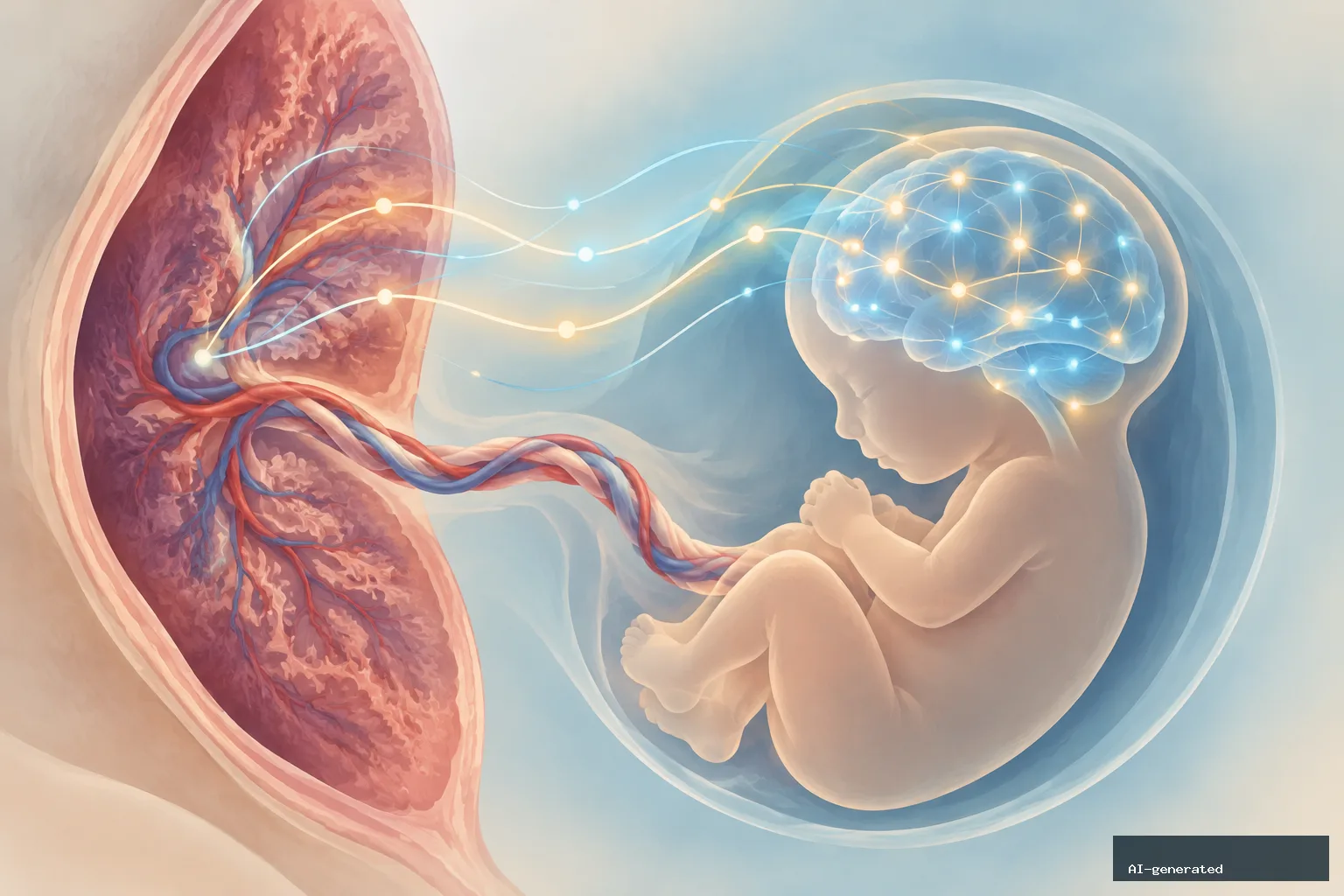
A 2026 MRI study of 105 pregnancies found that chronic placental inflammation was associated with differences in fetal brain connectivity. The researchers also examined autism trait scores at age 3, but the results did not show that placental inflammation causes autism or that fetal scans can be used as a pregnancy test.
What the study found
After delivery, microscopic examination showed that 44 of the 105 placentas, or 41.9%, had at least one type of chronic inflammation. The examination was carried out by two perinatal pathologists who did not know the fetal brain results.
The inflammation group included villitis of unknown etiology, chronic chorioamnionitis and chronic deciduitis. Because these lesions often occurred together, the researchers analyzed them as one exposure, even though the conditions have different biology.
Fetal resting-state functional MRI scans were collected between 24 and 38 weeks of pregnancy, at an average of 30.7 weeks. The researchers divided each fetal brain into 197 regions organized into 15 networks.
Compared with fetuses not exposed to placental inflammation, exposed fetuses had differences in 10 pairs of brain networks: four connections were weaker and six were stronger. The weaker connections involved the left prefrontal and right operculum networks, the cerebellum and cingulate networks, the cerebellum and medial visual network, and the ventromedial prefrontal and right motor networks.
The link with age-3 traits
Age-3 data were available for 71 children. Autism traits were measured using a 13-item parent questionnaire; no child in the study was reported as having an autism diagnosis.
The weaker connection between the cerebellum and medial visual network was selected as the strongest prenatal predictor of autism trait scores in 95.6% of repeated resampling runs. Fetal connectivity accounted for about 15% of the variation in trait scores on average, but the 95% confidence interval ranged from 0% to 43%.
Statistically, placental inflammation was associated with weaker cerebellum-to-visual-network connectivity, while weaker connectivity was associated with higher autism trait scores. However, the complete proposed pathway—from inflammation through brain connectivity to autism traits—was not statistically significant. The study also found no direct association between inflammation and autism trait scores.
Why the findings remain preliminary
The study was observational, so it cannot establish that placental inflammation changes fetal brain development or causes autism traits. The researchers suggested that weaker connections could reflect disrupted pathways, while stronger connections could represent the developing brain rerouting around inflammation. Those explanations were not tested directly.
Chronic placental inflammation was identified only after birth, meaning the study does not establish a prenatal clinical test or a prevention step. The researchers also lacked complete information about maternal infection, antibiotic use and autoimmune conditions—factors that could affect the findings.
Other limitations included the absence of age-3 follow-up data for 34 children, the use of a parent-report screening questionnaire rather than an observational or diagnostic assessment, and the grouping of three biologically distinct inflammatory conditions. The fetal brain network map was built from 168 fetal scans, including the 105 scans in the study, so its network boundaries were not fully independent of the results.
The participants were mostly Black, lower-income Detroit families facing high stress: 85.7% of the mothers were Black, and mothers ranged from 18 to 41 years old, with an average age of 25.7. Results may differ in other populations.
What the study does—and does not—say
The findings add to research examining how inflammation during pregnancy may relate to fetal brain development. A 2016 meta-analysis of 15 studies involving more than 40,000 autism cases found that maternal infection was associated with modestly higher odds of autism in offspring, with somewhat higher odds when infection required hospitalization. That earlier association does not establish that placental inflammation causes autism either.
Overall, this study identifies a possible relationship between placental inflammation and fetal brain-network connectivity. Its results are hypothesis-generating rather than evidence that inflammation leads to autism, predicts an individual child’s future, or supports a pregnancy intervention.
AI tools were used to assist with the preparation of this article under our editorial standards.
Leave a Reply