
⏱ 9 min read
- Article
- Published:
Abstract
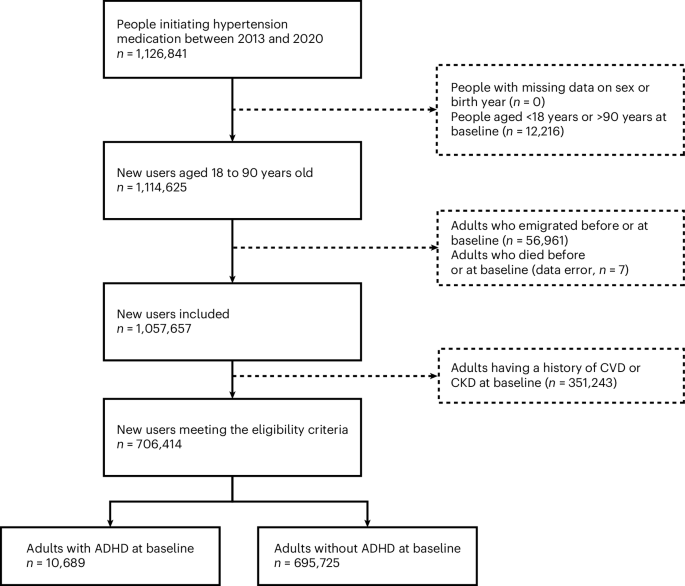
Adults with attention deficit hyperactivity disorder (ADHD) have a higher prevalence and incidence of hypertension, but whether long-term cardiorenal trajectories after the initiation of antihypertensive medications differ by ADHD status is unclear. Here, in this nationwide retrospective cohort study using Dutch register data, we included 706,414 new users (52.2% female, aged 18–90 years) of antihypertensive medications without prior cardiovascular disease or chronic kidney disease (CKD); 10,689 had ADHD. Multistate modelling was used to characterize long-term cardiorenal illness trajectories and compare transition-specific rates between adults with and without ADHD. Adults with ADHD had higher adjusted rates of heart failure hospitalization (HHF; hazard ratio (HR), 1.46; 95% confidence interval (CI), 1.12–1.90) and stroke (HR, 1.19; 95% CI, 1.03–1.38) after antihypertensive medication initiation. They also had higher adjusted rates of cardiorenal death after HHF (HR, 1.79; 95% CI, 1.01–3.17) or CKD (HR, 2.57; 95% CI, 1.33–4.97) onset. Ten-year trajectories through HHF or CKD to cardiorenal death were more common in adults with ADHD.
This is a preview of subscription content, access via your institution
Access options
Access through your institution
Subscribe to this journal
Receive 12 digital issues and online access to articles
79,00 € per year
only 6,58 € per issue
Buy this article
- Purchase on SpringerLink
- Instant access to the full article PDF.
39,95 €
Prices may be subject to local taxes which are calculated during checkout
Data availability
This study was approved by Statistics Netherlands (CBS) under project agreement 9205 microdata services research. The data contain de-identified individual-level administrative and healthcare information and are subject to legal restrictions under the Dutch Statistics Act and General Data Protection Regulation. Statistics Netherlands (CBS) acts as the data controller and imposes strict conditions on data access. Access to CBS microdata is granted only to researchers affiliated with accredited institutions following formal approval by CBS and is provided exclusively through the secure CBS Remote Access environment. The data cannot be downloaded or made publicly available. Under certain conditions, these microdata are accessible for statistical and scientific research. For further information, please contact microdata@cbs.nl.
Code availability
References
-
Faraone, S. V. et al. Attention-deficit/hyperactivity disorder. Nat. Rev. Dis. Primers 10, 11 (2024).
-
Faraone, S. V. et al. The World Federation of ADHD International Consensus Statement: 208 evidence-based conclusions about the disorder. Neurosci. Biobehav. Rev. 128, 789–818 (2021).
-
Libutzki, B., Neukirch, B., Reif, A. & Hartman, C. A. Somatic burden of attention-deficit/hyperactivity disorder across the lifecourse. Acta Psychiatr. Scand. 150, 105–117 (2024).
-
Li, L. et al. Attention-deficit/hyperactivity disorder as a risk factor for cardiovascular diseases: a nationwide population-based cohort study. World Psychiatry 21, 452–459 (2022).
-
Li, L. et al. Attention-deficit/hyperactivity disorder is associated with increased risk of cardiovascular diseases: a systematic review and meta-analysis. JCPP Adv. 3, e12158 (2023).
-
Du Rietz, E. et al. Mapping phenotypic and aetiological associations between ADHD and physical conditions in adulthood in Sweden: a genetically informed register study. Lancet Psychiat. 8, 774–783 (2021).
-
Zhou, B., Perel, P., Mensah, G. A. & Ezzati, M. Global epidemiology, health burden and effective interventions for elevated blood pressure and hypertension. Nat. Rev. Cardiol. 18, 785–802 (2021).
-
Olsen, M. H. et al. A call to action and a lifecourse strategy to address the global burden of raised blood pressure on current and future generations: the Lancet Commission on hypertension. Lancet 388, 2665–2712 (2016).
-
Campbell, N. R. C. et al. 2021. World Health Organization guideline on pharmacological treatment of hypertension: policy implications for the region of the Americas. Lancet Reg. Health Am. 9, 100219 (2022).
-
Williams, B. et al. 2018 ESC/ESH Guidelines for the management of arterial hypertension: the Task Force for the management of arterial hypertension of the European Society of Cardiology (ESC) and the European Society of Hypertension (ESH). Eur. Heart J. 39, 3021–3104 (2018).
-
Abbasi, K. How to model life’s trajectory from major diagnosis to death. BMJ 384, q568 (2024).
-
Murray, S. A. et al. Using illness trajectories to inform person centred, advance care planning. BMJ 384, e067896 (2024).
-
Andersen, P. K. & Ravn, H. Models for Multi-State Survival Data: Rates, Risks, and Pseudo-Values 1st edn (Chapman and Hall/CRC, 2023).
-
Kidney Disease: Improving Global Outcomes (KDIGO) CKD Work Group. KDIGO 2024 Clinical Practice Guideline for the Evaluation and Management of Chronic Kidney Disease. Kidney Int. 105, S117–S314 (2024).
-
Visseren, F. L. J. et al. 2021 ESC Guidelines on cardiovascular disease prevention in clinical practice. Eur. Heart J. 42, 3227–3337 (2021).
-
McDonagh, T. A. et al. 2021 ESC Guidelines for the diagnosis and treatment of acute and chronic heart failure. Eur. Heart J. 42, 3599–3726 (2021).
-
Cai, R., Wu, X., Li, C. & Chao, J. Prediction models for cardiovascular disease risk in the hypertensive population: a systematic review. J. Hypertens. 38, 1632–1639 (2020).
-
Camanni, G. et al. ‘Being disabled’ as an exclusion criterion for clinical trials: a scoping review. BMJ Glob. Health 8, e013473 (2023).
-
Azizi, Z. et al. Challenge of optimizing medical therapy in heart failure: unlocking the potential of digital health and patient engagement. J. Am. Heart Assoc. 13, e030952 (2024).
-
Schrauben, S. J. et al. A qualitative study of facilitators and barriers to self-management of CKD. Kidney Int. Rep. 7, 46–55 (2022).
-
Larsson, H. How can we improve the management of individuals with attention deficit hyperactivity disorders and co-occurring cardiometabolic disease? Expert Rev. Cardiovasc. Ther. 21, 725–728 (2023).
-
Yao, H. et al. ADHD and adherence to antihypertensive medication treatment: a multinational cohort study. BMC Med. 24, 122 (2026).
-
Theodoratou, M. Communication issues in co-occurring ADHD and autism spectrum disorders. Evaluative approaches and targeted interventions: mini review. Postep. Psychiatr. Neurol. 33, 188–195 (2024).
-
Kendall, M. et al. Outcomes, experiences and palliative care in major stroke: a multicentre, mixed-method, longitudinal study. CMAJ 190, E238–E246 (2018).
-
Holt, A. et al. Long-term cardiovascular risk associated with treatment of attention-deficit/hyperactivity disorder in adults. J. Am. Coll. Cardiol. 83, 1870–1882 (2024).
-
Goodman, D. W., Cortese, S. & Faraone, S. V. Why is ADHD so difficult to diagnose in older adults? Expert Rev. Neurother. 24, 941–944 (2024).
-
Gillies, M. B. et al. Medicine utilization studies in Australian individual-level dispensing data: a blinded, multi-center replicated analysis. Pharmacoepidemiol. Drug Saf. 33, e5776 (2024).
-
Brikell, I. et al. ADHD medication discontinuation and persistence across the lifespan: a retrospective observational study using population-based databases. Lancet Psychiat. 11, 16–26 (2024).
-
Pouwels, K. B., Voorham, J., Hak, E. & Denig, P. Identification of major cardiovascular events in patients with diabetes using primary care data. BMC Health Serv. Res. 16, 110 (2016).
-
Steenhuis, D., de Vos, S., Bos, J. H. J. & Hak, E. Risk factors for drug-treated major adverse cardio-cerebrovascular events in patients on primary preventive statin therapy: a retrospective cohort study. Prev. Med. Rep. 34, 102258 (2023).
-
Steenhuis, D., Li, X., Feenstra, T. L. & Hak, E. Validation of medication proxies for the identification of hospitalizations for major adverse cerebro-cardiovascular events. Clin. Epidemiol. 17, 327–336 (2025).
-
Li, Y. et al. Familial co-aggregation and shared heritability between neurodevelopmental problems and cardiometabolic conditions. Nat. Ment. Health 3, 1545–1554 (2025).
-
Hrzic, R., Clemens, T., Westra, D. & Brand, H. Comparability in cross-national health research using insurance claims data: the cases of Germany and the Netherlands. Gesundheitswesen 82, S83–S90 (2020).
-
Suchard, M. A. et al. Comprehensive comparative effectiveness and safety of first-line antihypertensive drug classes: a systematic, multinational, large-scale analysis. Lancet 394, 1816–1826 (2019).
-
Iacobelli, S. & Carstensen, B. Multiple time scales in multi-state models. Stat. Med. 32, 5315–5327 (2013).
-
Greenland, S., Mansournia, M. A. & Altman, D. G. Sparse data bias: a problem hiding in plain sight. BMJ 352, i1981 (2016).
-
King, G., Tomz, M. & Wittenberg, J. Making the most of statistical analyses: improving interpretation and presentation. Am. J. Pol. Sci. 44, 341–355 (2000).
Acknowledgements
We acknowledge the services of microdata, Statistics Netherlands and all the study participants. We thank Q. Shi from the University of Groningen for his assistance with statistical analysis and interpretation.
Funding
This project received funding from the European Union’s Horizon 2020 research and innovation programme under grant agreement no. 965381. This publication reflects only the authors’ view, and the European Commission is not responsible for any use that may be made of the information it contains. Y.Z. was supported by a joint scholarship from the China Scholarship Council and the University of Groningen. The funders had no role in study design, data collection and analysis, decision to publish or preparation of the manuscript.
Ethics declarations
Competing interests
The authors declare no competing interests.
Peer review
Peer review information
Nature Mental Health thanks Howaida Elmowafi and the other, anonymous, reviewer(s) for their contribution to the peer review of this work.
Additional information
Publisher’s note Springer Nature remains neutral with regard to jurisdictional claims in published maps and institutional affiliations.
Supplementary information
Rights and permissions
Springer Nature or its licensor (e.g. a society or other partner) holds exclusive rights to this article under a publishing agreement with the author(s) or other rightsholder(s); author self-archiving of the accepted manuscript version of this article is solely governed by the terms of such publishing agreement and applicable law.
About this article

Cite this article
Zhou, Y., Postmus, D., Li, S. et al. Long-term cardiorenal illness trajectories after initiation of antihypertensive medications in adults with and without ADHD: a nationwide cohort study. Nat. Mental Health (2026). https://doi.org/10.1038/s44220-026-00718-1
-
Received:
-
Accepted:
-
Published:
-
Version of record:
-
DOI: https://doi.org/10.1038/s44220-026-00718-1
Leave a Reply