
Johnson, S. WHO declares loneliness a ‘global public health concern’. Guardian https://www.theguardian.com/global-development/2023/nov/16/who-declares-loneliness-a-global-public-health-concern (2023).
Hawkley, L. C. Loneliness and health. Nat. Rev. Dis. Primers 8, 22 (2022).
Albasheer, O. et al. The impact of social isolation and loneliness on cardiovascular disease risk factors: a systematic review, meta-analysis, and bibliometric investigation. Sci. Rep. 14, 12871 (2024).
Veazie, S., Gilbert, J., Winchell, K., Paynter, R. & Guise, J.-M. Addressing Social Isolation to Improve the Health of Older Adults: A Rapid Review (Agency for Healthcare Research and Quality, 2019); https://doi.org/10.23970/ahrqepc-rapidisolation
Öngür, D. Psychiatry and the Make America Healthy Again Commission. JAMA 333, 2145–2146 (2025).
Holt-Lunstad, J., Smith, T. B. & Baker, M. Loneliness and social isolation as risk factors for mortality: a meta-analytic review. Perspect. Psychol. Sci. 10, 227–237 (2015).
National Academies of Sciences, Engineering, and Medicine Social Isolation and Loneliness in Older Adults: Opportunities for the Health Care System (National Academies Press, 2020); https://doi.org/10.17226/25663
Na, P., Jeste, D. V. & Pietrzak, R. Social disconnection as a global behavioral epidemic: a call to action to address social disconnection in health policy, education, research, and clinical practice. JAMA Psychiatry 80, 101–102 (2023).
Acuña-Rodríguez, M. P., Fiorillo-Moreno, O., Montoya-Quintero, K. F. & Mansaray, T. Mental health workforce inequities across income levels: aligning global health indicators, policy readiness, and disease burden. Psychol. Res. Behav. Manage. 18, 1449–1454 (2025).
Vaswani, A. et al. Attention is all you need. Adv. Neural Inf. Process. Syst. 30, 5998–6008 (2017).
Brown, T. B. et al. Language models are few-shot learners. Adv. Neural Inf. Process. Syst. 33, 1877–1901 (2020).
Blease, C. & Rodman, A. Generative artificial intelligence in mental healthcare: an ethical evaluation. Curr. Treat. Options Psychiatry https://doi.org/10.1007/s40501-024-00340-x (2025).
Fitzpatrick, K. K., Darcy, A. & Vierhile, M. Delivering cognitive behavior therapy to young adults with symptoms of depression and anxiety using a fully automated conversational agent (Woebot): a randomized controlled trial. JMIR Ment. Health 4, e19 (2017).
Hua, Y. et al. From statistics to deep learning: using large language models in psychiatric research. Int. J. Methods Psychiatr. Res. 34, e70007 (2025).
Malgaroli, M. et al. Large language models for the mental health community: framework for translating code to care. Lancet Digit. Health 7, e282–e285 (2025).
Moell, B. Comparing the efficacy of GPT-4 and ChatGPT in mental health care: a blind assessment. Preprint at https://doi.org/10.48550/arXiv.2405.09300 (2024).
Torous, J. et al. The evolving field of digital mental health: current evidence and implementation issues for smartphone apps, generative artificial intelligence, and virtual reality. World Psychiatry 24, 156–174 (2025).
Jeste, D. V. & Vahia, I. V. Comparison of the conceptualization of wisdom in ancient Indian literature with modern views: focus on the Bhagavad Gita. Psychiatry 71, 197–209 (2008).
Achenbaum, W. A. & Orwoll, L. Becoming wise: a psycho-gerontological interpretation of the Book of Job. Int. J. Aging Hum. Dev. 32, 21–39 (1991).
Ardelt, M. Empirical assessment of a three-dimensional wisdom scale. Res. Aging 25, 275–324 (2003).
Glück, J. New developments in psychological wisdom research: a growing field of increasing importance. J. Gerontol. B 73, 1335–1338 (2018).
Jeste, D. V. et al. The new science of practical wisdom. Perspect. Biol. Med. 62, 216–236 (2019).
Nusbaum, H. Understanding the psychology of practical wisdom. J. Med. Philos. 50, 104–116 (2025).
Sternberg, R. J. A balance theory of wisdom. Rev. Gen. Psychol. 2, 347–365 (1998).
Birren, J. E. & Svensson, C. M. in A Handbook Of Wisdom: Psychological Perspectives (eds Sternberg, R. J. & Jordan, J.) 3–28 (Cambridge Univ. Press, 2005); https://doi.org/10.1017/CBO9780511610486.002
Jeste, D. V. et al. Expert consensus on characteristics of wisdom: a Delphi method study. Gerontologist 50, 668–680 (2010).
Montross-Thomas, L. P., Joseph, J., Edmonds, E. C., Palinkas, L. A. & Jeste, D. V. Reflections on wisdom at the end of life: qualitative study of hospice patients aged 58–97 years. Int. Psychogeriatr. 30, 1759–1766 (2018).
Meeks, T. W. & Jeste, D. V. Neurobiology of wisdom: a literature overview. Arch. Gen. Psychiatry 66, 355–365 (2009).
Jeste, D. V., Lee, E. E., Palmer, B. W. & Treichler, E. B. H. Moving from humanities to sciences: a new model of wisdom fortified by sciences of neurobiology, medicine, and evolution. Psychol. Inq. 31, 134–143 (2020).
Bangen, K. J., Meeks, T. W. & Jeste, D. V. Defining and assessing wisdom: a review of the literature. Am. J. Geriatr. Psychiatry 21, 1254–1266 (2013).
Jeste, D. V. et al. Is spirituality a component of wisdom? Study of 1,786 adults using expanded San Diego Wisdom Scale (Jeste-Thomas Wisdom Index). J. Psychiatr. Res. 132, 174–181 (2021).
Jeste, D. V. et al. Wisdom, resilience, and well-being in later life. Annu. Rev. Clin. Psychol. 21, 33–59 (2025).
Thomas, M. L. et al. Individual differences in level of wisdom are associated with brain activation during a moral decision-making task. Brain Behav. 9, e01302 (2019).
Thomas, M. L. et al. Abbreviated San Diego Wisdom Scale (SD-WISE-7) and Jeste-Thomas Wisdom Index (JTWI). Int. Psychogeriatr. 34, 617–626 (2022).
Dortaj, F., Daneshpayeh, M. & Shakvari Vosta, F. Investigating the psychometric properties of the San Diego Wisdom Scale. J. Educ. Meas. 12, 81–97 (2021).
Vaisi, S., Kordnoghabi, R., Imani, S. & Kashefi, F. Psychometric properties of the Persian version abbreviated wisdom scale in Iranian adults. J. Appl. Psychol. Res. 16, 161–179 (2025).
Kordnoghabi, R. & Veisi, S. Developing a model of wisdom based on successful intelligence and psychological well-being in students: the mediating role of creativity. Posit. Psychol. Res. 10, 29–50 (2024).
Volz, P. M. et al. Is physical activity associated with a higher degree of wisdom? Cross-sectional study with high school students. J. Phys. Educ. 34, e3457 (2024).
Shoqeirat, M. A. et al. Married & wise: a correlational study of wisdom, well-being, and resilience in relation to gender, age and marital status. J. Soc. Stud. Educ. Res. 14, 145–166 (2023).
Dewangan, R. L., Pathaka, S., Jeste, D. V. & Thomas, M. L. Psychometric validation of Indian adaptation of the San-Diego Wisdom Scale (SD-WISE-28). Curr. Psychol. 43, 23611–23623 (2024).
Jeste, D. V. et al. Study of loneliness and wisdom in 482 middle-aged and oldest-old adults: a comparison between people in Cilento, Italy and San Diego, USA. Aging Ment. Health 25, 2149–2159 (2021).
Fraenz, C. et al. Interindividual differences in matrix reasoning are linked to functional connectivity between brain regions nominated by parieto-frontal integration theory. Intelligence 87, 101545 (2021).
Kütük, H. et al. Investigation of the relationships between mindfulness, wisdom, resilience and life satisfaction in Turkish adult population. J. Ration. Emot. Cogn. Behav. Ther. 41, 536–551 (2023).
Jeste, D. V. & Lee, E. E. Emerging empirical science of wisdom: definition, measurement, neurobiology, longevity, and interventions. Harv. Rev. Psychiatry 27, 127–140 (2019).
Sigelman, L. Is ignorance bliss? A reconsideration of the folk wisdom. Hum. Relat. 34, 965–974 (1981).
Watten, R. G., Syversen, J. L. & Myhrer, T. Quality of life, intelligence and mood. Soc. Indic. Res. 36, 287–299 (1995).
Wirthwein, L. & Rost, D. H. Giftedness and subjective well-being: a study with adults. Learn. Individ. Differ. 21, 182–186 (2011).
Grossmann, I., Na, J., Varnum, M. E. W., Kitayama, S. & Nisbett, R. E. A route to well-being: intelligence versus wise reasoning. J. Exp. Psychol. Gen. 142, 944–953 (2013).
Webster, J. D., Westerhof, G. J. & Bohlmeijer, E. T. Wisdom and mental health across the lifespan. J. Gerontol. B 69, 209–218 (2014).
Zadworna, M. & Stetkiewicz-Lewandowicz, A. The relationships between wisdom, positive orientation and health-related behavior in older adults. Sci. Rep. 13, 16724 (2023).
Lee, E. E. et al. Outcomes of randomized clinical trials to enhance social, emotional, and spiritual components of wisdom: a systematic review and meta-analysis. JAMA Psychiatry 77, 925–935 (2020).
Wang, H. Wisdom: a potential ecological domain of mental health in old age. Int. Psychogeriatr. 34, 209–211 (2022).
Ardelt, M. & Jeste, D. V. Wisdom and hard times: the ameliorating effect of wisdom on the negative association between adverse life events and well-being. J. Gerontol. B 73, 1374–1383 (2018).
Lindbergh, C. A. et al. Wisdom and fluid intelligence are dissociable in healthy older adults. Int. Psychogeriatr. 34, 229–239 (2022).
Wu, Z. et al. Association between wisdom and psychotic-like experiences in the general population: a cross-sectional study. Front. Psychiatry 13, 814242 (2022).
Lindsay, E. K., Young, S., Brown, K. W., Smyth, J. M. & Creswell, J. D. Mindfulness training reduces loneliness and increases social contact in a randomized controlled trial. Proc. Natl Acad. Sci. USA 116, 3488–3493 (2019).
Jazaieri, H. et al. A randomized controlled trial of compassion cultivation training: effects on mindfulness, compassion, and loneliness. Motiv. Emot. 38, 23–35 (2014).
Lim, M. H., Eres, R. & Peck, K. The loneliness–compassion paradox: when do we feel more compassion? J. Soc. Pers. Relat. 33, 1120–1135 (2016).
Morlett-Paredes, A. et al. Qualitative study of loneliness in a senior housing community: the importance of wisdom and other coping strategies. Aging Ment. Health 25, 559–566 (2020).
Best, T., Herring, L., Clarke, C., Kirby, J. N. & Gilbert, P. The experience of loneliness: the role of fears of compassion and social safeness. Pers. Individ. Differ. 183, 111161 (2021).
Lee, E. E. et al. Compassion toward others and self-compassion predict mental and physical well-being: a 5-year longitudinal study of 1,090 community-dwelling adults across the lifespan. Transl. Psychiatry 11, 397 (2021).
Daneshpayeh, M., Dortaj, F. & Mazoosaz, A. Explaining the model of psychological well-being based on wisdom mediated by feelings of loneliness in women. Womens Stud. Sociol. Psychol. 20, 84–109 (2022).
Sugianto, D., Sutanto, H. & Suwartono, C. Self-compassion as a way to embrace loneliness in university students. Psikodimensia 19, 122–131 (2020).
Gao, P., Mosazadeh, H. & Nazari, N. The buffering role of self-compassion in the association between loneliness with depressive symptoms: a cross-sectional survey study among older adults living in residential care homes during COVID-19. Int. J. Ment. Health Addict. 22, 2706–2726 (2024).
Christodoulou, N. & Adonis, M. N. The role of self-compassion in loneliness. Hellenic J. Psychol. 21, 141–154 (2024).
Jiang, D. et al. Effects of wisdom-enhancement narrative-therapy and empathy-focused interventions on loneliness over 4 weeks among older adults: a randomized controlled trial. Am. J. Geriatr. Psychiatry 33, 18–30 (2025).
Lee, E. E. et al. High prevalence and adverse health effects of loneliness in community-dwelling adults across the lifespan: role of wisdom as a protective factor. Int. Psychogeriatr. 31, 1447–1462 (2019).
Nguyen, T. et al. Predictors of loneliness by age decade: study of psychological and environmental factors in 2,843 community-dwelling Americans aged 20–69 years. J. Clin. Psychiatry 81, 20m13378 (2020).
Grennan, G. et al. Cognitive and neural correlates of loneliness and wisdom during emotional bias. Cereb. Cortex 31, 3311–3322 (2021).
Nguyen, T. T. et al. Association of loneliness and wisdom with gut microbial diversity and composition: an exploratory study. Front. Psychiatry 12, 648475 (2021).
Jeste, D. V. et al. Beyond artificial intelligence: exploring artificial wisdom. Int. Psychogeriatr. 32, 993–1001 (2020).
Laukkonen, R. et al. Contemplative artificial intelligence. Preprint at https://doi.org/10.48550/arXiv.2504.15125 (2025).
Bubeck, S. et al. Sparks of artificial intelligence: early experiments with GPT-4. Preprint at https://doi.org/10.48550/arXiv.2303.12712 (2023).
Alexopoulos, G. S. Artificial intelligence in geriatric psychiatry through the lens of contemporary philosophy. Am. J. Geriatr. Psychiatry 32, 293–299 (2024).
Alexopoulos, G. S. Philosophy concepts can guide interventions aimed to promote wisdom in late life. Int. Psychogeriatr. 36, 860–863 (2024).
Murphy, J. P. Pragmatism from Peirce to Davidson 59–77 (Westview Press, 1990).
Searle, J. R. Minds, brains, and programs. Behav. Brain Sci. 3, 417–424 (1980).
Flathers, M., Smith, G., Wagner, E., Fisher, C. E. & Torous, J. AI depictions of psychiatric diagnoses: a preliminary study of generative image outputs in Midjourney V.6 and DALL-E 3. BMJ Ment. Health 27, e301298 (2024).
Floridi, L. The Philosophy of Information (Oxford Univ. Press, 2011).
Floridi, L. Informational realism. Preprint at SSRN https://doi.org/10.2139/ssrn.3839564 (2014).
Chen, H., Kim, Y., Patterson, K., Breazeal, C. & Park, H. W. Social robots as conversational catalysts: enhancing long-term human-human interaction at home. Sci. Robot. 10, eadk3307 (2025).
Kurzweil, R. Human 2.0. New Sci. 187, 32–37 (2005).
Kurzweil, R. The Singularity Is Near: When Humans Transcend Biology (Penguin Press, 2006).
Morris, M. R. et al. Levels of AGI for operationalizing progress on the path to AGI. Preprint at https://doi.org/10.48550/arXiv.2311.02462 (2024).
Chiang, W. L. et al. Chatbot Arena: an open platform for evaluating LLMs by human preference. Preprint at https://doi.org/10.48550/arXiv.2403.04132 (2024).
Barnard, M. & Otte, W. Is the machine surpassing humans?: Large language models, structuralism, and liturgical ritual: a position paper. Int. J. Pract. Theol. 28, 289–306 (2024).
Kosinski, M. Evaluating large language models in theory of mind tasks. Proc. Natl Acad. Sci. USA 121, e2405460121 (2024).
Lawrence, H. R. et al. The opportunities and risks of large language models in mental health. JMIR Ment. Health 11, e59479 (2024).
Christiano, P., Shlegeris, B. & Amodei, D. Supervising strong learners by amplifying weak experts. Preprint at https://doi.org/10.48550/arXiv.1810.08575 (2018).
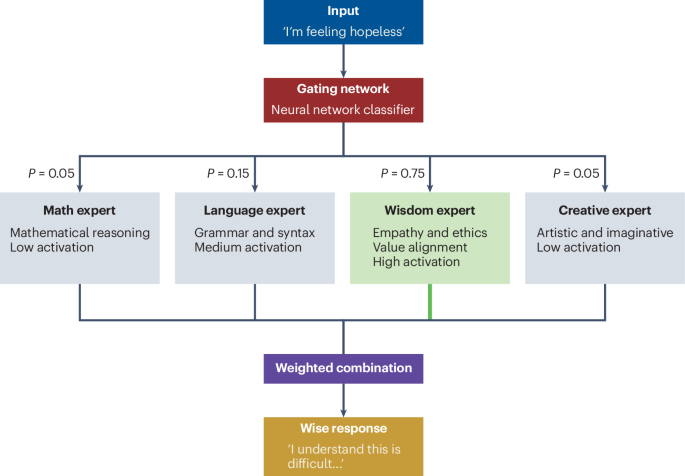
Shazeer, N. et al. Outrageously large neural networks: the sparsely-gated mixture-of-experts layer. Preprint at https://doi.org/10.48550/arXiv.1701.06538 (2017).
Rafailov, R. et al. Direct preference optimization: your language model is secretly a reward model. Preprint at https://doi.org/10.48550/arXiv.2305.18290 (2023).
Schmer-Galunder, S. et al. Annotator in the loop: a case study of in-depth rater engagement to create a prosocial benchmark dataset. Preprint at https://doi.org/10.48550/arXiv.2408.00880 (2024).
Jacobs, R. A., Jordan, M. I., Nowlan, S. J. & Hinton, G. E. Adaptive mixtures of local experts. Neural Comput. 3, 79–87 (1991).
Stiennon, N. et al. Learning to summarize from human feedback. Preprint at https://doi.org/10.48550/arXiv.2009.01325 (2020).
Nolte, R. et al. How metacognitive architectures remember their own thoughts: a systematic review. Preprint at https://doi.org/10.48550/arXiv.2503.13467 (2025).
Du, N. et al. GLaM: efficient scaling of language models with mixture-of-experts. Proc. Mach. Learn. Res. 162, 5547–5569 (2022).
Rajbhandari, S. et al. DeepSpeed-MoE: advancing mixture-of-experts inference and training to power next-generation AI scale. Proc. Mach. Learn. Res. 162, 18332–18346 (2022).
Zoph, B. et al. ST-MoE: designing stable and transferable sparse expert models. Preprint at https://doi.org/10.48550/arXiv.2202.08906 (2022).
Gabriel, I. Artificial intelligence, values, and alignment. Minds Mach. 30, 411–437 (2020).
Amodei, D. et al. Concrete problems in AI safety. Preprint at https://doi.org/10.48550/arXiv.1606.06565 (2016).
Fedus, W., Zoph, B. & Shazeer, N. Switch transformers: scaling to trillion parameter models with simple and efficient sparsity. Preprint at https://doi.org/10.48550/arXiv.2101.03961 (2021).
Lepikhin, D. et al. GShard: scaling giant models with conditional computation and automatic sharding. Preprint at https://doi.org/10.48550/arXiv.2006.16668 (2020).
Floridi, L. & Cowls, J. A unified framework of five principles for AI in society. Harv. Data Sci. Rev. https://doi.org/10.1162/99608f92.8cd550d1 (2019).
Russell, S. & Norvig, P. Artificial Intelligence: A Modern Approach 4th edn (Pearson, 2021).
Macrae, N. John von Neumann: The Scientific Genius Who Pioneered the Modern Computer, Game Theory, Nuclear Deterrence, and Much More (Pantheon Books, 1992).
Vinge, V. The coming technological singularity: how to survive in the post-human era. Whole Earth Rev. 81, 88–95 (1993).
Bostrom, N. Superintelligence: Paths, Dangers, Strategies (Oxford Univ. Press, 2014).
Wu, Q. et al. AutoGen: enabling next-gen LLM applications via multi-agent conversation framework. Preprint at https://doi.org/10.48550/arXiv.2308.08155 (2023).
Hong, S. et al. MetaGPT: meta programming for a multi-agent collaborative framework. Preprint at https://doi.org/10.48550/arXiv.2308.00352 (2024).
Park, J. S. et al. Generative agents: interactive simulacra of human behavior. Proc. ACM Symp. User Interface Softw. Technol. https://doi.org/10.1145/3586183.3606763 (2023).
Spytska, L. The use of artificial intelligence in psychotherapy: development of intelligent therapeutic systems. BMC Psychol. 13, 175 (2025).
Beg, M. J., Verma, M., Vishvak Chanthar, K. M. M. & Verma, M. K. Artificial intelligence for psychotherapy: a review of the current state and future directions. Indian J. Psychol. Med. 47, 314–325 (2024).
Li, H. et al. Systematic review and meta-analysis of AI-based conversational agents for promoting mental health and well-being. npj Digit. Med. 6, 236 (2023).
Hua, Y. et al. Large language models in mental health care: a scoping review. Preprint at https://doi.org/10.48550/arXiv.2401.02984 (2024).
Guo, Z. et al. Large language models for mental health applications: systematic review. JMIR Ment. Health 11, e57400 (2024).
Xiao, M. et al. HealMe: harnessing cognitive reframing in large language models for psychotherapy. Preprint at https://doi.org/10.48550/arXiv.2403.05574 (2024).
Heinz, M. V. et al. Randomized trial of a generative ai chatbot for mental health treatment. N. Engl. J. Med. AI https://doi.org/10.1056/AIoa2400802 (2025).
Sorin, V. et al. Large language models and empathy: systematic review. J. Med. Internet Res. 26, e52597 (2024).
Elyoseph, Z. et al. Capacity of generative AI to interpret human emotions from visual and textual data: pilot evaluation study. JMIR Ment. Health 11, e54369 (2024).
Benge, J. F. & Scullin, M. K. A meta-analysis of technology use and cognitive aging. Nat. Hum. Behav. 9, 1405–1419 (2025).
Broadbent, E., Stafford, R. & MacDonald, B. Acceptance of healthcare robots for the older population: review and future directions. Int. J. Soc. Robot. 1, 319–330 (2009).
Gasteiger, N., Loveys, K., Law, M. & Broadbent, E. Friends from the future: a scoping review of research into robots and computer agents to combat loneliness in older people. Clin. Interv. Aging 16, 941–971 (2021).
Kim, M. et al. Therapeutic potential of social chatbots in alleviating loneliness and social anxiety: quasi-experimental mixed methods study. J. Med. Internet Res. 27, e65589 (2025).
Broadbent, E. et al. ElliQ, an AI-driven social robot to alleviate loneliness: progress and lessons learned. J. Aging Res. Lifestyle 13, 22–28 (2024).
Trovato, G., Weng, Y.-H., Sgorbissa, A. & Fiorini, S. Editorial introduction to special issue on religion in robotics. Int. J. Soc. Robot. 13, 537–538 (2021).
Löffler, D., Hurtienne, J. & Nord, I. Blessing robot BlessU2: a discursive design study to understand the implications of social robots in religious contexts. Int. J. Soc. Robot. 13, 569–586 (2021).
Satake, Y. et al. A week with a conversational large language model companion robot. Am. J. Geriatr. Psychiatry 33, 799–800 (2025).
Yang, Y., Wang, C., Xiang, X. & An, R. AI applications to reduce loneliness among older adults: a systematic review of effectiveness and technologies. Healthcare 13, 446 (2025).
Haltaufderheide, J. & Ranisch, R. The ethics of ChatGPT in medicine and healthcare: a systematic review on large language models (LLMs). npj Digit. Med. 7, 183 (2024).
Ranisch, R. & Haltaufderheide, J. Rapid integration of LLMs in healthcare raises ethical concerns: an investigation into deceptive patterns in social robots. Digit. Soc. 4, 7 (2025).
Lee, P., Bubeck, S. & Petro, J. Benefits, limits, and risks of GPT-4 as an AI chatbot for medicine. N. Engl. J. Med. 388, 1233–1239 (2023).
Siddals, S., Torous, J. & Coxon, A. “It happened to be the perfect thing”: experiences of generative AI chatbots for mental health. npj Ment. Health Res. 3, 48 (2024).
Nelson, B. W. et al. Evaluating the performance of general purpose large language models in identifying human facial emotions. npj Digit. Med. 8, 615 (2025).
Liu, L. et al. H3-MOSAIC: multimodal generative AI for semantic place detection from high-frequency GPS on H3 grids in mental health geomatics. Int. J. Health Geogr. 24, 35 (2025).
Flathers, M. et al. Interpreting psychiatric digital phenotyping data with large language models: a preliminary analysis. BMJ Ment. Health 28, e301817 (2025).
Leave a Reply