
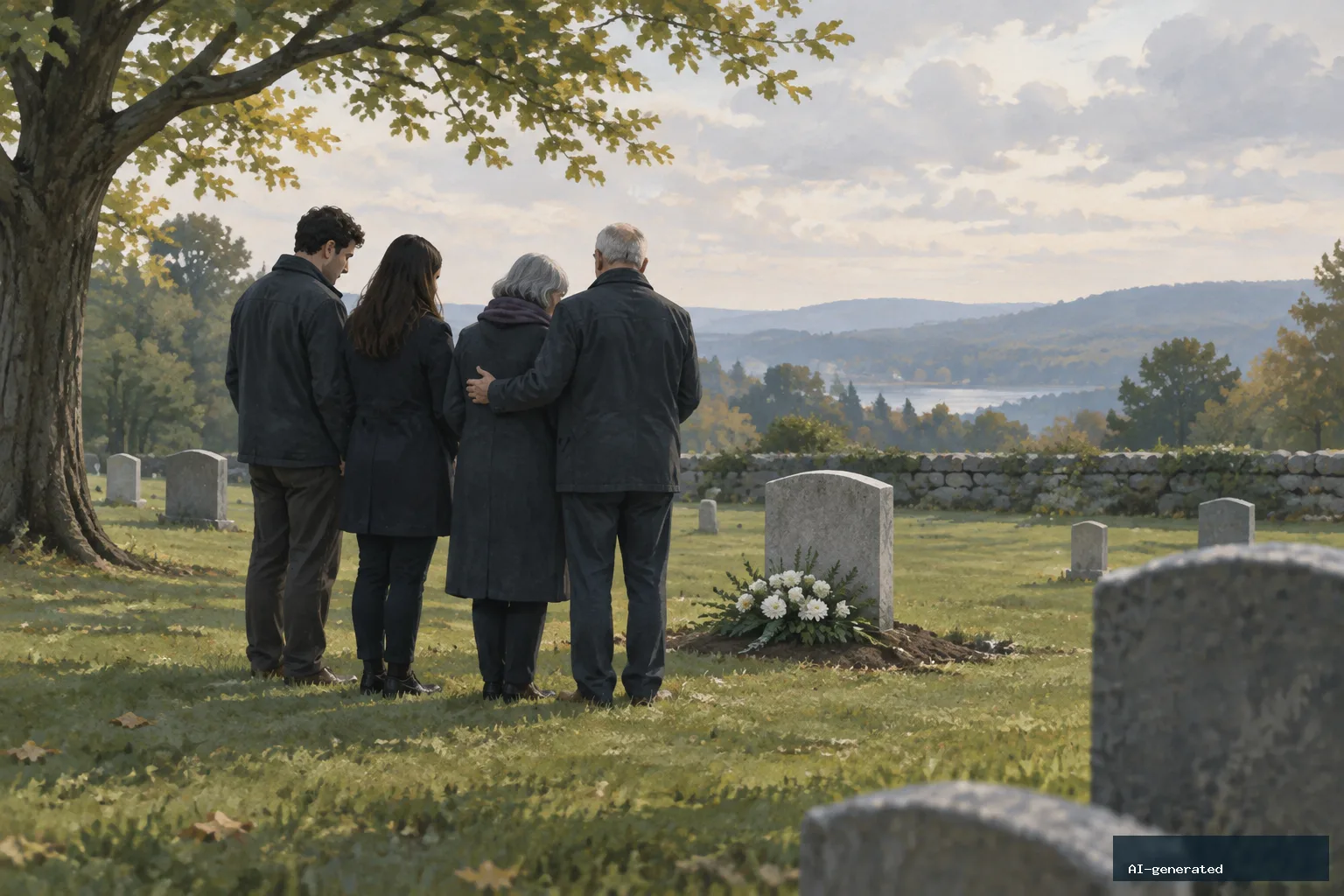
For people who knew Peter Giesel and Maria Kikkert, mourning did not end with their deaths. It became more complicated when they learned that both had been buried in unmarked communal graves in Sydney.
Giesel was buried at Rookwood general cemetery in late June with three other people. Nothing at the site identifies him. Kikkert was buried on 23 November 2022 with the remains of four others, also without a marker.
The cases are part of an investigation into how New South Wales handles funerals for people who cannot pay for them. The findings raise a basic question: when someone has little or no money, are their friends and relatives being given a meaningful chance to say goodbye?
What “persons without means” means
The NSW government uses the term “persons without means” for people unable to afford their own funerals. Once someone receives that designation, the state takes control of arrangements for their remains.
The process results in about 98 burials, 293 cremations and 22 ash interments each year, according to the investigation. Unmarked communal graves generally contain four to six people.
NSW policy says authorities should do everything possible to identify people willing to pay for a funeral. That includes contacting friends and other interested parties, as well as considering publicly available support such as crowdfunding.
Families and friends say they were not given the chance
Giesel’s sister, Nicole, said she was not told that an unmarked or communal grave would be used. She did not have money for his funeral, but his friend Elaine Grady said she would have helped. Grady also said friends in the United States could have contributed through crowdfunding if they had been contacted.
Giesel died of natural causes inside a caravan on 14 August 2024. His story illustrates how financial hardship can affect the final arrangements even when a person has people who want to help.
In another case, Roger Davies was placed in a grave with four strangers without his sister Chantel Dubsky’s knowledge. Dubsky, who was in Adelaide, said she would have paid for his cremation and repatriation.
Kikkert’s former employer, Kathy Cowley, said she was not given an opportunity to contribute. She said she would have paid for a headstone or another memorial if she had known about the communal grave. Kikkert’s stepdaughter said she was told the day before the burial that Kikkert was having a destitute burial, but not that she would be buried with four or five other people without a marker.
The investigation identified six cases in which friends, community leaders or relatives were either not told about an unmarked communal grave or were not given a proper chance to intervene and pay or crowdfund. It described those cases as a likely breach of government policy, rather than a definitive legal finding.
A wider pattern and differing approaches
At least 18 people known to Sydney homelessness services have been placed in unmarked graves since 2016, according to the investigation. Two Vietnam War veterans who served in the Royal Australian Navy were also identified as having been buried in unmarked communal graves in 2024 and 2025.
The Department of Veterans’ Affairs said it had not been approached to help fund the burials of destitute people since 2020.
Other states use different arrangements. Queensland also uses unmarked graves, but does not use communal interments in the same way as NSW. In Victoria, State Trustees uses a rural cemetery at Ballan for individual plots with markings. The agency describes that approach as a matter of respect and a way to ensure families and friends have somewhere to visit.
The Victorian burials cost $3,000 each. The investigation said using that rate in NSW would cost the state government at most about $360,000 a year.
What authorities say has changed
NSW Health apologised for past failings and acknowledged that people without the financial means to pay for funerals had not always been treated with dignity and respect.
NSW Health assumed greater control of the process from police in 2025. It said it had introduced changes in 2025 and in recent months to improve funeral arrangements. NSW Health Pathology also created a funeral support assessment team with 6.2 full-time-equivalent positions to look for alternative arrangements and other possible sources of support.
Metropolitan Memorial Parks said the NSW government does not fund grave markings for people without means, and that permanent memorialisation is optional and not funded by the state. It said details of people buried at Rookwood, including those handled through the persons without means process, are published online with the grave location.
The organisation rejected suggestions that people were buried between individual headstones, under walkways or in trenches. It also said it had identified no legislation or regulation giving effect to a 2013 NSW government promise to mark graves.
For relatives, friends and former colleagues, the issue is not only where a person is buried. It is whether those who cared about them knew what was happening, had a chance to help and have a place where they can remember them.
AI tools were used to assist with the preparation of this article.
Leave a Reply