
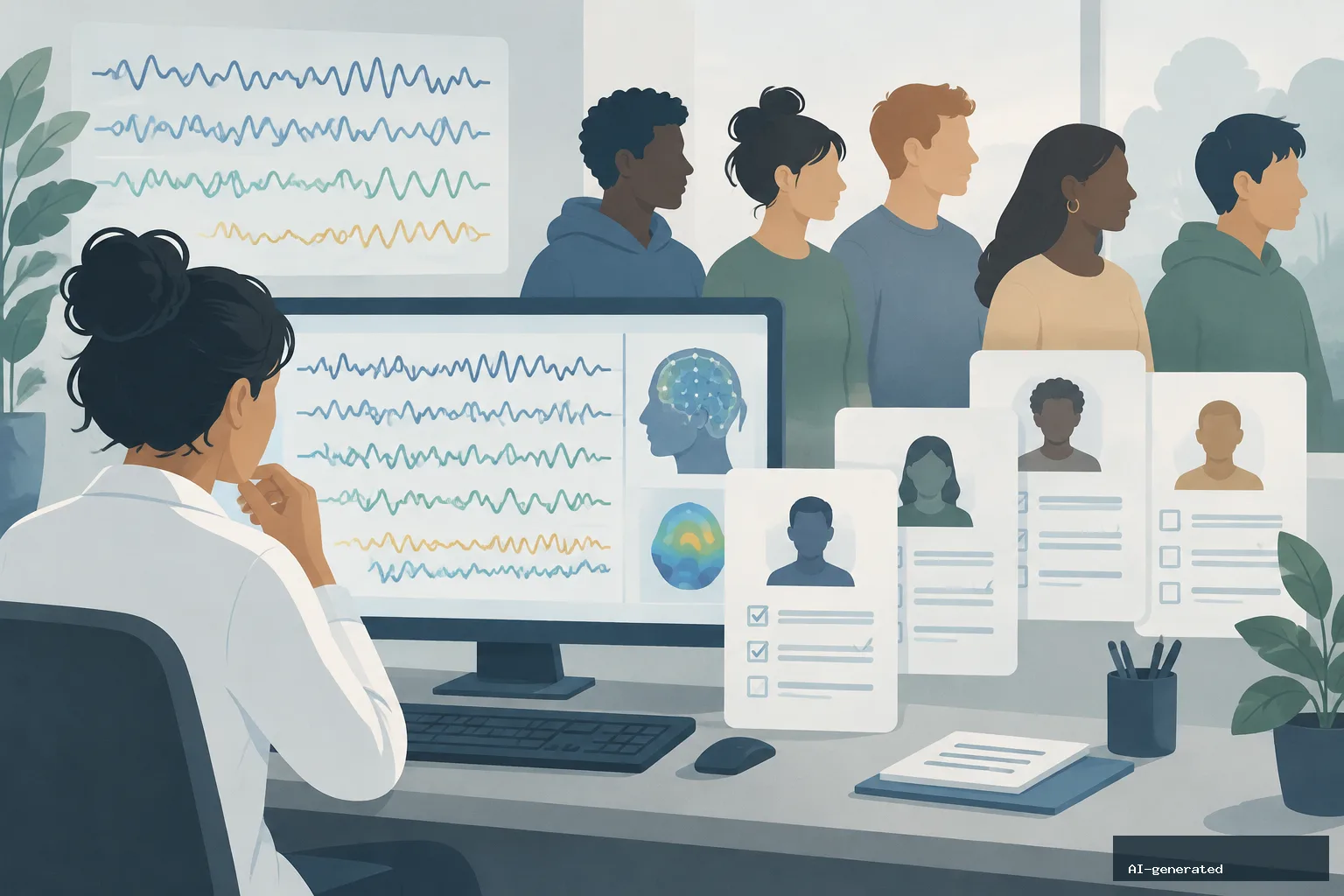
A deep-learning model classified ADHD screening results slightly more accurately when researchers combined electroencephalography (EEG) recordings with 17 socioeconomic questionnaire responses. However, the improvement was not statistically significant on any of the four attention tasks studied.
The analysis involved public data from 127 U.S. university students aged 18 to 30. The model predicted whether participants had a positive result on a six-question self-report screener, not whether they had a clinically confirmed ADHD diagnosis.
What the study tested
Participants completed four attention tasks: auditory oddball, visual oddball, flanker and visual search. The researchers analyzed between 59 and 95 students per task.
The socioeconomic questions covered topics including childhood social standing, education, food security, housing problems, street noise and perceived neighborhood safety. The researchers combined those answers with two EEG-based deep-learning networks, one using raw EEG data and another using frequency-by-time information.
A positive screening result required participants to mark at least four of six core questions at the screening threshold. Such a result can also reflect anxiety, sleep disorders or learning disabilities, according to the study information.
Accuracy rose, but the evidence remained uncertain
In testing that held out students from model development, EEG-only accuracy ranged from 86.4% to 90.5% across the four tasks. Adding socioeconomic data raised the reported range to 91.5% to 95.8%.
None of the combined-model results was lower than the corresponding EEG-only result. Yet only six to nine students per task changed classification, and paired McNemar tests produced p-values from 0.091 to 0.342. The researchers therefore did not find a statistically significant improvement on any task.
For visual search, the same 13 screen-positive students were identified with and without the socioeconomic information. Specificity increased from 0.90 to 0.98. Across tasks, sensitivity ranged from 0.71 to 0.96 with socioeconomic data, compared with 0.65 to 0.85 for EEG alone, while specificity ranged from 0.95 to 1.00.
Why the testing method matters
When EEG segments from the same person could appear in both training and testing, accuracy reached 97.6% to 99.9%. The lower held-out-student results are more informative about performance on people not represented in model training, because they reduce the risk that the system benefits from recognizing person-specific patterns.
The researchers described the work as a proof of concept and said a larger, multi-site study is needed. They also reported that the socioeconomic component represented only 13,888 of 36.1 million model settings, or 0.04% of the total model configuration.
Associations are not explanations
In analyses examining which inputs influenced the model, childhood social standing ranked at or near the top in seven of eight SHAP analyses. Lower reported standing was linked with a positive screening result in those analyses. Neighborhood safety appeared among the top 15 features in six of eight analyses, with safer neighborhoods linked with a negative screen. Food security and education also appeared across tasks.
These patterns describe associations in the model and do not show that socioeconomic conditions cause ADHD or cause a screening result. The source also notes that self-reported screening labels may contain socioeconomic bias, which a model could reproduce. No fairness analysis was performed.
What the child-data test showed
The EEG component was also applied without changes to a separate dataset of 121 children aged 7 to 12, including 61 with clinically diagnosed ADHD and 60 without. In held-out-child testing, the EEG model reached 80.4% accuracy with a reported plus-or-minus 6.4% value.
When segments rather than independently held-out children were tested, accuracy reached 97.5% to 97.9%. The children’s dataset did not include socioeconomic information, so the full combined model was not tested outside the original student sample.
What readers should take from it
The findings suggest that questionnaire information may add signal to EEG-based classification of screening status in this dataset. They do not establish a clinically validated ADHD diagnostic tool, and they do not show that socioeconomic characteristics explain or cause ADHD.
The study’s small, single-site university sample, limited number of screen-positive students and lack of external testing for the full model make broader conclusions premature. The researchers also did not account for sleep, medication or other psychiatric conditions, and childhood socioeconomic status was recalled rather than recorded at the time.
AI tools were used to assist with the preparation of this article under our editorial standards.
Leave a Reply