
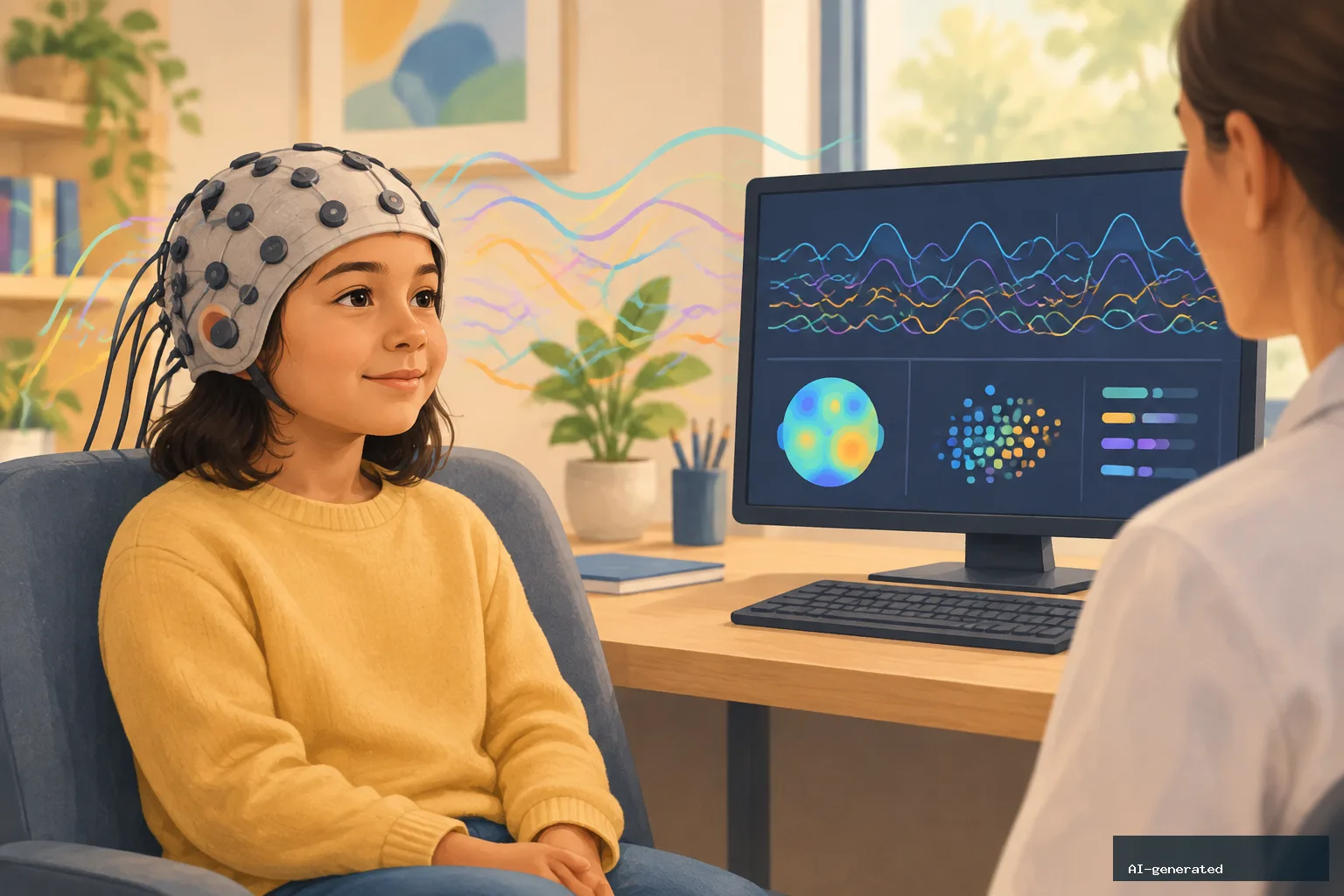
A 2026 study used electroencephalography (EEG) recordings and machine-learning models to classify 121 children ages about 7 to 12 as having ADHD or not having a psychiatric disorder. The strongest result came from a Random Forest model, which reached 81% accuracy during internal cross-validation.
The finding does not establish an EEG test for ADHD. The researchers described their framework as exploratory, and the study did not include an outside test group. Its performance also varied depending on the model and testing approach.
What the study tested
The dataset included 61 children diagnosed with ADHD by an experienced psychiatrist using DSM-IV criteria and 60 children without a psychiatric disorder, epilepsy or reported high-risk behavior.
Researchers recorded EEG activity from 19 scalp electrodes while the children counted cartoon characters on a screen. The recordings were divided into overlapping four-second sections. From each section, the team calculated 95 signal features involving theta, alpha and beta activity.
To reduce the risk of treating many recordings from the same child as independent evidence, the study used subject-wise cross-validation. Each child’s EEG sections stayed together, while the model was tested on one group of children after being trained on the other four groups.
How accurately did the models classify children?
Random Forest performed best overall, with 81% accuracy. A bootstrap 95% range for that estimate extended from 74% to 88%, showing meaningful uncertainty around the result. The model had 84% sensitivity and 78% specificity.
In practical terms within this study group, sensitivity describes the proportion of children with ADHD who were correctly identified, while specificity describes the proportion of children without ADHD who were correctly left unflagged. These measures do not show how the model would perform in a broader clinical population.
A separate leave-one-child-out test of a support vector machine classified 98 of the 121 children correctly. It missed 10 of the 61 children with ADHD and wrongly flagged 13 of the 60 children without ADHD. The support vector machine had 85% sensitivity and an area under the curve of 0.85.
Random Forest, the support vector machine and Gradient Boosting were statistically tied. Logistic regression performed less well, with 71% accuracy.
What the EEG signals may be capturing
The Random Forest model gave the greatest weight to Fz, a midline electrode at the front of the scalp. F3, Fp1 and F7 followed. The result points to frontal recordings as important within this dataset, but it does not prove that a specific brain region or rhythm causes ADHD or can independently identify it.
The researchers did not use advanced cleanup such as independent component analysis. That matters because frontal EEG signals can partly reflect eye movement or tension in forehead muscles, rather than brain rhythms alone.
When the researchers redefined EEG bands around each child’s individual alpha frequency, accuracy fell for every model. Random Forest accuracy dropped from 81% to 73%.
Why the result is not yet a clinical test
The study used one existing public dataset and internal cross-validation. There was no external group of children from another clinic to test whether the results would hold with different participants or equipment.
The children with ADHD had taken methylphenidate, also known as Ritalin, for up to six months, while the control children had not. As a result, the models could have been partly detecting medication-related differences in EEG rather than ADHD-related patterns.
The comparison was also limited to ADHD versus typical children. The study did not test whether the models could distinguish ADHD from anxiety, learning disorders, sleep problems or other conditions that may be relevant when evaluating attention or behavior.
The exact sex split was not reported, and children with ADHD contributed more EEG sections on average than controls—75 compared with 56. These features further limit how broadly the results can be interpreted.
Earlier EEG studies that reported accuracy between 86% and 96% often used looser testing methods, such as scoring individual EEG sections rather than requiring correct classification of whole children. The 2026 study’s subject-wise approach was designed to keep each child’s recordings together during testing, but it still requires outside validation.
What comes next
The source describes testing the same pipeline on children from other clinics as the next step, including unmedicated children and children with other conditions. The 2026 model and a 2025 Korean model have not been tested on each other’s participants. The Korean study, which involved 168 children, relied most on beta activity at O1, an electrode over the back of the head, highlighting that different datasets may produce different influential signals.
For now, the study is best understood as evidence that EEG features can support experimental classification in a carefully defined dataset—not as evidence that an EEG-based machine-learning system can diagnose ADHD in routine care.
AI tools were used to assist with the preparation of this article under our editorial standards.
Leave a Reply