

⏱ 9 min read
Coffee is widely framed as cognitively friendly, but a 2026 prospective study from Boscaini et al. published in Nature Communications used shotgun metagenomics, metabolomics, and cognitive testing in 62 healthy adults to show that coffee drinkers and non-coffee drinkers differ on the gut microbiome, key neurotransmitter-related metabolites, and behavioral measures — with coffee drinkers showing higher impulsivity but worse memory than non-coffee drinkers.1
Research Highlights
- Coffee drinkers had higher abundance of Cryptobacterium and Eggerthella species in fecal microbiome, with significant group differences after baseline comparison.1
- Coffee drinkers had lower fecal levels of indole-3-propionic acid, indole-3-carboxyaldehyde, and GABA (the brain’s main inhibitory neurotransmitter, also produced by gut bacteria).1
- Behavioral differences favored non-coffee drinkers on memory and coffee drinkers on impulsivity. Coffee drinkers exhibited greater impulsivity and emotional reactivity than non-coffee drinkers; non-coffee drinkers performed better on standardized memory testing than coffee drinkers.1
- The microbiome change was caffeine-independent. After a 14-day washout, coffee reintroduction in both caffeinated (n = 16) and decaffeinated (n = 15) arms produced acute microbiome changes, indicating non-caffeine compounds in coffee drive part of the effect.1
- Nine key metabolites linked the microbiome to cognition. An integrated model identified theophylline, caffeine, and selected phenolic acids as bridges between microbial species composition and cognitive measures.1
The popular narrative on coffee and brain health pulls heavily on epidemiological data: cohort studies link moderate coffee consumption to lower risks of Parkinson’s disease, depression, and Alzheimer’s-type dementia.2,3
Mechanistically, those benefits are usually attributed to caffeine, polyphenols, and antioxidants — but the cellular pathways have remained incompletely mapped, and the gut microbiome’s role has been largely speculative.
The Boscaini study tightens the picture by combining microbiome, metabolome, and behavioral measurements in the same participants, with a controlled abstinence-and-reintroduction phase.
Boscaini 2026: 62 Adults, Three-Phase Design, Shotgun Metagenomics
The trial enrolled 62 healthy adults: 31 habitual coffee drinkers and 31 matched non-coffee drinkers.1
The three-phase design:
- Phase 1 (baseline): compare coffee drinkers (CD) to non-coffee drinkers (NCD) on microbiome, metabolome, cognition, mood, and physiology.
- Phase 2 (washout): CD participants abstained from coffee for 14 days.
- Phase 3 (reintroduction): CD participants reintroduced either caffeinated coffee (n = 16) or decaffeinated coffee (n = 15) for 21 days, allowing the team to separate caffeine-specific effects from other coffee compounds.
NCD participants did not continue through Phases 2 and 3.
The instruments were comprehensive: shotgun metagenomic sequencing of fecal microbiome, targeted and untargeted metabolomics, weighted 7-day food diaries before each visit, validated cognitive and behavioral assessments, blood pressure, BMI, sleep, and gastrointestinal symptom inventories.
Participants were genotyped for ADORA2A SNPs (rs2298383, rs5751876) related to caffeine sensitivity. Childhood trauma, education, predicted IQ, and alcohol consumption were balanced across groups.
No baseline dietary differences were observed between CD and NCD beyond coffee itself, and BMI, blood pressure, stress, anxiety, depression, sleep quality, and physical activity were similar at baseline.
Coffee Drinkers Had Distinct Gut Microbes and Lower GABA-Linked Metabolites
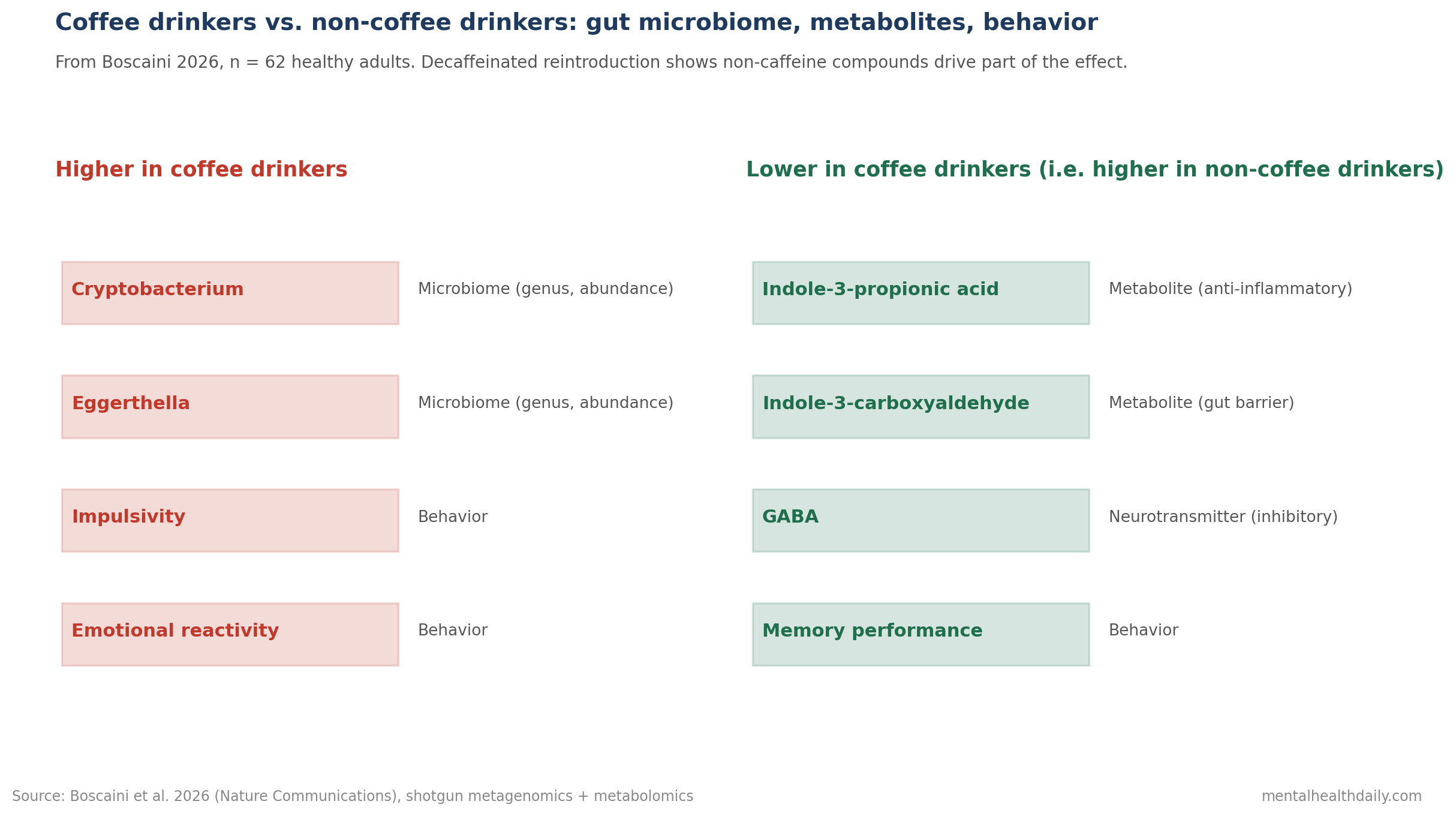
Fecal microbiome composition showed significant group-level differences.
Coffee drinkers had elevated abundance of Cryptobacterium and Eggerthella species.1 Both genera are involved in the metabolism of dietary phenolics, including the chlorogenic acids that coffee delivers in large quantities.
Three key metabolites were lower in coffee drinkers:
- Indole-3-propionic acid (IPA): a tryptophan-derived metabolite produced by gut bacteria, with documented anti-inflammatory and neuroprotective signaling.
- Indole-3-carboxyaldehyde: another tryptophan-pathway metabolite linked to gut barrier function.
- GABA (γ-aminobutyric acid): the brain’s main inhibitory neurotransmitter. Gut bacteria produce GABA, and changes in fecal GABA reflect altered microbial activity.
The directional pattern matters. Coffee shifts the microbiome toward phenolic-metabolizing organisms while reducing tryptophan-derived signaling metabolites and microbial GABA — a fingerprint quite distinct from a generic “coffee is good or bad” claim.
Behavioral Surprise: Lower Memory, Higher Impulsivity in Coffee Drinkers
The behavioral comparison did not match the popular cognition narrative.1
Coffee drinkers showed greater impulsivity on standardized impulsivity measures and reported greater emotional reactivity.
Non-coffee drinkers showed better memory performance on standardized memory testing.
This is a calibrated-correction moment. The epidemiological literature consistently shows lower Alzheimer’s incidence in coffee drinkers in long-term cohorts, but at the snapshot level in healthy young-to-middle-aged adults, this study finds non-coffee drinkers performing better on memory and similarly or worse on impulsivity.
Three reasonable interpretations of the apparent contradiction with cohort epidemiology:
Different time scales. The Alzheimer’s-prevention literature looks at decades; the Boscaini behavioral measures are cross-sectional in healthy adults. Cumulative coffee benefit could emerge with aging without producing measurable advantages in younger populations.
Selection effects. People who choose to drink coffee may differ on baseline traits (lower baseline tonic alertness, sleep schedules requiring caffeine, behavioral preferences) that themselves correlate with memory and impulsivity differences.
Specificity of measures. The Boscaini cognitive battery may emphasize aspects of memory where coffee provides no benefit, even if other cognitive domains (sustained attention, processing speed) might favor coffee drinkers in different testing paradigms.
Decaffeinated Coffee Also Shifted Gut Microbes
The reintroduction phase is what makes the study mechanistically informative.
After 14 days of coffee abstinence, the CD group split into caffeinated (n = 16) and decaffeinated (n = 15) reintroduction arms.1
Both arms produced acute microbiome changes when coffee was reintroduced. Decaffeinated coffee shifted the microbiome too, indicating that caffeine alone does not account for the gut effects.
The implication is that coffee’s many non-caffeine compounds — chlorogenic acids, melanoidins, diterpenes, fiber-like polysaccharides — are individually or collectively driving the microbiome signal.
The integrated metabolome-microbiome-cognition model identified nine key metabolites bridging the three layers:
- Theophylline — a caffeine metabolite with its own pharmacological activity.
- Caffeine itself.
- Selected phenolic acids — including products of microbial metabolism of coffee polyphenols.
The phenolic-acid signal, in particular, fits with the increased abundance of Eggerthella in coffee drinkers, since this genus specializes in phenolic metabolism.
Coffee Findings Do Not Justify Quitting Based on a 62-Person Study
- Coffee meaningfully shapes the gut microbiome. The change is real, replicable across reintroduction, and partly independent of caffeine. Habitual coffee drinkers carry a measurably different gut microbial profile than non-drinkers.
- Some changes look like trade-offs. Lower fecal GABA and tryptophan-derived metabolites are not unambiguously good. The behavioral data showing higher impulsivity and lower memory performance fit with reduced inhibitory neurotransmitter availability and altered indole signaling.
- Don’t read this as a verdict against coffee. Population-level epidemiology consistently shows benefits for cardiovascular disease, type 2 diabetes, Parkinson’s, and Alzheimer’s. The Boscaini findings highlight specific pathways where the picture is more complicated, in a small healthy-adult cohort.
- Decaffeinated coffee is not a placebo. The microbiome and metabolite changes occur substantially through non-caffeine compounds. People switching from caffeinated to decaffeinated for sleep or anxiety reasons should not assume they’re avoiding all coffee biology.
- Self-experimentation has limits. Microbiome and metabolite changes are subtle and hard to feel directly. Behavioral effects of habitual coffee at the individual level are highly variable.
Small Observational Coffee Data Cannot Separate Habit From Causality
Sample size is small for behavioral comparisons. 31 vs. 31 at baseline produces meaningful microbiome differences (where between-person variance is high relative to measurement noise) but is underpowered for cognitive subtleties. The memory and impulsivity differences need replication.
Causal direction is not established. Cross-sectional comparison of self-selected coffee drinkers to non-drinkers cannot rule out that personality and cognitive traits influence coffee preference, rather than coffee influencing those traits.
The reintroduction phase is short. Three weeks captures acute coffee re-effects on the microbiome but does not test long-term steady-state outcomes.
Cognitive measures are limited in scope. The behavioral battery tested specific aspects of memory and impulsivity. Coffee benefits on attention, processing speed, or working memory under sustained-vigilance conditions may not have been captured.
Generalizability to non-healthy populations is untested. Participants were healthy adults. Coffee’s microbiome and metabolite effects in inflammatory bowel disease, chronic fatigue, depression, or older adults may differ.
Questions About Coffee, the Microbiome, and Cognition
Should I drink coffee or not?
The question doesn’t have a single answer from this study. Population-level epidemiology supports benefits of moderate coffee consumption for cardiovascular disease, Parkinson’s, type 2 diabetes, and possibly Alzheimer’s. Cross-sectional behavioral comparison in this small cohort showed coffee drinkers with higher impulsivity and lower memory performance.1,2
For most healthy adults, moderate coffee (3–4 cups/day) is consistent with good outcomes in epidemiology. Anyone with anxiety, sleep disturbance, or arrhythmia should discuss coffee with their clinician.
Is decaffeinated coffee really different?
Decaffeinated coffee produced microbiome changes in the reintroduction phase, indicating non-caffeine compounds drive substantial gut effects.1
Decaf removes the caffeine while retaining the chlorogenic acids, melanoidins, and other phenolic compounds that the gut microbiome responds to. From a microbiome perspective, decaf delivers most of coffee’s biological signal apart from the central caffeine effect.
Why would coffee drinkers have lower fecal GABA?
GABA in the gut is produced largely by specific bacterial taxa (especially Lactobacillus and Bifidobacterium species). Coffee shifts microbial composition toward phenolic-metabolizing organisms (Cryptobacterium, Eggerthella) while potentially reducing GABA-producing taxa.1
Whether reduced fecal GABA translates to reduced GABA signaling in the brain (across the gut-blood-brain pathway) is mechanistically plausible but not directly tested here.
Can the microbiome predict whether someone is a coffee drinker?
The Boscaini analysis suggests yes. The microbiome differences between coffee drinkers and non-coffee drinkers are large enough that fecal microbiome profiling could identify habitual coffee consumption patterns reasonably reliably.1
This is an interesting marker biology finding rather than a clinical use case. No one needs a microbiome test to find out whether someone drinks coffee.
Does this contradict the literature on coffee preventing dementia?
Not directly. The dementia-prevention evidence comes from long-term cohort studies tracking outcomes over decades. The Boscaini cognitive measures are cross-sectional in healthy adults at one time point.3
Coffee may produce subtle short-term cognitive trade-offs while still delivering long-term protective benefits via separate pathways (anti-inflammatory effects, alpha-synuclein interactions, vascular protection).
References
- Habitual coffee intake shapes the gut microbiome and modifies host physiology and cognition. Boscaini S et al. Nature Communications. 2026;17:3439. doi:10.1038/s41467-026-71264-8
- Long-term coffee consumption and risk of cardiovascular disease: a systematic review and a dose-response meta-analysis of prospective cohort studies. Ding M et al. Circulation. 2014;129(6):643-659. doi:10.1161/CIRCULATIONAHA.113.005925
- Coffee, decaffeinated coffee, caffeine, and tea consumption in young adulthood and atherosclerosis later in life: the CARDIA study. Reis JP et al. Arteriosclerosis, Thrombosis, and Vascular Biology. 2010;30(10):2059-2066. doi:10.1161/ATVBAHA.110.208280
- The microbiota-gut-brain axis. Cryan JF et al. Physiological Reviews. 2019;99(4):1877-2013. doi:10.1152/physrev.00018.2018
- Coffee, caffeine, and risk of depression among adults: a systematic review and meta-analysis. Wang L et al. Australian & New Zealand Journal of Psychiatry. 2016;50(3):228-242. doi:10.1177/0004867415603131
Leave a Reply