
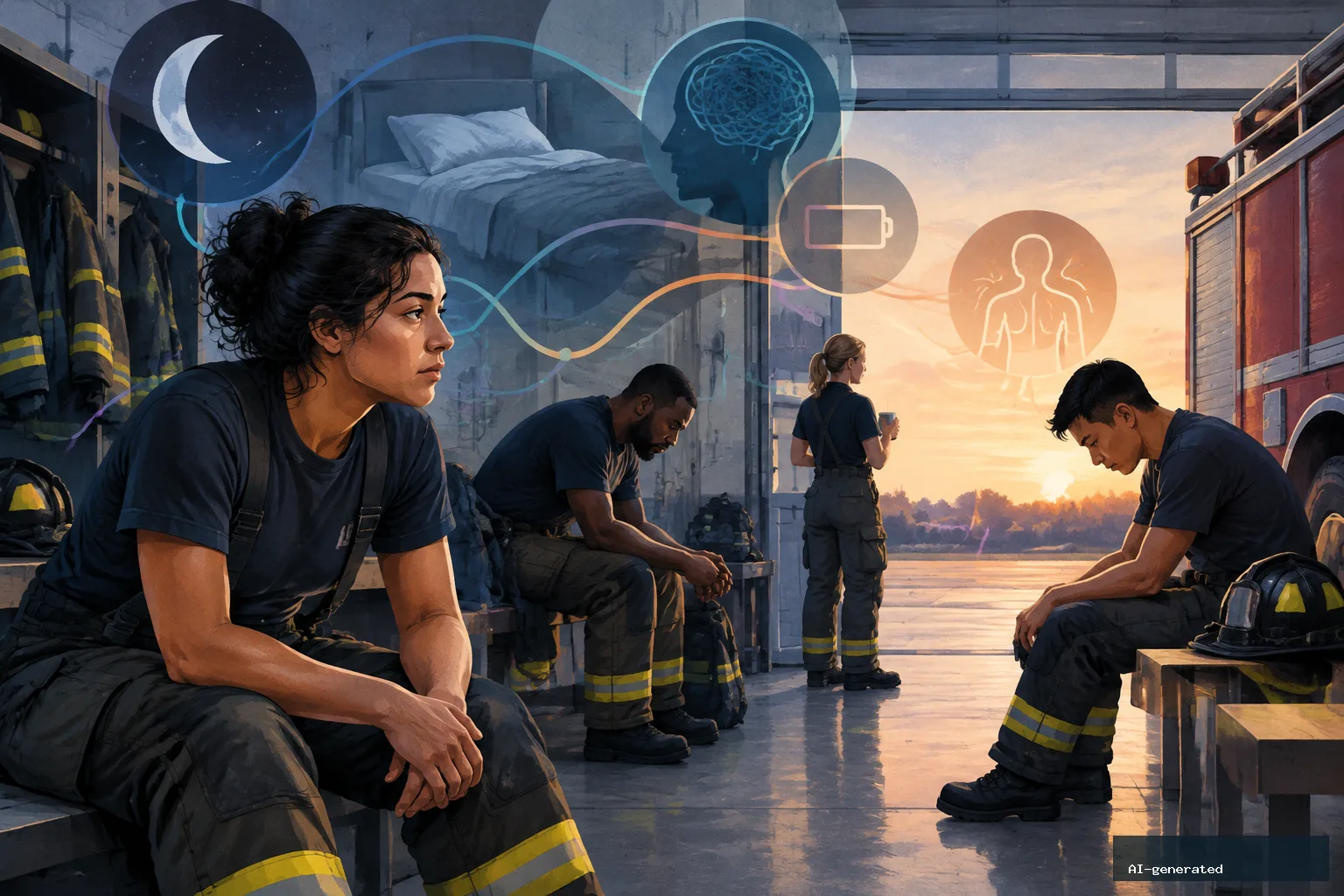
A survey of 6,240 Chinese firefighters found that sleep difficulties and fatigue were among the symptoms most closely connecting depression and post-traumatic stress disorder (PTSD) screening responses.
The findings point to symptoms that tended to appear together. They do not show that sleep problems or fatigue cause depression or PTSD, and they do not establish that addressing one symptom would resolve others.
What the survey found
The participants completed the nine-item Patient Health Questionnaire (PHQ-9) and the 17-item PTSD Checklist-Civilian Version (PCL-C). Both are screening questionnaires that ask how much symptoms have bothered someone recently; neither can diagnose depression or PTSD.
The strongest single connection between the two symptom sets was between feeling tired on the depression questionnaire and sleep difficulties on the PTSD questionnaire. Thoughts of death or self-harm, sleep difficulties and fatigue had the highest overall bridge strength between the two groups of symptoms.
Avoidance was the busiest overall hub in the network, followed by avoiding reminders and difficulty concentrating. The researchers cautioned that the self-harm-related item should not be read as causing other symptoms. They said it more likely reflects an accumulation of depression and PTSD symptoms. The study did not report how many firefighters selected that item.
Differences in average scores
The sample included 5,357 men and 883 women who provided complete questionnaires. Participants were about 29 years old on average, and data were collected from March through May 2023 in supervised group sessions using online questionnaires.
Women had higher average depression scores than men, 3.87 compared with 2.54, and higher average PTSD scores, 23.96 compared with 21.29. The reported differences were statistically significant. However, both groups were described as having low average symptom levels, and both average PHQ-9 scores were below 5.
Sleep difficulties appeared as a bridge symptom in both men and women. Among women, fatigue and trouble concentrating were also identified as bridges. Among men, slowed or restless movement and thoughts of death or self-harm were additional bridges.
Those sex-specific patterns remain tentative. A Network Comparison Test found no significant sex difference in the overall network structure, overall connection strength or any individual connection. The smaller number of women in the sample also limited the ability to detect differences between the networks.
Why the results need careful interpretation
This was a one-time survey, so it captured symptoms that occurred together at one point rather than showing how they changed or which came first. The participants were not a group of firefighters diagnosed with depression or PTSD, and no clinical interviews were used.
The survey also did not record the type, frequency or timing of traumatic calls. Because the participants were Chinese firefighters surveyed in 2023, workplace culture and stress related to the COVID-19 pandemic may have influenced the results.
The findings also differ from a 2023 network study of 1,768 Chinese firefighters, which identified emotional numbness, being on high alert, sad mood and guilt or self-blame as different bridges. In that earlier study, feeling that life was empty was the most central symptom, followed by fatigue and loss of interest.
Taken together, the research suggests that sleep, fatigue and other symptoms may be useful areas for further study in firefighter mental-health research. It does not yet show that these symptoms should be treated as causes, or that targeting them would change depression or PTSD symptoms.
AI tools were used to assist with the preparation of this article under our editorial standards.
Leave a Reply