
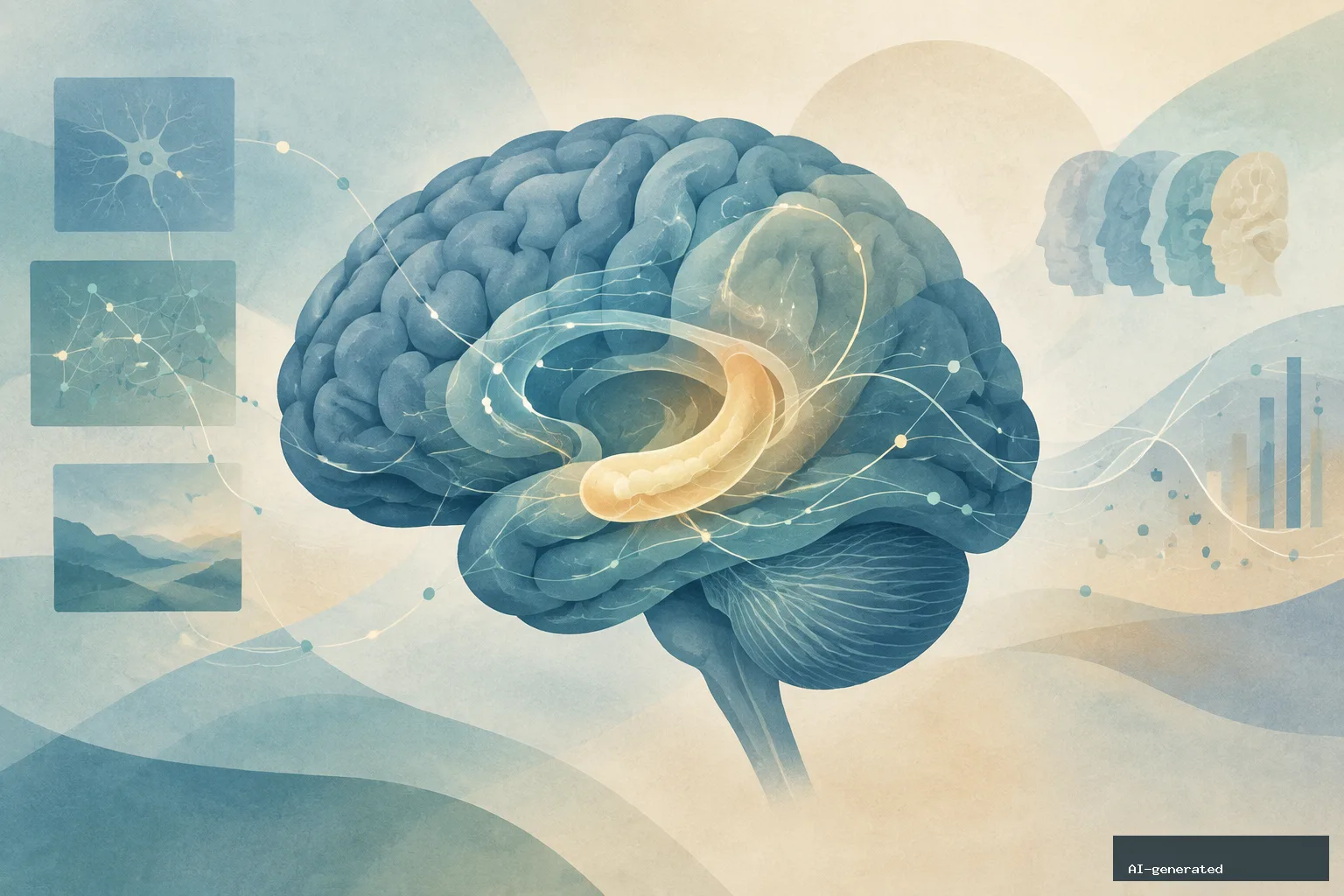
A research article published in Nature Mental Health on 7 October 2026 focuses on connectivity within the hippocampus and its possible relationship to early clinical trajectories in a psychosis risk state.
The article, by Lukas Roell, Christoph Lindner, Ye Ella Tian and colleagues, is titled “Connectivity within the hippocampus as a neural marker of early clinical trajectories in the psychosis risk state.” It has been peer reviewed, and the journal states that reviewer reports are available.
What the available record confirms
The study used data and/or research tools obtained from the National Institute of Mental Health Data Archive. The relevant dataset has collection identifier 2275. The authors say that the data supporting the findings cannot be made publicly available because access permission from the archive is required.
The study code is publicly available through the authors’ GitHub repository. That makes the analysis code accessible, but it does not make the underlying dataset openly available.
The authors also note that the manuscript reflects their own views and may not represent the opinions of the National Institutes of Health or the people who originally submitted the data to the archive.
Why the limits matter
The verified information available for this report does not include the study’s methods, sample characteristics, results or conclusions. As a result, it is not possible to assess from this record how hippocampal connectivity was measured, how participants were selected, or whether the proposed neural marker performed reliably.
It is also not possible to say whether the findings have implications for individual prediction, clinical decision-making or treatment. A research article about a potential marker should not be taken as evidence that a person’s future mental-health trajectory can be determined from brain data.
Publication and funding details
The manuscript was received on 28 March 2026, accepted on 15 September 2026 and published as the version of record on 7 October 2026. Its DOI is 10.1038/s44220-026-00739-w.
Lukas Roell received a Walter-Benjamin-Fellowship funded by the Deutsche Forschungsgemeinschaft. The work was also endorsed by the Federal Ministry of Research, Technology and Space during the development phase of the German Center for Mental Health, with grants assigned to Peter Falkai and Andrea Schmitt. The funders reported no role in the study design, data collection and analysis, publication decision or manuscript preparation.
The authors report competing interests for Peter Falkai and Isabel Maurus; the other authors declare no competing interests. Steffen Zitzmann and Andrew Zalesky contributed equally, and Lukas Roell is the corresponding author.
The practical takeaway
This publication adds to research on brain connectivity and psychosis risk, but the fact sheet available here supports only a description of the article’s scope and data-access arrangements—not an evaluation of its scientific findings. Readers should wait for the full methods and results before drawing conclusions about accuracy, usefulness or relevance to individual care.
AI tools were used to assist with the preparation of this article.
Leave a Reply