
⏱ 8 min read
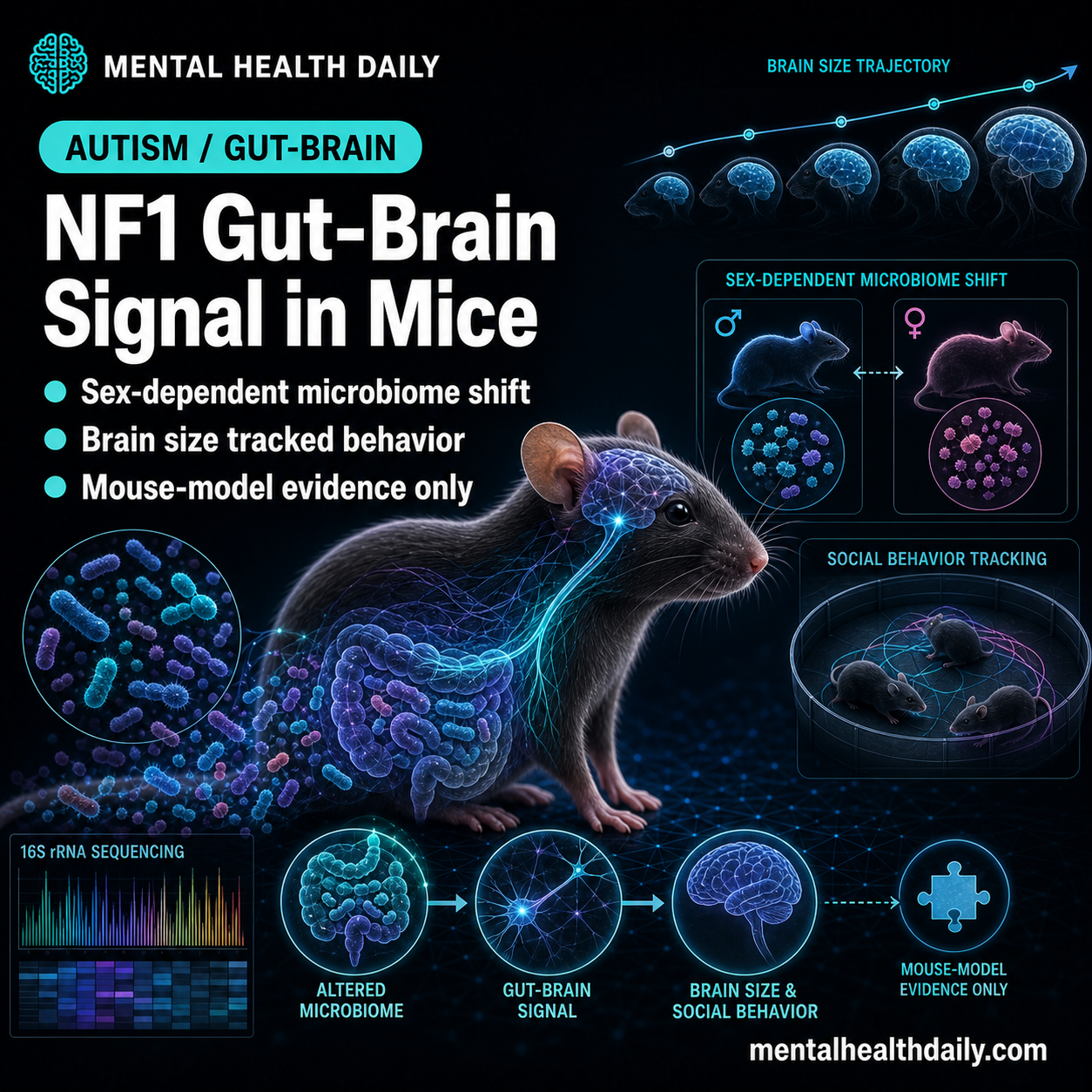
A 2026 NF1 mouse-model study found a gut-brain signal that was strongest in males: Nf1 +/- mice had altered gut microbiome composition, higher relative brain mass in 2 cohorts, reduced sociability, and combined autism-like phenotype shifts, with male microbiome beta diversity differing from controls at p = 0.0120.1 The result is a preclinical mechanism lead, not evidence that probiotics treat neurofibromatosis type 1.
Research Highlights
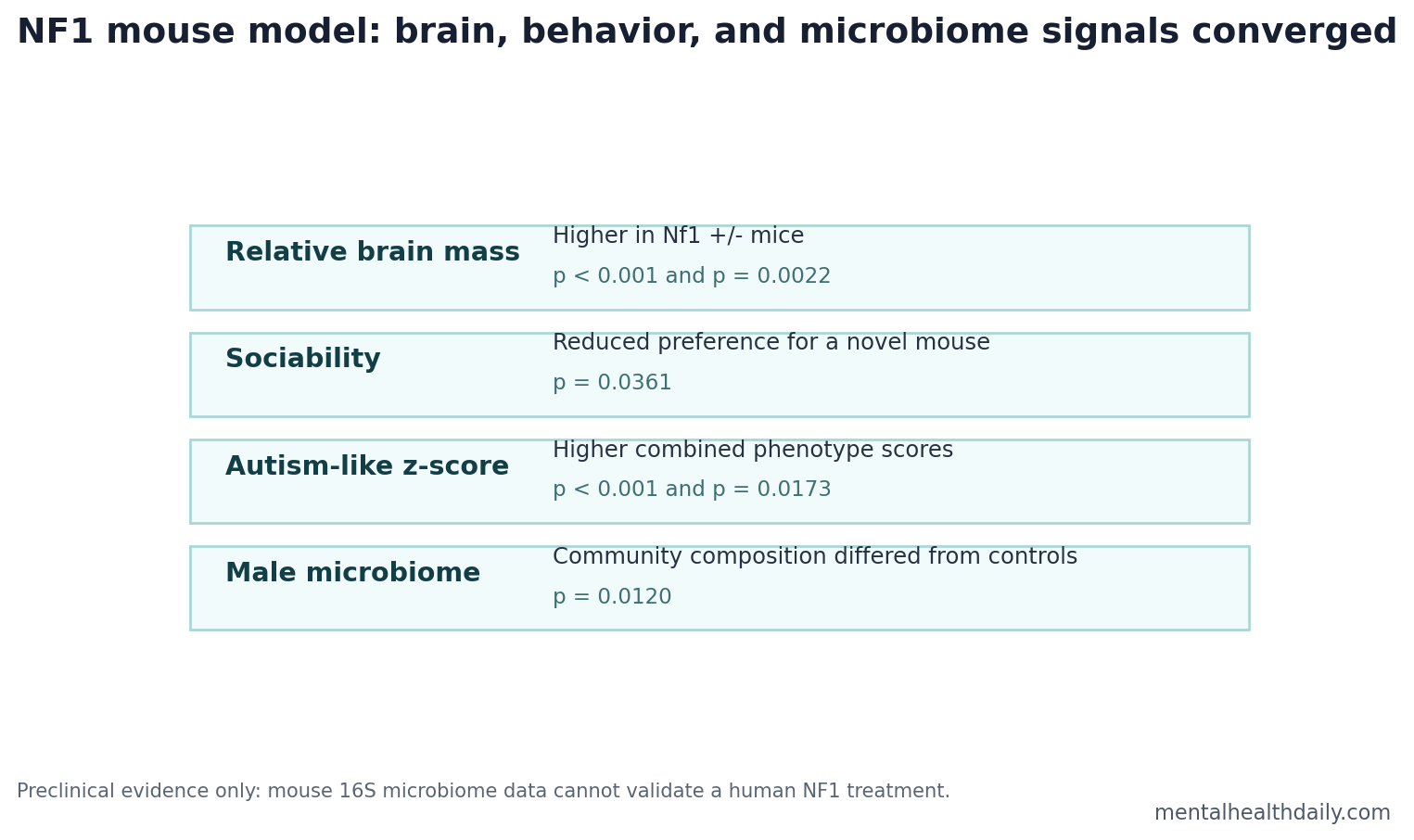
- Brain size was higher in Nf1 mice: Relative brain mass was increased in Nf1 +/- mice in cohort 1, p < 0.001, and cohort 2, p = 0.0022.1
- Sociability was reduced: Nf1 +/- mice showed lower sociability in the 3-chamber test, with a genotype effect of p = 0.0361 and a trend for sex moderation, p = 0.0651.1
- Combined behavioral scores exposed subtler deficits: The integrated cognitive z-score was lower in Nf1 +/- mice, p = 0.0207, while autism-like z-scores were higher in 2 cohorts, p < 0.001 and p = 0.0173.1
- Microbiome composition shifted by sex: Male Nf1 +/- mice differed from male controls in beta diversity, p = 0.0120, with differential species including Clostridium and Blautia taxa.1
- Mechanism is still unproven: The microbiome-brain signature correlated with genotype and brain size in males; it did not establish that gut bacteria cause NF1 neurobehavioral symptoms.
Neurofibromatosis type 1 (NF1) is a genetic condition caused by changes in the NF1 gene, which encodes neurofibromin, a protein that helps regulate Ras-MAPK and related growth-signaling pathways. NF1 is widely known for tumors and skin findings, but cognitive, attention, learning, autism-related, anxiety, and mood symptoms are also common.2
Nf1 +/- mice carry one disrupted copy of the Nf1 gene. They model aspects of human NF1 without reproducing the whole human condition. Reisinger et al. used this model to test behavior, brain anatomy, gut function, inflammation markers, and gut microbiota composition.1
Reduced Sociability Appeared Without Broad Anxiety or Motor Deficits
Standard single tests did not show large deficits in Y-maze short-term spatial memory, novel-object recognition, prepulse inhibition, fear conditioning, fear extinction, or rotarod motor performance. That matters because the social result cannot be dismissed as a simple motor or global learning artifact.1
- Sociability: Nf1 +/- mice spent relatively less time with a novel mouse than wild-type controls, p = 0.0361.
- Social recognition: recognition of a novel vs. familiar mouse was not significantly different.
- Anxiety/depression-like tests: large open field, light-dark box, elevated plus maze, saccharin preference, and Porsolt swim did not show a broad emotional-behavior phenotype.
Relative Brain Mass Was Consistently Higher
Body-weight-corrected brain weight was higher in Nf1 +/- mice in both main cohorts. Cohort 1 showed a genotype effect at p < 0.001; cohort 2 showed p = 0.0022. Region-specific measures in cohort 1 also showed higher relative hippocampal weight, p = 0.0008, and striatal weight, p = 0.0108, while prefrontal cortex relative weight was altered specifically in females.1
Autism-like endophenotype means a measurable trait that resembles part of a disorder-linked profile without claiming the animal has the human diagnosis. The combined autism-like z-score included behavior and brain-weight measures; it was higher in Nf1 +/- mice in cohort 1, p < 0.001, and cohort 2, p = 0.0173.1
Gut Microbiome Differences Were Stronger in Male Nf1 Mice
16S rRNA sequencing profiles bacterial communities by sequencing a conserved microbial gene. It can show which bacterial groups are more or less abundant, but it does not directly measure microbial metabolites or all functional genes.
Nf1 +/- mice showed higher alpha diversity by Simpson and Shannon indices, with genotype effects of p = 0.0309 and p = 0.0191. Beta diversity, which asks whether overall community composition differs between groups, showed a genotype-by-sex interaction, p = 0.0240; the male +/+ vs. Nf1 +/- comparison was significant, p = 0.0120, while females did not show the same beta-diversity separation.1
Male Nf1 +/- mice showed differential abundance of species from or related to Clostridium, Blautia, and Lachnospiraceae. Those names matter because some autism microbiome studies have also implicated Clostridium and Lachnospiraceae family taxa, although directions and species-level findings vary across studies.4,5
The Gut-Brain Signature Was Correlational
Reisinger et al. used DIABLO, a multiblock statistical integration method, to combine microbiome species, body weight, brain weight, gut transit time, and stool score. In males, a signature containing 7 microbial species plus brain weight and stool score separated genotype groups and linked several bacterial species with brain weight.1
Evidence-strength note: this is exploratory omics work in mice. It can generate a mechanism hypothesis: neurofibromin deficiency may change microbiota and brain development in related ways. It cannot decide whether microbiome changes cause altered brain size, follow altered physiology, or both.
Autism Microbiome Models Make This NF1 Signal Plausible
Microbiome work in neurodevelopment has moved from association to partial causality tests in animals. Hsiao et al. showed that microbiota manipulation could alter behavioral and physiological abnormalities in a mouse model.4 Sharon et al. later reported that gut microbiota from autistic human donors could promote behavioral alterations in mice.5
NF1 is not idiopathic autism, and an Nf1 mouse is not a child with NF1. The relevance is narrower: a single-gene neurodevelopmental condition with autism-like traits now has a plausible gut-microbiome research lane that can be tested directly in humans.
What This NF1 Study Can and Cannot Support
Supported: Nf1 +/- mice showed higher relative brain mass, subtle combined cognitive and autism-like phenotype shifts, lower sociability, and sex-dependent gut microbiome differences.
Not supported: probiotic treatment for NF1, microbiome testing for autism risk, or a claim that human NF1 patients have the same bacterial pattern. Human stool, metagenomic, metabolomic, diet, medication, and symptom studies are still needed.
Best next test: collect microbiome and metabolite data from people with NF1 alongside brain imaging and standardized cognition, ADHD, and autism-trait measures, then test whether microbial signals predict symptom clusters beyond age, sex, diet, and medication.
Why Brain Weight, Stool Score, and Microbes Were Modeled Together
The DIABLO analysis is easy to overread because it sounds like a black-box biomarker. In this study, its job was narrower: integrate several host and microbial layers to see whether the same animals carried a coordinated genotype-linked signature. The male signature included 7 microbial species, brain weight, and stool score, which means the result tied gut composition to host physiology rather than listing bacterial hits in isolation.1
Brain weight is a model phenotype: higher relative brain mass in Nf1 +/- mice may reflect altered development, growth signaling, glial biology, neuronal structure, or several of those processes at once. The result belongs in a preclinical mechanism model rather than a direct claim about human autism, macrocephaly, or clinical severity.
Stool score keeps the gut signal grounded: microbiome differences can reflect diet, transit time, inflammation, cage effects, or host genotype. Including stool and gut-function measures makes the gut-brain model more plausible than a bacteria-only association, but it still cannot decide causal direction.
Sex separation is not a side note: the clearest beta-diversity difference appeared in males, and female integrated analysis was limited. A future NF1 microbiome study that pools sexes too aggressively could miss the very pattern this mouse work highlights.
Human follow-up also needs stronger exposure control than a simple case-control stool study. Diet, antibiotics, gastrointestinal symptoms, stimulant use, selective serotonin reuptake inhibitors, antipsychotics, sleep, and activity can all shift microbiome composition. NF1 cohorts would need to measure those factors alongside genotype, cognition, autism traits, attention symptoms, anxiety, and brain imaging before a microbial pattern could be interpreted as disease-linked rather than lifestyle-linked.
The mouse finding is still useful because it names testable variables. If male-skewed microbial signatures, brain-size measures, stool traits, and social behavior move together in Nf1 mice, human studies can ask whether people with NF1 show similar clusters or whether the animal signal is model-specific. Either answer would improve the field more than a broad claim that the microbiome is “involved.”
Intervention studies would need to come after that mapping step. Changing the microbiome before proving which microbial or metabolic signal matters would risk treating a correlated marker as the cause. The cleaner path is sequence first: replicate the human association, identify metabolites or pathways, then test targeted manipulation in animals and carefully selected patients.
The NF1 angle is narrower than general autism microbiome work: NF1 has a defined genetic driver, so gut-brain findings can be tested against a known Ras-MAPK-linked developmental condition. That makes the model cleaner than idiopathic autism cohorts, where many genetic and environmental routes are mixed together.
Parallel pathways remain possible: neurofibromin deficiency could alter brain development, feeding behavior, gut motility, immune signaling, or microbial ecology at the same time.
The next useful experiments are the ones that separate those possibilities rather than treating all gut-brain correlations as one pathway.
Questions About NF1 and the Gut Microbiome
Does this mean NF1 is a gut disorder?
No. NF1 is a genetic multisystem condition. The study suggests the gut microbiome may be one modifiable layer interacting with brain and behavior phenotypes.
Why was the male microbiome result emphasized?
The clearest beta-diversity and integrated host-microbial signature appeared in males. Female data were still important, but some integrated analyses were limited by sample size.
Should people with NF1 take probiotics?
This study does not support that. It supports human observational work and carefully controlled preclinical intervention studies before any treatment claim.
References
- Reisinger SN, Kong G, van de Garde N, et al. Gut microbiome alterations are sex-dependently associated with brain abnormalities in a mouse model of Neurofibromatosis type I. Molecular Psychiatry. 2026. doi:10.1038/s41380-026-03609-0
- Neurofibromatosis type 1 cognitive and behavioral symptom literature. PubMed
- Clinical NF1 and autism prevalence literature. PubMed
- Hsiao EY, McBride SW, Hsien S, et al. Microbiota modulate behavioral and physiological abnormalities associated with neurodevelopmental disorders. Cell. 2013. doi:10.1016/j.cell.2013.11.024
- Sharon G, Cruz NJ, Kang DW, et al. Human gut microbiota from autism spectrum disorder promote behavioral symptoms in mice. Cell. 2019. doi:10.1016/j.cell.2019.05.004
Leave a Reply