
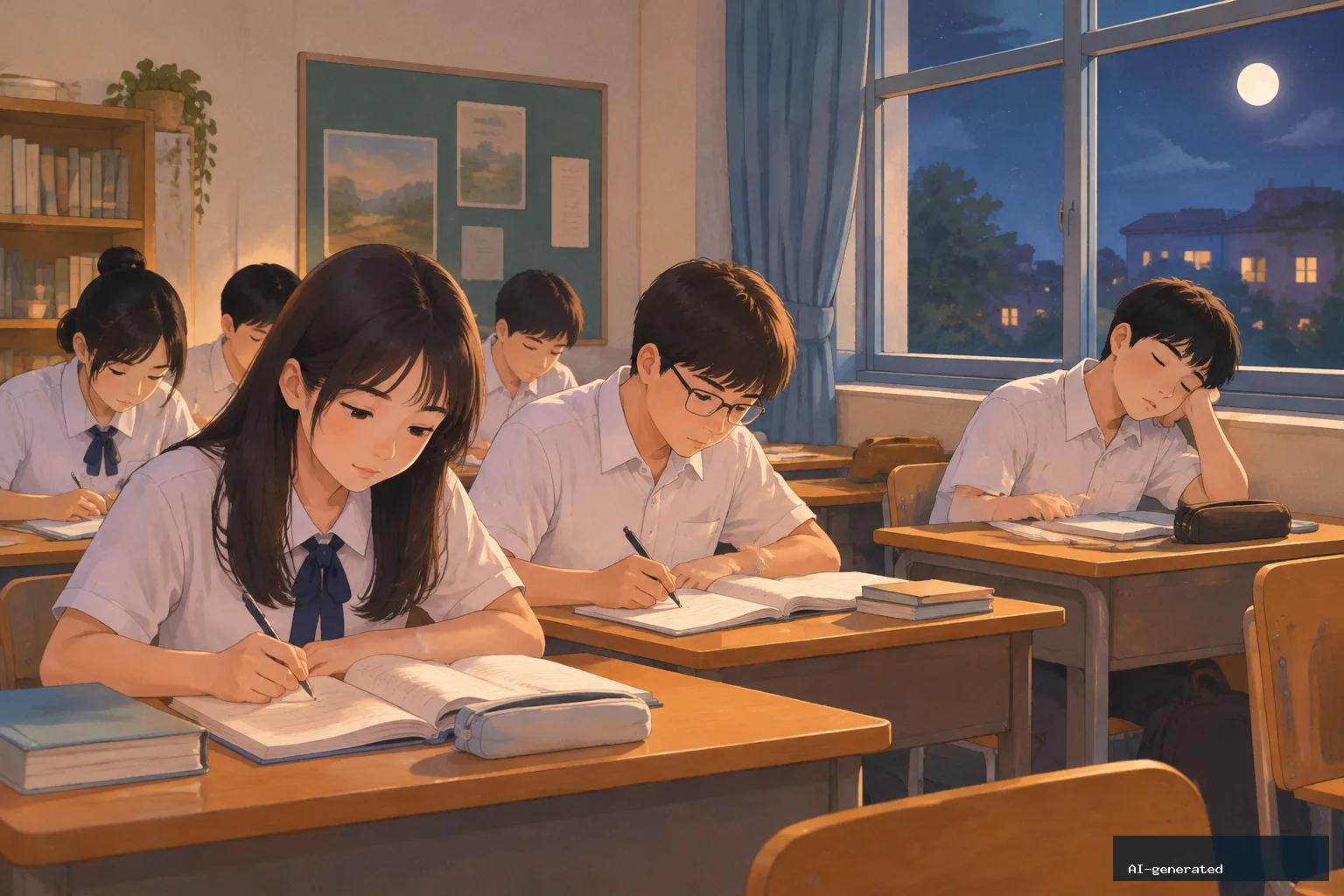
A survey of 541 Vietnamese high-school students found that poorer reported sleep was associated with slightly lower self-reported grades. The relationship was statistically significant but small, and it disappeared after fatigue and motivation were included in the analysis.
The findings show a link rather than a cause-and-effect relationship. Because sleep and grades were measured at the same time, the study cannot establish whether poor sleep affected school performance, whether academic pressures affected sleep, or whether other factors contributed to both.
What the survey found
The students were in Grades 10 and 11 and attended four schools: two in urban Hanoi and two in rural Hung Yen province. Of 750 students approached, 639 participated with parental consent, and 541 provided complete answers for the analysis. Grade 12 students were excluded because of the demands of college entrance exams.
The first overall sleep-and-grades pattern had a canonical correlation of r = 0.20, with a permutation p-value of 0.0108. In practical terms, the combined sleep and grade scores shared about 4% of their variation. A second pattern, with a correlation of 0.11, was not statistically significant.
The sleep-related pattern appeared in students’ self-reported GPA rather than in their four-point ratings of their own performance. GPA included overall results and grades in mathematics, literature and a foreign language.
Which sleep measures mattered most
Sleep was assessed with a Vietnamese version of the Pittsburgh Sleep Quality Index, which rates seven components from no problem to severe problem. These included sleep quality, time taken to fall asleep, sleep duration, sleep efficiency, sleep disturbances, sleep-medication use and daytime dysfunction.
Three measures carried the main link with grades:
- Sleep duration had a weight of 0.68.
- Sleep-medication use had a weight of 0.50.
- Daytime dysfunction had a weight of 0.47.
The study used 0.40 as the cutoff for a meaningful weight. On the grade side, self-reported GPA had a weight of −0.74, while the four-point performance ratings were below the cutoff.
Sleep difficulties were common in the sample. Sixty-eight percent of students usually took more than 15 minutes to fall asleep, 59% reported at least some daytime dysfunction and about half reported at least some shortfall in sleep duration. Eight percent reported using sleep medication.
The medication finding should not be read as evidence that medication lowered grades. The researchers suggested that medication use may instead indicate more severe sleep problems, and noted that the result needs confirmation in a larger group of users.
Fatigue and motivation changed the result
When fatigue and motivation were both added to the analysis, the correlation fell from 0.20 to 0.15 and was no longer statistically significant, with p = 0.167. Each factor on its own reduced the correlation somewhat but left it statistically significant.
This supports the possibility that tiredness and motivation may help explain part of the observed relationship. However, the study cannot confirm a sequence in which poor sleep leads to fatigue, reduced motivation and then lower grades. That pathway is plausible but untested by a one-time survey.
The pattern also differed by grade. Among Grade 10 students, daytime dysfunction was associated with lower GPA, while sleep duration was not. Among Grade 11 students, shorter sleep was associated with lower GPA, while daytime dysfunction was not. The reason for this difference has not been tested. Gender did not change the observed pattern.
Why the findings need careful interpretation
The survey adds to earlier research but does not settle the question. A 2010 meta-analysis found modest associations between school performance and sleepiness, sleep quality and sleep duration. A 2023 review of 25 longitudinal studies reported that poor sleep quality and sleep disturbances predicted later declines in school engagement and performance, while school stress, burnout and early start times also worsened sleep over time.
The Vietnamese study was limited to four schools in northern Vietnam and two grade levels. It did not measure school or classroom clustering, family income or other socioeconomic factors. It also relied on students’ reports of both sleep and grades rather than school records.
The sleep questionnaire measures sleep quality and insomnia symptoms; it does not diagnose insomnia disorder. Students who have persistent trouble falling or staying asleep, or daytime sleepiness that interferes with school, should raise those concerns with a doctor.
AI tools were used to assist with the preparation of this article.
Leave a Reply