
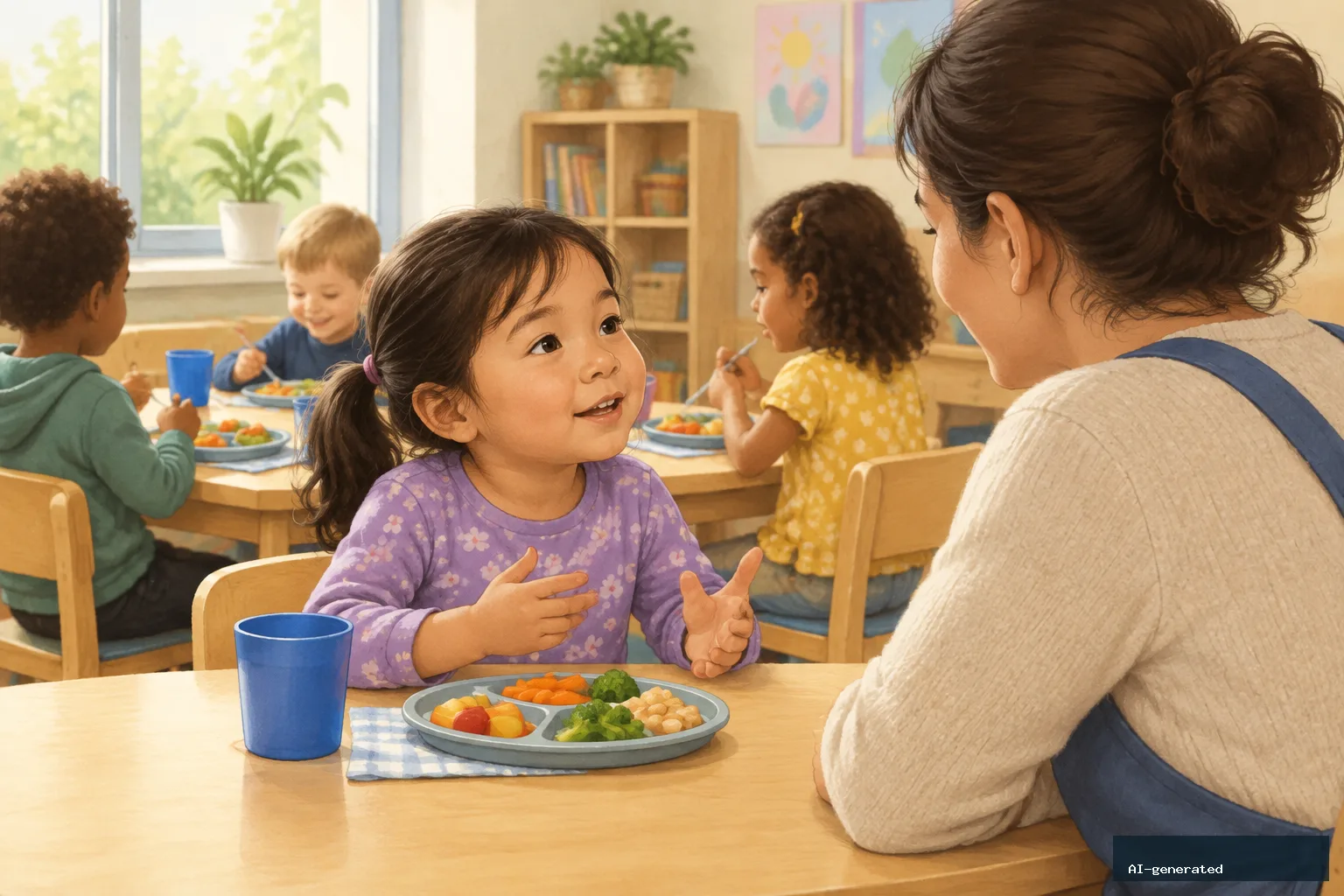
When young children say they are full, the adults around them usually appear to treat the comment as meaningful. That is the finding from a video study of ordinary lunches at four Swedish preschools.
The study examined 97 lunches and identified 77 statements in which children said they were full. In 41 lunches—42% of those recorded—at least one such statement was made. The researchers observed the exchanges rather than asking adults or children to recall what had happened later.
What the researchers observed
Forty-four children aged 2 to 6 said they were full at least once. The statements came from children aged 2 years 3 months to 6 years 2 months; none of the 1-year-olds made a statement about being full that an adult could make out.
Children initiated 45 of the 77 statements, or 58%. The other 32 followed something an adult or another child had said. The median statement came 25 minutes after children began serving themselves, with most occurring between 20 and 39 minutes into the meal.
The most common adult response was to repeat or check the child’s words—for example, asking, “Are you full?”—which happened in 30 cases. Researchers also recorded adults acknowledging fullness, moving the conversation to the next step, praising the statement, pointing to food or drink, or using rules about eating. Eight statements went unanswered because the child was difficult to hear, someone spoke over them, or the adult was occupied with another conversation.
Some adults pointed to food left on the plate or continued offering food. However, no adult claimed to know better than the child whether the child was full, and no adult described fullness as a bad thing.
A close look at responsive feeding
The exchanges fit with responsive feeding, a back-and-forth approach in which adults notice children’s hunger and fullness cues and respond warmly rather than overriding them. International and Swedish guidelines recommend this style of feeding.
The Swedish preschools in the study serve free hot lunches. Staff take part in “pedagogic meals,” sitting with children and often eating the same food. Sandra Nyberg-Akremi and colleagues at Linköping University filmed lunches between October 2021 and November 2022, visiting each preschool once a week during three recording periods lasting about five to seven weeks.
The recordings involved 92 children aged 1 to 6 and 22 adults, including preschool teachers, child carers and trainees. Researchers used three cameras and two microphones at each table and stayed out of the room during the meal.
What the study cannot show
The researchers counted what children said, not whether they were physically full or how much food they ate. Nonverbal signs—such as stopping eating or rubbing the stomach—were not included. The study also did not track later eating, weight or appetite regulation, so it cannot show whether the observed adult responses affect children’s health or eating over time.
The researchers interpreted the conversations as suggesting that children treated fullness as something adults needed to hear and respond to, rather than only as a private feeling. That is an interpretation of the recorded exchanges, not a direct measurement of children’s internal states.
The findings also come from only four Swedish preschools. Staff knew they were being filmed, and the study did not collect background information such as children’s diets or home languages. It did not test specific strategies, including whether serving smaller portions or allowing children to ask for more would change eating.
Why meal-to-meal variation matters
Earlier research cited alongside the study found that 15 children aged 2 to 5 ate substantially different amounts from one meal to another, while their total daily calorie intake remained fairly steady. After a larger meal, they tended to eat less; after a smaller one, they tended to eat more.
That earlier finding came from separate research and does not prove that the preschool responses observed in Sweden produce the same pattern. It does help explain why a single meal may not provide a reliable picture of a child’s overall intake.
For adults at the table, the study offers a practical point without settling every question: a child’s statement of fullness is worth hearing and responding to calmly. It should not be treated as proof of exactly how much the child has eaten, nor as evidence that one particular response guarantees a long-term outcome.
AI tools were used to assist with the preparation of this article.
Leave a Reply