
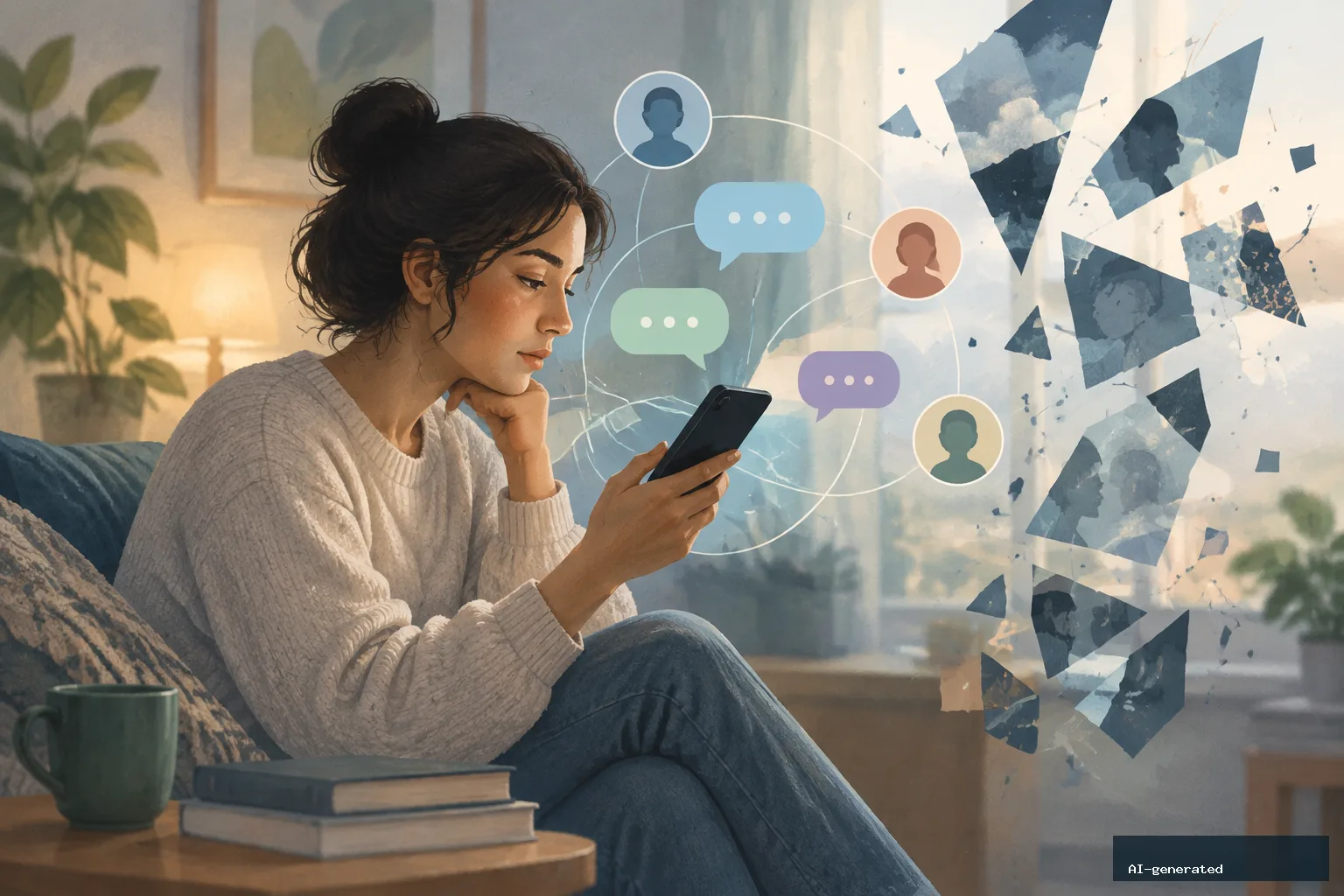
Social media is neither clearly a universal help nor a universal harm for people living with schizophrenia and other psychotic disorders. A systematic review of 14 studies found no consistent association between social media use and more severe positive symptoms, such as paranoia. It also found links between social media use, better psychosocial functioning and higher quality of life in some studies.
Those findings should be interpreted cautiously. Most of the research was cross-sectional, meaning it captured social media use and symptoms at one point in time. Such studies can identify associations, but they cannot show whether social media affects symptoms—or whether people who are already feeling better are more able or willing to use it.
What the review examined
Maddalena Cipriani and colleagues at Harvard Medical School examined whether social media helps, harms or has little meaningful effect on symptom severity among people with schizophrenia and other psychotic disorders.
The review included 14 studies published since 2010, with 1,957 participants in total. Nine studies were cross-sectional, three were longitudinal, one was qualitative and one used mixed methods. Eight studies recruited people from clinical settings, while six used online adverts or social media platforms. Diagnoses were either self-reported or clinically established, depending on the study.
Findings on symptoms and functioning
Five cross-sectional studies associated greater social media use with fewer negative symptoms and better psychosocial functioning. Social media use was also associated with higher quality of life in the included research.
Positive symptoms—particularly paranoia—were assessed in eight studies. The review reported that these studies consistently found no significant association between social media use and the severity of positive symptoms.
Two longitudinal studies reported small reductions in paranoia after social media use. One study reported an approximately 10% decrease in paranoia, while another found that passive browsing predicted reduced paranoia. However, one of the two studies found no association between overall social media use and paranoia, and the reported reductions were short-term.
Why the way people use platforms may matter
The review authors concluded that social media was not inherently harmful for people with psychosis. They suggested that how someone uses social media may matter more than the amount of time spent online.
The findings on mood and problematic use were less consistent. Some studies linked lower social media use with more depressive symptoms, while others associated higher use with more anxiety. Feeling closer to other people online was associated with lower depression.
By contrast, compulsive or unhealthy use was linked to poorer well-being. One study found that problematic use was associated with poorer quality of life, mainly through disrupted sleep and increased feelings of shame or self-stigma. Among young people at higher risk of developing psychosis, one study linked greater emotional distress with internet addiction.
One study also found that venting on social media predicted lower mood. These findings suggest that an online connection or activity cannot be understood simply by counting hours spent on a platform.
Important limits to the evidence
The review authors acknowledged that most of the evidence had moderate to high risk of bias and relied on cross-sectional designs. The review’s critique also noted that many quantitative studies used non-validated questionnaires, raising concerns about measurement accuracy.
Because symptoms may influence social media use—and social media use may influence symptoms—the direction of any relationship remains uncertain. A person experiencing fewer negative symptoms may be more socially active, have better functioning and therefore use social media more. That would create an association without proving that social media caused the improvement.
The critique further argued that a genuinely protective effect on paranoia would need to involve longer-term symptom improvement, rather than temporary changes in how someone feels or reports symptoms.
A wider picture of possible risks
The fact sheet also describes findings from another recent systematic review suggesting that social media can heighten feelings of surveillance and self-consciousness for some people. It may also intensify paranoia by weakening cues used in reality testing or by presenting content that aligns with existing delusional beliefs.
These concerns do not establish that social media has the same effect on everyone. They do, however, reinforce the need to distinguish between different platforms, activities and individual experiences rather than treating “social media use” as one uniform behavior.
What can reasonably be concluded
This evidence does not support the claim that social media routinely worsens psychotic symptoms. It also does not establish that social media improves those symptoms. The most defensible conclusion is that the relationship is mixed and uncertain, with possible benefits in connection and functioning alongside potential problems related to compulsive use, sleep, mood and distress.
Stronger longitudinal and experimental studies are needed to determine whether social media changes symptoms over time or mainly reflects changes in a person’s existing well-being. Until then, research findings are best understood as context—not as a diagnosis or a prediction about any one person’s experience.
AI tools were used to assist with the preparation of this article.
Leave a Reply