
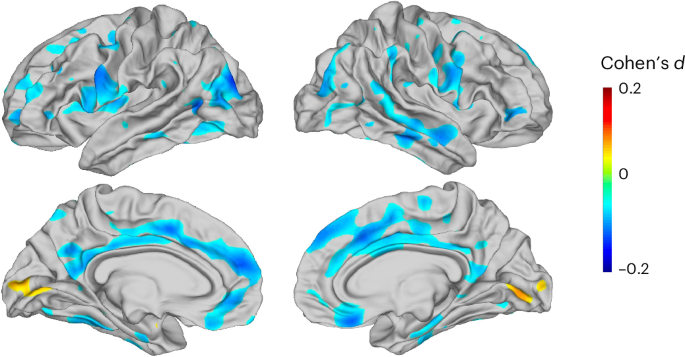
Vertex-wise cortical abnormalities in major depressive disorder from 64 cohorts from the DIRECT and ENIGMA MDD consortia – Nature Mental Health

vertex-wise-cortical-abnormalities-in-major-depressive-disorder-from-64-cohorts-from-the-direct-and-enigma-mdd-consortia-–-nature-mental-health

Data availability

The dataset required to interpret, replicate and extend the findings of this study consists of the derived meta-analytic statistical maps and summary data generated during the analyses for all participating sites. These data are available at https://doi.org/10.57760/sciencedb.29686. Individual-level participant data from the contributing cohorts cannot be publicly shared owing to local ethics and data-sharing restrictions across participating sites.

Code availability

Custom scripts used for data processing, statistical analysis and figure generation in this study are publicly available via GitHub at https://github.com/Chaogan-Yan/PaperScripts/tree/master/Yan_2026_NatureMentalHealth.

References

  1. Smith, K. Mental health: a world of depression. Nature 515, 180–181 (2014).

    Article  Google Scholar 

  2. Cuijpers, P. et al. Absolute and relative outcomes of psychotherapies for eight mental disorders: a systematic review and meta-analysis. World Psychiatry 23, 267–275 (2024).

    Article  PubMed  PubMed Central  Google Scholar 

  3. Trivedi, M. H. et al. Evaluation of outcomes with citalopram for depression using measurement-based care in STAR*D: implications for clinical practice. Am. J. Psychiatry 163, 28–40 (2006).

    Article  PubMed  Google Scholar 

  4. Wang, K. et al. Brain structural abnormalities in adult major depressive disorder revealed by voxel- and source-based morphometry: evidence from the REST-meta-MDD Consortium. Psychol. Med. 53, 3672–3682 (2023).

    Article  PubMed  Google Scholar 

  5. Matsumoto, J. et al. Cerebral cortical structural alteration patterns across four major psychiatric disorders in 5549 individuals. Mol. Psychiatry 28, 4915–4923 (2023).

    Article  PubMed  PubMed Central  Google Scholar 

  6. Kochunov, P. et al. Comparison of regional brain deficit patterns in common psychiatric and neurological disorders as revealed by big data. NeuroImage Clin. 29, 102574 (2021).

    Article  PubMed  PubMed Central  Google Scholar 

  7. Schmaal, L. et al. Cortical abnormalities in adults and adolescents with major depression based on brain scans from 20 cohorts worldwide in the ENIGMA Major Depressive Disorder Working Group. Mol. Psychiatry 22, 900–909 (2017).

    Article  PubMed  Google Scholar 

  8. Schmaal, L. et al. ENIGMA MDD: seven years of global neuroimaging studies of major depression through worldwide data sharing. Transl. Psychiatry 10, 172 (2020).

    Article  PubMed  PubMed Central  Google Scholar 

  9. Schmaal, L. et al. Subcortical brain alterations in major depressive disorder: findings from the ENIGMA Major Depressive Disorder Working Group. Mol. Psychiatry 21, 806–812 (2016).

    Article  PubMed  Google Scholar 

  10. Desikan, R. S. et al. An automated labeling system for subdividing the human cerebral cortex on MRI scans into gyral based regions of interest. NeuroImage 31, 968–980 (2006).

    Article  PubMed  Google Scholar 

  11. Ho, T. C. et al. Subcortical shape alterations in major depressive disorder: findings from the ENIGMA Major Depressive Disorder Working Group. Hum. Brain Mapp. 43, 341–351 (2022).

    Article  PubMed  Google Scholar 

  12. Chen, X. et al. Subgenual anterior cingulate cortex functional connectivity abnormalities in depression: insights from brain imaging big data and precision-guided personalized intervention via transcranial magnetic stimulation. Sci. Bull. https://doi.org/10.1016/j.scib.2025.05.042 (2025).

  13. de Kovel, C. G. F. et al. No alterations of brain structural asymmetry in major depressive disorder: an ENIGMA Consortium Analysis. Am. J. Psychiatry 176, 1039–1049 (2019).

    Article  PubMed  PubMed Central  Google Scholar 

  14. Suh, J. S. et al. Cortical thickness in major depressive disorder: a systematic review and meta-analysis. Prog. Neuropsychopharmacol. Biol. Psychiatry 88, 287–302 (2019).

    Article  PubMed  Google Scholar 

  15. Li, Q. et al. Meta-analysis of cortical thickness abnormalities in medication-free patients with major depressive disorder. Neuropsychopharmacology 45, 703–712 (2020).

    Article  PubMed  Google Scholar 

  16. Kaiser, R. H., Andrews-Hanna, J. R., Wager, T. D. & Pizzagalli, D. A. Large-scale network dysfunction in major depressive disorder: a meta-analysis of resting-state functional connectivity. JAMA Psychiatry 72, 603–611 (2015).

    Article  PubMed  PubMed Central  Google Scholar 

  17. Yan, C. G. et al. Reduced default mode network functional connectivity in patients with recurrent major depressive disorder. Proc. Natl Acad. Sci. USA 116, 9078–9083 (2019).

    Article  PubMed  PubMed Central  Google Scholar 

  18. Zhou, H. X. et al. Rumination and the default mode network: meta-analysis of brain imaging studies and implications for depression. NeuroImage 206, 116287 (2020).

    Article  PubMed  Google Scholar 

  19. Fox, M. D., Buckner, R. L., White, M. P., Greicius, M. D. & Pascual-Leone, A. Efficacy of transcranial magnetic stimulation targets for depression is related to intrinsic functional connectivity with the subgenual cingulate. Biol. Psychiatry 72, 595–603 (2012).

    Article  PubMed  PubMed Central  Google Scholar 

  20. Kanwisher, N. & Yovel, G. The fusiform face area: a cortical region specialized for the perception of faces. Phil. Trans. R. Soc. B 361, 2109–2128 (2006).

    Article  PubMed  PubMed Central  Google Scholar 

  21. Zhang, B. et al. Roles of the medial and lateral orbitofrontal cortex in major depression and its treatment. Mol. Psychiatry 29, 914–928 (2024).

    Article  PubMed  Google Scholar 

  22. Du, M. et al. Brain grey matter volume alterations in late-life depression. J. Psychiatry Neurosci. 39, 397–406 (2014).

    Article  PubMed  PubMed Central  Google Scholar 

  23. Ancelin, M. L. et al. Lifetime major depression and grey-matter volume. J. Psychiatry Neurosci. 44, 45–53 (2019).

    Article  PubMed  PubMed Central  Google Scholar 

  24. Patel, Y. et al. Virtual histology of cortical thickness and shared neurobiology in 6 psychiatric disorders. JAMA Psychiatry 78, 47–63 (2021).

    Article  PubMed  PubMed Central  Google Scholar 

  25. Grasby, K. L. et al. The genetic architecture of the human cerebral cortex. Science https://doi.org/10.1126/science.aay6690 (2020).

  26. Castrén, E. & Monteggia, L. M. Brain-derived neurotrophic factor signaling in depression and antidepressant action. Biol. Psychiatry 90, 128–136 (2021).

    Article  PubMed  Google Scholar 

  27. Frangou, S. et al. Cortical thickness across the lifespan: data from 17,075 healthy individuals aged 3–90 years. Hum. Brain Mapp. 43, 431–451 (2022).

    Article  PubMed  Google Scholar 

  28. Petersen, M. et al. Mapping the association of cerebral small vessel disease, gray matter integrity, and cognitive function. Neurology 105, e214215 (2025).

    Article  PubMed  PubMed Central  Google Scholar 

  29. Albert, P. R. Why is depression more prevalent in women? J. Psychiatry Neurosci. 40, 219–221 (2015).

    Article  PubMed  PubMed Central  Google Scholar 

  30. Mohammadi, S. et al. Brain-based sex differences in depression: a systematic review of neuroimaging studies. Brain Imaging Behav. 17, 541–569 (2023).

    Article  PubMed  PubMed Central  Google Scholar 

  31. Miller, K. L. et al. Multimodal population brain imaging in the UK Biobank prospective epidemiological study. Nat. Neurosci. 19, 1523–1536 (2016).

    Article  PubMed  PubMed Central  Google Scholar 

  32. Winter, N. R. et al. Quantifying deviations of brain structure and function in major depressive disorder across neuroimaging modalities. JAMA Psychiatry 79, 879–888 (2022).

    Article  PubMed  PubMed Central  Google Scholar 

  33. Marek, S. et al. Reproducible brain-wide association studies require thousands of individuals. Nature 603, 654–660 (2022).

    Article  PubMed  Google Scholar 

  34. Jha, S. C. et al. Environmental influences on infant cortical thickness and surface area. Cereb. Cortex 29, 1139–1149 (2019).

    Article  PubMed  PubMed Central  Google Scholar 

  35. Tozzi, L. et al. Interactive impact of childhood maltreatment, depression, and age on cortical brain structure: mega-analytic findings from a large multi-site cohort. Psychol. Med. 50, 1020–1031 (2020).

    Article  PubMed  Google Scholar 

  36. Fjell, A. M. et al. Continuity and discontinuity in human cortical development and change from embryonic stages to old age. Cereb. Cortex 29, 3879–3890 (2019).

    Article  PubMed  Google Scholar 

  37. Storsve, A. B. et al. Differential longitudinal changes in cortical thickness, surface area and volume across the adult life span: regions of accelerating and decelerating change. J. Neurosci. 34, 8488–8498 (2014).

    Article  PubMed  PubMed Central  Google Scholar 

  38. Ducharme, S. et al. Trajectories of cortical thickness maturation in normal brain development—the importance of quality control procedures. NeuroImage 125, 267–279 (2016).

    Article  PubMed  Google Scholar 

  39. Bethlehem, R. A. I. et al. Brain charts for the human lifespan. Nature 604, 525–533 (2022).

    Article  PubMed  PubMed Central  Google Scholar 

  40. Fu, J. et al. Cross-ancestry genome-wide association studies of brain imaging phenotypes. Nat. Genet. 56, 1110–1120 (2024).

    Article  PubMed  Google Scholar 

  41. Bigdeli, T. B. et al. Genetic effects influencing risk for major depressive disorder in China and Europe. Transl. Psychiatry 7, e1074 (2017).

    Article  PubMed  PubMed Central  Google Scholar 

  42. Howard, D. M. et al. Genome-wide meta-analysis of depression identifies 102 independent variants and highlights the importance of the prefrontal brain regions. Nat. Neurosci. 22, 343–352 (2019).

    Article  PubMed  PubMed Central  Google Scholar 

  43. Algermissen, J. & Mehler, D. M. A. May the power be with you: are there highly powered studies in neuroscience, and how can we get more of them. J. Neurophysiol. 119, 2114–2117 (2018).

    Article  PubMed  Google Scholar 

  44. Boedhoe, P. S. W. et al. An empirical comparison of meta- and mega-analysis with data from the ENIGMA Obsessive–Compulsive Disorder Working Group. Front. Neuroinform. 12, 102 (2018).

    Article  PubMed  Google Scholar 

  45. Dale, A. M., Fischl, B. & Sereno, M. I. Cortical surface-based analysis. I. Segmentation and surface reconstruction. NeuroImage 9, 179–194 (1999).

    Article  PubMed  Google Scholar 

  46. Yan, C.-G., Wang, X.-D. & Lu, B. DPABISurf: data processing and analysis for brain imaging on surface. Sci. Bull. 66, 2453–2455 (2021).

    Article  Google Scholar 

  47. Esteban, O. et al. fMRIPrep: a robust preprocessing pipeline for functional MRI. Nat. Methods 16, 111–116 (2019).

    Article  PubMed  Google Scholar 

  48. Tustison, N. J. et al. N4ITK: improved N3 bias correction. IEEE Trans. Med. Imaging 29, 1310–1320 (2010).

    Article  PubMed  PubMed Central  Google Scholar 

  49. Avants, B. B., Epstein, C. L., Grossman, M. & Gee, J. C. Symmetric diffeomorphic image registration with cross-correlation: evaluating automated labeling of elderly and neurodegenerative brain. Med. Image Anal. 12, 26–41 (2008).

    Article  PubMed  Google Scholar 

  50. Zhang, Y., Brady, M. & Smith, S. Segmentation of brain MR images through a hidden Markov random field model and the expectation-maximization algorithm. IEEE Trans. Med. Imaging 20, 45–57 (2001).

    Article  PubMed  Google Scholar 

  51. Klein, A. et al. Mindboggling morphometry of human brains. PLoS Comput. Biol. 13, e1005350 (2017).

    Article  PubMed  PubMed Central  Google Scholar 

  52. Benazzi, F. Classifying mood disorders by age-at-onset instead of polarity. Prog. Neuropsychopharmacol. Biol. Psychiatry 33, 86–93 (2009).

    Article  PubMed  Google Scholar 

  53. Benjamini, Y. & Hochberg, Y. Controlling the false discovery rate: a practical and powerful approach to multiple testing. J. R. Stat. Soc. B 57, 289–300 (1995).

    Article  Google Scholar 

Download references

Acknowledgments

We acknowledge the following: Brain Science and Brain-Like Intelligence Technology-National Science and Technology Major Project (grant nos. 2021ZD0200600 and 2021ZD0200601 to C.-G.Y.), National Natural Science Foundation of China (grant nos. 82572192 and 82122035 to C.-G.Y.), Beijing Nova Program of Science and Technology (grant no. 20230484465 to C.-G.Y.), Beijing Natural Science Foundation (grant no. J230040 to C.-G.Y.), National Health and Medical Research Council (NHMRC) (App 1161356 to B.C.-D.), German Research Foundation (grant no. STR 1146/18-1 to B.S.M.), DFG SFB/TRR 393 consortium (grant no. 521379614 to B.S.), LOEWE program of the Hessian Ministry of Science and Arts (grant no. LOEWE1/16/519/03/09.001(0009)/98 to B.S.), Intramural Research Program at the National Institute of Mental Health, National Institutes of Health (grant no. ZIAMH002857 to C.A.Z.), National Institute for Health Research Biomedical Research Centre for Mental Health at South London and Maudsley NHS Foundation Trust and King’s College London (C.H.Y.F.), National Institute of Mental Health (grant no. R01MH134236 to C.H.Y.F.), Milken Institute Baszucki Brain Research (grant no. BD00029 to C.H.Y.F.), Rosetrees Trust (grant no. CF20212104 to C.H.Y.F.), International Psychoanalytical Association (grant no. IPA158102845 to C.H.Y.F.), National Institute for Health Research Biomedical Research Centre for Mental Health at South London and Maudsley NHS Foundation Trust and King’s College London (D.D.), Research Wales (grant no. HS/14/20 to D.E.J.L.), Medical Research Council (grant no. G 1100629 to D.E.J.L.), Agence Nationale de la Recherche (ANR) (grant ANR SAMENTA 2012 to E.C.), Institut National de la Santé Et de la Recherche Médicale (grant no. C1325 to E.C.), German Research Foundation SFB/TRR 393 (grant no. 521379614 to E.J.L.), Federal Ministry of Education and Research (grant nos. 01ZZ9603, 01ZZ0103 and 01ZZ0403 to H.J.G.), Ministry of Cultural Affairs (H.J.G.), Social Ministry of the Federal State of Mecklenburg-West Pomerania (H.J.G.), NHMRC Investigator Grant (grant no. 2016346 to I.B.H.), National Institute of Mental Health (grant no. R37MH101495 to I.H.G.), National Institute of Mental Health (grant no. 1R01MH085667-01A1 to J.C.S.), John S. Dunn Foundation (J.C.S.), Pat Rutherford Chair in Psychiatry (J.C.S.), Intramural Research Program at the National Institute of Mental Health, National Institutes of Health (grant no. ZIAMH002857 to J.W.E.), German Federal Ministry for Education and Research (BMBF) (grant nos. FKZ-01ER0816 and FKZ-01ER1506 to K.B.), National Institute of Mental Health (grant no. K23MH090421 to K.R.C.), National Alliance for Research on Schizophrenia and Depression (K.R.C.), University of Minnesota Graduate School (K.R.C.), Minnesota Medical Foundation (K.R.C.), Biotechnology Research Center (grant no. P41 RR008079 to K.R.C.), Deborah E. Powell Center for Women’s Health Seed Grant (K.R.C.), National Institute of Mental Health (grant no. R01MH125850 to M.D.S.), Federal Ministry of Education and Research (grant nos. 01ZZ9603, 01ZZ0103 and 01ZZ0403 to R.B.), Ministry of Cultural Affairs (R.B.), Social Ministry of the Federal State of Mecklenburg-West Pomerania (R.B.), Siemens Healthineers (R.B.), Federal State of Mecklenburg-West Pomerania (R.B.), Agence Nationale de la Recherche (ANR) (grant ANR SAMENTA 2012 to R.C.), Institut National de la Santé Et de la Recherche Médicale (grant no. C1325 to R.C.), German Federal Ministry of Education and Research (BMBF) (grant no. 01 ZX 1507 to R.G.-M.), NIH (grant nos. R01MH123163, R01MH121246 and R01MH116147 to S.I.T.), NIH Big Data to Knowledge program (grant no. U54 EB020403 to P.M.T.), NHMRC (grant no. APP2025674 to S. Medland), NHMRC of Australia (grant no. 1125504 to S.W.), Brain and Behavior Research Foundation (S.W.), National Institutes of Health (grant no. K01MH117442 to T.C.H.), Klingenstein Third Generation Foundation (T.C.H.), Stanford Maternal Child and Health Institute (T.C.H.), Stanford Center for Cognitive and Neurobiological Imaging Center (T.C.H.), Ray and Dagmar Dolby Family Fund (T.C.H.), National Institutes of Health (grant nos. R01MH127176 and R21MH130817 to T.C.H.), German Federal Ministry of Education and Research (BMBF) (grant no. 01 ZX 1507 to T.E.-G.), German Research Foundation (DFG) (grant nos. FOR2107 KI588/14-1, KI588/14-2, KI588/20-1 and KI588/22-1 to T. Kircher), DFG SFB/TRR 393 consortium (grant no. 521379614 to T. Kircher), LOEWE program of the Hessian Ministry of Science and Arts (grant no. LOEWE1/16/519/03/09.001(0009)/98 to T. Kircher), National Center for Complementary and Integrative Health (grant nos. 1R61AT009864-01A1 and R33AT009864 to T.T.Y.), German Research Foundation (DFG) (grant nos. FOR2107 DA1151/5-1, DA1151/5-2, DA1151/9-1, DA1151/10-1 and DA1151/11-1 to U.D.), DFG SFB/TRR 393 consortium (project grant no. 521379614 to U.D.), Interdisciplinary Center for Clinical Research (IZKF) of the Medical Faculty of Münster (grant no. Dan3/016/26 to U.D.) Convergence|Healthy Start (Y.T.), National Institute of Mental Health (grant no. K23MH090421 to Z.B.), National Alliance for Research on Schizophrenia and Depression (Z.B.), University of Minnesota Graduate School (Z.B.), Minnesota Medical Foundation (Z.B.), Biotechnology Research Center (grant no. P41 RR008079 to Z.B.) and Deborah E. Powell Center for Women’s Health Seed Grant (Z.B.), National Natural Science Foundation of China (grant nos. 82572350 to T.-L.C.). We would like to acknowledge the late Professor Dan J. Stein for his longstanding leadership and collaboration within ENIGMA-MDD Working Group and for his invaluable contributions to psychiatry, neuroscience, and mental health research. His intellectual generosity, mentorship, and unwavering support shaped this work and the broader field in lasting ways. His scientific legacy and his kindness to colleagues continue to inspire us.

Author information

Author notes

  1. These authors contributed equally: Elena Pozzi, Lianne Schmaal.

Authors and Affiliations

  1. Department of Psychological and Cognitive Sciences, Tsinghua University, Beijing, China

    Chao-Gan Yan

  2. State Key Laboratory of Cognitive Science and Mental Health, Institute of Psychology, Chinese Academy of Sciences, Beijing, China

    Chao-Gan Yan, Zi-Han Wang, Si-Cheng Chen, Xiao Chen, Yan-Rong Chen, Qing-Lin Gao, Zheng-Jia-Yi Hu, Xue-Ying Li, Yi-Fan Liao, Hai-Long Liu, Bin Lu, Han-Lin Wang, Xin-Yu Wang & Chen-Nan Wu

  3. Research Center for Culture and Psychology, Tsinghua University, Beijing, China

    Chao-Gan Yan

  4. Department of Psychology, University of Chinese Academy of Sciences, Beijing, China

    Zi-Han Wang, Xiao Chen, Qing-Lin Gao, Xue-Ying Li, Yi-Fan Liao, Hai-Long Liu, Bin Lu & Chen-Nan Wu

  5. Department of Psychiatry, Amsterdam UMC, Vrije Universiteit Amsterdam, Amsterdam, the Netherlands

    Laura K. M. Han, Annemiek Dols, Brenda W. J. H. Penninx & Dick J. Veltman

  6. Amsterdam Neuroscience, Mood, Anxiety, Psychosis, Stress and Sleep Program, Amsterdam UMC, Vrije Universiteit Amsterdam, Amsterdam, the Netherlands

    Laura K. M. Han

  7. Amsterdam Public Health, Mental Health Program, Amsterdam UMC, Vrije Universiteit Amsterdam, Amsterdam, the Netherlands

    Laura K. M. Han

  8. Department of Psychiatry and Psychotherapy, University of Marburg, Marburg, Germany

    Nina Alexander, Hamidreza Jamalabadi, Tilo Kircher, Benjamin Straube & Florian Thomas-Odenthal

  9. Clinical Neuroscience Research Group, Department of Psychology, University of Oslo, Oslo, Norway

    Dag Alnæs, Nils Inge Landrø & Lars Tjelta Westlye

  10. Centre for Precision Psychiatry, Oslo University Hospital and Institute of Clinical Medicine, University of Oslo, Oslo, Norway

    Dag Alnæs & Lars Tjelta Westlye

  11. Department of Psychiatry and Behavioral Sciences, University of Minnesota Medical School, Minneapolis, MN, USA

    Zeynep Başgöze & Kathryn R. Cullen

  12. Masonic Institute of the Developing Brain, Minneapolis, MN, USA

    Zeynep Başgöze & Kathryn R. Cullen

  13. Department of Psychiatry, Leiden University Medical Center, Leiden, the Netherlands

    Stéphanie E. E. C. Bauduin, Nic J. A. van der Wee & Steven J. A. van der Werff

  14. Department of Radiology, University of Münster, Münster, Germany

    Jochen Bauer

  15. Psychiatry and Clinical Psychobiology, Division of Neuroscience, IRCCS Ospedale San Raffaele, Milano, Italy

    Francesco Benedetti & Sara Poletti

  16. University Vita-Salute San Raffaele, Milano, Italy

    Francesco Benedetti

  17. Institute of Epidemiology and Social Medicine, University of Münster, Münster, Germany

    Klaus Berger & Marco Hermesdorf

  18. Department of Psychiatry and Psychotherapy, Jena University Hospital, Jena, Germany

    Bianca Besteher, Meng Li & Martin Walter

  19. Institute for Translational Psychiatry, University of Münster, Münster, Germany

    Tiana Borgers, Udo Dannlowski, Kira Flinkenflügel, Dominik Grotegerd, Tim Hahn, Anna Kraus, Elisabeth J. Leehr, Susanne Meinert, Hendrik Schlieper & Nils R. Winter

  20. Institute of Diagnostic Radiology and Neuroradiology, University Medicine Greifswald, Greifswald, Germany

    Robin Bülow

  21. Affiliated Brain Hospital of Guangzhou Medical University, Guangzhou, China

    Li-Ping Cao & Jian-Shan Chen

  22. The First Affiliated Hospital of Jinan University, Guangzhou, China

    Guan-Mao Chen & Ying Wang

  23. Magnetic Resonance Imaging Research Center, Institute of Psychology, Chinese Academy of Sciences, Beijing, China

    Si-Cheng Chen, Yan-Rong Chen & Xin-Yu Wang

  24. Department of Radiology, The First Affiliated Hospital, College of Medicine, Zhejiang University, Hangzhou, China

    Tao Chen & Hong Yang

  25. Department of Radiology, Huaxi MR Research Center (HMRRC), Institute of Radiology and Medical Imaging, Psychoradiology Key Laboratory of Sichuan Province, West China Hospital of Sichuan University, Chengdu, China

    Tao-Lin Chen & Qi-Yong Gong

  26. Xiamen Key Lab of Psychoradiology and Neuromodulation, Department of Radiology, West China Xiamen Hospital of Sichuan University, Xiamen, China

    Tao-Lin Chen & Qi-Yong Gong

  27. Affiliated Mental Health Center and Hangzhou Seventh People’s Hospital, Zhejiang University School of Medicine, Hangzhou, People’s Republic of China

    Yu-Qi Cheng & Xiu-Feng Xu

  28. Department of Psychiatry, First Affiliated Hospital of Kunming Medical University, Kunming, China

    Zhao-Song Chu

  29. MOODS Team, INSERM 1018, CESP, Faculté de Médecine Paris-Saclay, University of Paris-Saclay, Paris, France

    Romain Colle & Emmanuelle Corruble

  30. Service Hospitalo-Universitaire de Psychiatrie de Bicêtre, Groupe Hospitalier Paris-Saclay, Assistance Publique-Hôpitaux de Paris, Hôpital de Bicêtre, Le Kremlin Bicêtre, France

    Romain Colle & Emmanuelle Corruble

  31. Department of Biomedical Sciences, Florida State University, Tallahassee, FL, USA

    Colm G. Connolly

  32. Sorbonne University, Paris Brain Institute (ICM), CNRS, Inria, Inserm, AP-HP, Hôpital de la Pitié Salpêtrière, Paris, France

    Baptiste Couvy-Duchesne

  33. Institute for Molecular Bioscience, University of Queensland, St Lucia, Queensland, Australia

    Baptiste Couvy-Duchesne

  34. Brain & Mental Health Program, QIMR Berghofer Medical Research Institute, Brisbane, Queensland, Australia

    Baptiste Couvy-Duchesne

  35. School of Biomedical Sciences, Faculty of Health, Queensland University of Technology, Brisbane, Queensland, Australia

    Baptiste Couvy-Duchesne

  36. Department of Psychiatry, and National Clinical Research Center for Mental Disorders, The Second Xiangya Hospital of Central South University, Changsha, China

    Xi-Long Cui, Wen-Bin Guo, Xin-Lei Ji, Zhe-Ning Liu, Yi-Cheng Long, Xiao-Xiao Shan, Xiang Wang, Guang-Rong Xie & Jing-Ping Zhao

  37. Department of Psychiatry, Medical School and University Medical Center OWL, Protestant Hospital of the Bethel Foundation, Bielefeld University, Bielefeld, Germany

    Udo Dannlowski

  38. German Center for Mental Health (DZPG), Site Jena–Magdeburg–Halle, Jena–Magdeburg–Halle, Germany

    Udo Dannlowski

  39. Center for Intervention and Research on Adaptive and Maladaptive Brain Circuits Underlying Mental Health (C-I-R-C), Site Jena–Magdeburg–Halle, Jena–Magdeburg–Halle, Germany

    Udo Dannlowski

  40. Department of Psychiatry, University of Melbourne, Melbourne, Victoria, Australia

    Christopher Davey, Ben Harrison & Alec Jamieson

  41. Centre of Clinical, Social and Cognitive Neuroscience, Department of Psychology and Neuroscience, City St George’s, University of London, London, UK

    Danai Dima

  42. Department of Neuroimaging, Institute of Psychiatry, Psychology and Neuroscience, King’s College London, London, UK

    Danai Dima

  43. Department of Psychiatry, Division Brain, UMC Utrecht, Utrecht, the Netherlands

    Annemiek Dols

  44. Laboratory of Systems Neuroscience and Imaging in Psychiatry (SNIP-Lab), Department of Psychiatry and Psychotherapy, University Medical Center Göttingen (UMG), Göttingen, Germany

    Tracy Erwin-Grabner & Roberto Goya-Maldonado

  45. Experimental Therapeutics and Pathophysiology Branch, National Institute of Mental Health, NIH, Bethesda, MD, USA

    Jennifer W. Evans & Carlos A. Zarate

  46. Centre for Affective Disorders, School of Academic Psychiatry, Institute of Psychiatry, Psychology and Neuroscience, King’s College London, London, UK

    Cynthia H. Y. Fu

  47. Department of Psychology, University of East London, London, UK

    Cynthia H. Y. Fu

  48. FIDMAG Germanes Hospitalaries Research Foundation, Barcelona, Spain

    Paola Fuentes-Claramonte, Edith Pomarol-Clotet, Elena Rodriguez-Cano & Raymond Salvador

  49. Centro de Investigación Biomédica en Red de Salud Mental, Instituto de Salud Carlos III, Madrid, Spain

    Paola Fuentes-Claramonte, Edith Pomarol-Clotet, Maria J. Portella, Elena Rodriguez-Cano & Raymond Salvador

  50. Ege University School of Medicine SoCAT Lab Izmir, Izmir, Turkey

    Ali Saffet Gönül & Aslihan Uyar

  51. Department of Psychology, Stanford University, Stanford, CA, USA

    Ian H. Gotlib

  52. Laboratory of Translational Psychiatry, Department of Psychiatry and Psychotherapy, Jena University Hospital (UKJ), Jena, Germany

    Roberto Goya-Maldonado

  53. German Center for Mental Health (DZPG), partner site Jena, Jena, Germany

    Roberto Goya-Maldonado

  54. Department of Psychiatry and Psychotherapy, University Medicine Greifswald, Greifswald, Germany

    Hans J. Grabe & Katharina Wittfeld

  55. Department of Psychiatry and Mental Health, Neuroscience Institute, University of Cape Town, Cape Town, South Africa

    Nynke Groenewold & Sheri-Michelle Koopowitz

  56. Department of Psychology, Neuroscience and Behaviour, McMaster University, Hamilton, Ontario, Canada

    Geoffrey B. Hall

  57. Department of Clinical and Biological Psychology, University of Bergen, Bergen, Norway

    J. Paul Hamilton

  58. Brain and Mind Centre, University of Sydney, Sydney, New South Wales, Australia

    Sean Hatton & Ian B. Hickie

  59. Department of Neurology, Affiliated ZhongDa Hospital of Southeast University, Nanjing, China

    Can-Can He & Chun-Ming Xie

  60. Department of Psychology, University of California, Los Angeles, CA, USA

    Tiffany C. Ho

  61. Department of Psychiatry and Behavioral Science, University of California, San Francisco, CA, USA

    Tiffany C. Ho

  62. Sino-Danish College, University of Chinese Academy of Sciences, Beijing, China

    Zheng-Jia-Yi Hu, Han-Lin Wang & Wen-Yi Zhong

  63. Department of Psychiatry, The First Affiliated Hospital of Chongqing Medical University, Chongqing, China

    Qian Huang & Li Kuang

  64. Imaging Genetics Center, Mark and Mary Stevens Neuroimaging and Informatics Institute, Keck School of Medicine of USC, University of Southern California, Marina del Rey, CA, USA

    Neda Jahanshad, Sophia I. Thomopoulos & Paul M. Thompson

  65. Department of Clinical Psychology, Suzhou Psychiatric Hospital, The Affiliated Guangji Hospital of Soochow University, Suzhou, China

    Feng-Nan Jia & Yan-Song Liu

  66. Department of Psychiatry and Neurosciences, Graduate School of Biomedical and Health Sciences, Hiroshima University, Hiroshima, Japan

    Toshiharu Kamishikiryo, Go Okada & Hotaka Shinzato

  67. Department of Psychiatry and Psychotherapy, University Hospital, Bonn, Germany

    Axel Krug

  68. Thompson Brain and Mind Healthcare, Maroochydore, Queensland, Australia

    Jim Lagopoulos

  69. Cardiff University Brain Research Imaging Centre, School of Psychology, Cardiff, UK

    Thomas Lancaster, David E. J. Linden & David M. A. Mehler

  70. MRC Centre for Neuropsychiatric Genetics and Genomics, School of Medicine, Cardiff University, Cardiff, UK

    Thomas Lancaster, David E. J. Linden & David M. A. Mehler

  71. Department of Psychology, University of Bath, Bath, UK

    Thomas Lancaster

  72. Xijing Hospital of Air Force Military Medical University, Xi’an, China

    Bao-Juan Li & Hua-Ning Wang

  73. Beijing Anding Hospital, Capital Medical University, Beijing, China

    Feng Li & Chuan-Yue Wang

  74. The Third Affiliated Hospital of Zhengzhou University, Zhengzhou, China

    Hui-Xian Li

  75. Affiliated Mental Health Center and Hangzhou Seventh People’s Hospital, Zhejiang University School of Medicine, Hangzhou, China

    Tao Li & Hua Yu

  76. Mental Health Center and Psychiatric Laboratory, West China Hospital of Sichuan University, Chengdu, China

    Tao Li & Hua Yu

  77. Beijing Key Laboratory of Learning and Cognition, School of Psychology, Capital Normal University, Beijing, China

    Ze-Di Lin

  78. Department of Psychiatry and Neuropsychology, Mental Health and Neuroscience Institute, Maastricht University, Maastricht, the Netherlands

    David E. J. Linden

  79. Department of Psychosomatics and Psychiatry, Zhongda Hospital, School of Medicine, Southeast University, Nanjing, China

    Xiao-Yun Liu & Yong-Gui Yuan

  80. Shenzhen Kangning Hospital, Shenzhen, China

    Jian-Ping Lu & Zhen-Peng Xue

  81. University of Calgary, Calgary, Alberta, Canada

    Frank P. MacMaster

  82. Department of Psychiatry, Dalhousie University, Halifax, Nova Scotia, Canada

    Frank P. MacMaster

  83. IWK Health, Halifax, Nova Scotia, Canada

    Frank P. MacMaster

  84. Data Management, IT Department, University of Oslo, Oslo, Norway

    Luigi A. Maglanoc

  85. Division of Psychiatry, Centre for Clinical Brain Science, University of Edinburgh, Edinburgh, UK

    Andrew M. McIntosh & Heather C. Whalley

  86. Psychiatric Genetics, QIMR Berghofer, Brisbane, Queensland, Australia

    Sarah Medland

  87. Department of Psychiatry, Psychotherapy and Psychosomatics, Medical School, Uniklinik RWTH Aachen, Aachen, Germany

    David M. A. Mehler

  88. Institute for Translational Neuroscience, University of Münster, Münster, Germany

    Susanne Meinert

  89. Center of Excellence on Mood Disorders, Louis A. Faillace, MD, Department of Psychiatry and Behavioral Sciences, The University of Texas Health Science Center at Houston, Houston, TX, USA

    Benson Mwangi, Jair C. Soares, Mon-Ju Wu & Giovana B. Zunta-Soares

  90. Center for Neuroscience, University of Pittsburgh, Pittsburgh, PA, USA

    Amar Ojha

  91. Center for the Neural Basis of Cognition, University of Pittsburgh, Pittsburgh, PA, USA

    Amar Ojha

  92. Department of Psychiatry, Boelelaan 1117, Amsterdam UMC, Vrije Universiteit Amsterdam, Amsterdam, the Netherlands

    Mardien L. Oudega & Margot Wagenmakers

  93. GGZ inGeest Mental Health Care, De Nieuwe Valerius, Amsterdam, the Netherlands

    Mardien L. Oudega & Margot Wagenmakers

  94. Sant Pau Mental Health Research Group, Institut de Recerca Sant Pau, Barcelona, Spain

    Maria J. Portella

  95. Department of Psychiatry and Forensic Medicine, Universitat Autònoma de Barcelona, Bellaterra, Spain

    Maria J. Portella

  96. Faculty of Psychology, Southwest University, Chongqing, China

    Jiang Qiu & Xin-Ran Wu

  97. Amsterdam UMC, Department of Radiology and Nuclear Medicine, University of Amsterdam, Amsterdam, the Netherlands

    Liesbeth Reneman & Anouk Schrantee

  98. Department of Psychology, University of Oslo, Oslo, Norway

    Henning S. Rise

  99. Consorci Sanitari del Maresme, Mataró, Spain

    Elena Rodriguez-Cano

  100. Meditation Research Program, Department of Psychiatry, Massachusetts General Hospital, Harvard Medical School, Boston, MA, USA

    Matthew D. Sacchet

  101. Department of Neuropsychiatry, Graduate School of Medicine, University of the Ryukyus, Okinawa, Japan

    Hotaka Shinzato

  102. National Clinical Research Center for Mental Disorders (Peking University Sixth Hospital) and Key Laboratory of Mental Health, Ministry of Health (Peking University), Beijing, China

    Tian-Mei Si & Yan-Kun Wu

  103. West Region, Institute of Mental Health, Singapore, Singapore

    Kang Sim

  104. Yong Loo Lin School of Medicine, National University of Singapore, Singapore, Singapore

    Kang Sim

  105. Lee Kong Chian School of Medicine, Nanyang Technological University, Singapore, Singapore

    Kang Sim

  106. SAMRC Unit on Risk and Resilience in Mental Disorders, Department of Psychiatry and Mental Health, University of Cape Town, Cape Town, South Africa

    Dan J. Stein

  107. Brain and Mental Health, QIMR Berghofer, Brisbane, Queensland, Australia

    Lachlan T. Strike

  108. Xi’an Central Hospital, Xi’an, China

    Peng-Feng Sun & Xiao-Ping Wu

  109. Erasmus School of Social and Behavioral Sciences, Erasmus University, Rotterdam, the Netherlands

    Yara Toenders

  110. Department of Developmental Psychology, Psychology Research Institute, University of Amsterdam, Amsterdam, the Netherlands

    Ilya M. Veer

  111. Department of Psychiatry and Psychotherapy, Charité–Universitätsmedizin Berlin (corporate member of FU Berlin and Humboldt Universität zu Berlin), Berlin, Germany

    Ilya M. Veer & Henrik Walter

  112. Institute for Community Medicine, University Medicine Greifswald, Greifswald, Germany

    Henry Völzke

  113. German Center for Mental Health (DZPG), German Center for Mental Health (partner site Halle–Jena), Magdeburg, Germany

    Martin Walter

  114. Department of Psychiatry, Yale School of Medicine, New Haven, CT, USA

    Yu-Wei Wang

  115. KG Jebsen Centre for Neurodevelopmental Disorders, University of Oslo, Oslo, Norway

    Lars Tjelta Westlye

  116. School of Psychology, Deakin University, Burwood, Victoria, Australia

    Sarah Whittle

  117. Institute of Neuroscience, Chongqing Medical University, Chongqing, China

    Peng Xie

  118. Department of Psychiatry and Behavioral Sciences, Division of Child and Adolescent Psychiatry, Weill Institute for Neurosciences, University of California, San Francisco (UCSF), San Francisco, CA, USA

    Tony T. Yang

  119. Chongqing Key Laboratory of Neurobiology, Chongqing, China

    Jian Yang

  120. Department of Radiology, The First Affiliated Hospital of Anhui Medical University, Hefei, China

    Yong-Qiang Yu & Jia-Jia Zhu

  121. Research Center of Clinical Medical Imaging, Hefei, China

    Yong-Qiang Yu & Jia-Jia Zhu

  122. West China Hospital of Sichuan University, Chengdu, China

    Min-Lan Yuan & Wei Zhang

  123. Precision TMS Center/Department of Neurology, The Affiliated Hospital of Hangzhou Normal University, Hangzhou, China

    Yu-Feng Zang

  124. Zhejiang Key Laboratory for Research in Assessment of Cognitive Impairments, Hangzhou, China

    Yu-Feng Zang

  125. First Hospital of Shanxi Medical University, Taiyuan, China

    Ai-Xia Zhang & Ke-Rang Zhang

  126. School of Biomedical Engineering, Southern Medical University, Guangzhou, China

    Wen-Yi Zhong

  127. Developmental Population Neuroscience Research Center, IDG/McGovern Institute for Brain Research, Beijing Normal University, Beijing, China

    Xi-Nian Zuo

  128. National Basic Science Data Center, Beijing, China

    Xi-Nian Zuo

  129. Centre for Youth Mental Health, University of Melbourne, Melbourne, Victoria, Australia

    Elena Pozzi & Lianne Schmaal

  130. Orygen, Parkville, Victoria, Australia

    Elena Pozzi & Lianne Schmaal

Contributions

C.-G.Y., Z.-H.W., E.P. and L.S. conceived and designed the study and interpreted the data. C.-G.Y., L.K.M.H., N.A., D.A., Z.B., S.E.E.C.B., J.B., F.B., K.B., B.B., T.B., R.B., L.-P.C., G.-M.C., J.-S.C., S.-C.C., T.C., T.-L.C., X.C., Y.-R.C., Y.-Q.C., Z.-S.C., R.C., C.G.C., E.C., B.C.-D., X.-L.C., K.R.C., U.D., C.D., D.D., A.D., T.E.-G., J.W.E., K.F., C.H.Y.F., P.F.-C., Q.-L.G., Q.-Y.G., A.S.G., I.H.G., R.G.-M., H.J.G., N.G., D.G., W.-B.G., T.H., G.B.H., J.P.H., B.H., S.H., C.-C.H., M.H., I.B.H., T.C.H., Z.-J.-Y.H., Q.H., N.J., H.J., A.J., X.-L.J., F.-N.J., T. Kamishikiryo, T. Kircher, S.-M.K., A. Kraus, A. Krug, L.K., J.L., T. Lancaster, N.I.L., E.J.L., M.L., B.-J.L., F.L., H.-X.L., T. Li, X.-Y. Li, Y.-F.L., Z.-D.L., D.E.J.L., H.-L.L., X.-Y. Liu, Z.-N.L., Y.-S.L., Y.-C.L., J.-P.L., B.L., F.P.M., L.A.M., A.M.M., S. Medland, D.M.A.M., S. Meinert, B.M., A.O., G.O., M.L.O., B.W.J.H.P., S.P., E.P.-C., M.J.P., J.Q., L.R., H.S.R., E.R.-C., M.D.S., R.S., H. Schlieper, A.S., X.-X.S., H. Shinzato, T.-M.S., K.S., J.C.S., D.J.S., B.S., L.T.S., P.-F.S., F.T.-O., S.I.T., P.M.T., Y.T., A.U., N.J.A.W., S.J.A.V.W., I.M.V., D.J.V., H.V., M. Wagenmakers, H.W., M. Walter, C.-Y.W., H.-L.W., H.-N.W., X.W., X.-Y.W., Y.W., Y.-W.W., L.T.W., H.C.W., S.W., N.R.W., K.W., M.-J.W., X.-P.W., X.-R.W., Y.-K.W., C.-N.W., C.-M.X., G.-R.X., P.X., X.-F.X., Z.-P.X., T.T.Y., H. Yang, J.Y., H. Yu, Y.-Q.Y., M.-L.Y., Y.-G.Y., Y.-F.Z., C.A.Z., A.-X.Z., K.-R.Z., W.Z., J.-P.Z., W.-Y.Z., J.-J.Z., G.B.Z.S., X.-N.Z., E.P. and L.S. contributed to data collection, data processing and/or data provision from the participating cohorts. All authors critically revised the paper and approved the final version for publication.

Corresponding authors

Correspondence to Chao-Gan Yan or Lianne Schmaal.

Ethics declarations

Competing interests

For the DIRECT consortium, the authors declare no competing interests. Regarding ENIGMA MDD, H.J.G. has received travel grants and speakers honoraria from Neuraxpharm, Servier, Indorsia and Janssen Cilag. I.B.H. has previously led community-based and pharmaceutical industry-supported (Wyeth, Eli Lily, Servier, Pfizer and AstraZeneca) projects focused on the identification and better management of anxiety and depression. He is the chief scientific advisor to, and a 3.2% equity shareholder in, InnoWell Pty Ltd. InnoWell was formed by the University of Sydney (45% equity) and PwC (Australia; 45% equity) to deliver the $30 million Australian government-funded Project Synergy (2017–2020) and to lead transformation of mental health services internationally through the use of innovative technologies. J.C.S. has received funding from other sources, and potential conflict of interests include: Alkermes (advisory board), Boehringer Ingelheim (consultant), Compass Pathways (research grant), Johnson and Johnson (consultant), LivaNova (consultant), Relmada (research grant), Sunovion (research grant) and Mind Med (research grant). T.T.Y.: UCSF and NeuroQore have a clinical trials agreement that provides funds to UCSF, and a portion of these funds are provided to T.T.Y. for research collaboration and papers with NeuroQore. None of the funds from NeuroQore were used to support T.T.Y. for this paper. T.T.Y. is a professor and full-time UCSF faculty member, and he is paid by UCSF. T. Kircher received unrestricted educational grants from Servier, Janssen, Recordati, Aristo, Otsuka and Neuraxpharm.

Peer review

Peer review information

Nature Mental Health thanks Xujun Duan, Delin Sun and the other, anonymous, reviewer(s) for their contribution to the peer review of this work.

Additional information

Publisher’s note Springer Nature remains neutral with regard to jurisdictional claims in published maps and institutional affiliations.

Supplementary information

About this article

Check for updates. Verify currency and authenticity via CrossMark

Cite this article

Yan, CG., Wang, ZH., Han, L.K.M. et al. Vertex-wise cortical abnormalities in major depressive disorder from 64 cohorts from the DIRECT and ENIGMA MDD consortia. Nat. Mental Health (2026). https://doi.org/10.1038/s44220-026-00667-9

Download citation

  • Received:

  • Accepted:

  • Published:

  • Version of record:

  • DOI: https://doi.org/10.1038/s44220-026-00667-9

Comments

Leave a Reply

Your email address will not be published. Required fields are marked *