
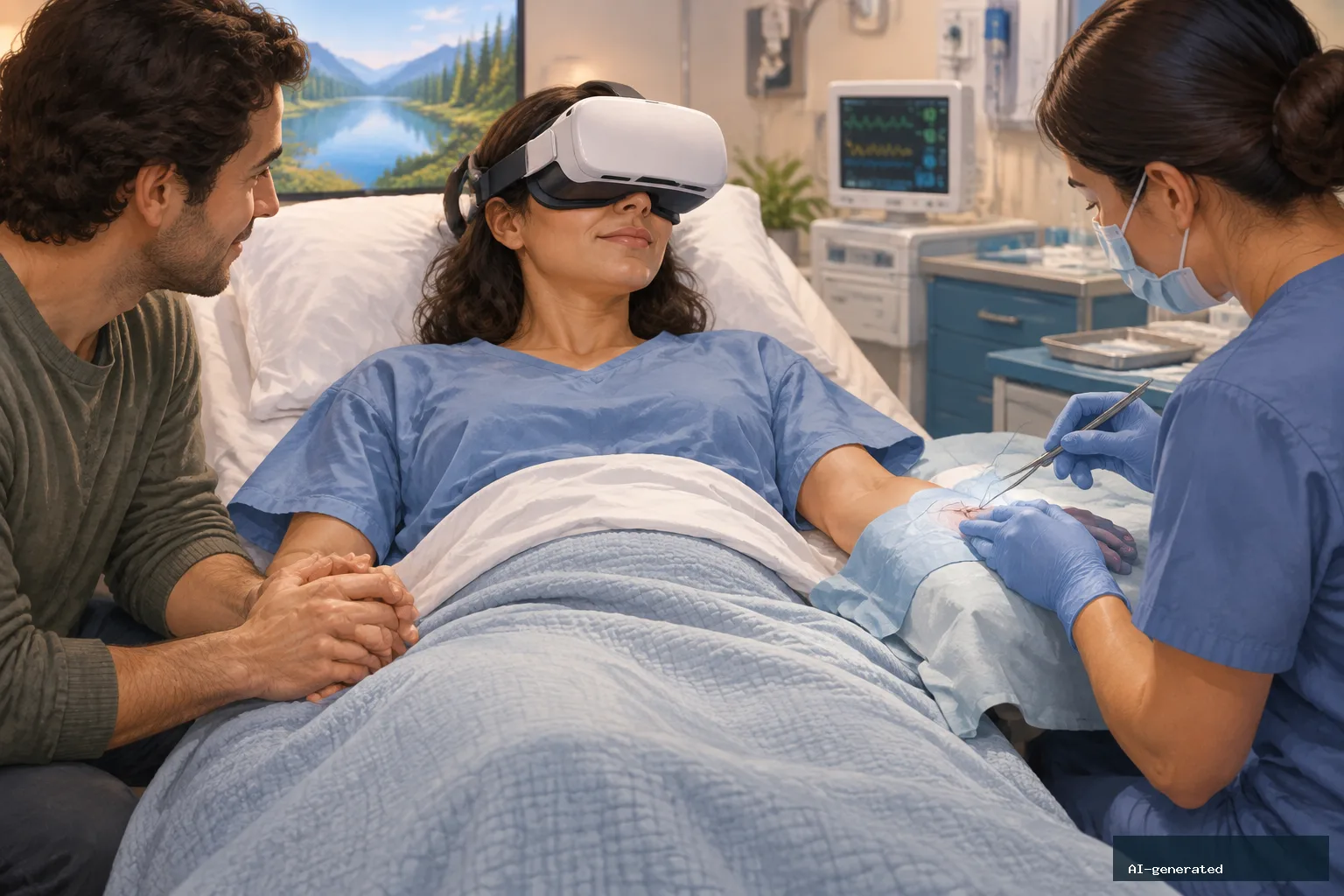
A small randomized trial from Iran found that two simple additions to emergency-room suturing—virtual reality and companion-delivered hand massage—were associated with lower immediate pain and anxiety scores than usual care.
The study included 90 adults with cuts requiring stitches, with 87 participants included in the final analysis. Everyone received wound cleaning, injected lidocaine and suturing from the same emergency physician. Each patient also had one companion present.
How the interventions worked
Patients in the companion-touch group closed their eyes and breathed deeply while their companion massaged the hand opposite the injury throughout the procedure. Three patients were excluded from this analysis because their companions declined to provide the massage.
Patients assigned to VR began using a smartphone-based headset five minutes before the first stitch. They watched 360-degree scenes of forests, ocean shores, skies and polar landscapes through noise-canceling headphones.
The remaining participants received usual care. Of the 87 analyzed patients, 30 were in the usual-care group, 27 received companion touch and 30 used VR.
What the researchers measured
Pain was recorded on a 0-to-10 visual analog scale, while state anxiety was measured with a questionnaire scored from 20 to 80. Ratings were taken five minutes before the numbing injection and within two minutes after the final stitch.
Average pain after suturing was 3.60 with usual care, 1.70 with companion touch and 1.27 with VR. Pain fell by 2.50 points in the usual-care group, compared with 3.63 points with touch and 4.17 points with VR.
Post-procedure anxiety scores were 54.87 with usual care, 41.56 with companion touch and 38.13 with VR. Anxiety fell by 7.50 points with usual care, 25.04 points with touch and 27.40 points with VR.
After adjustment for age and starting scores, both add-on approaches had lower pain and anxiety scores than usual care, with reported P values below 0.001.
VR was not clearly better for pain
The study did not find a statistically significant pain difference between VR and companion touch. That was true both in the straightforward comparison (P = 0.317) and after adjustment (P = 0.096).
VR did produce lower post-procedure anxiety scores than companion touch in the reported comparisons: 38.1 versus 41.6. However, the researchers cautioned that the adjusted anxiety result depended on patients’ starting anxiety levels.
No side effects were reported in any group, including dizziness or nausea related to the headset.
Why the findings need careful interpretation
This was an open-label study at one hospital, Shahid Bahonar Hospital in Kerman. Patients knew which approach they received, and the researcher who delivered or coached the intervention also collected the pain and anxiety ratings. That design may have influenced self-reported results, particularly for anxiety.
The groups were also small and recruited by convenience during certain shifts. The usual-care participants were older on average and began with somewhat lower anxiety than the add-on groups. Statistical adjustment cannot fully remove the effects of such imbalances in a small trial.
The touch findings describe companions who were willing to provide the massage, and the measurements captured only the minutes immediately around suturing. The study did not report longer-term effects, extra anesthetic use or patient satisfaction.
The source also notes an unclear timeline around the trial’s registration and manuscript submission, which adds another reason to avoid treating the result as definitive.
How this fits earlier evidence
A Hong Kong pilot study involving 80 adults undergoing wound stitching also found larger reductions in pain and anxiety when VR was added to standard care. Separately, a meta-analysis of six randomized trials involving 607 patients reported that VR reduced pain and fear during emergency laceration repair, although its pooled anxiety reduction was not statistically significant.
Those earlier trials had some risk-of-bias concerns, and anxiety results have been less consistent than pain results. Head-to-head comparisons of VR and supportive touch are rare, so larger and better-blinded studies are needed to determine whether VR has a genuine advantage for anxiety.
For now, the Iranian trial suggests that attention, sensory distraction and supportive touch may be useful complements during a distressing procedure. It does not establish that either approach replaces numbing medicine or other standard clinical care.
AI tools were used to assist with the preparation of this article.
Leave a Reply