
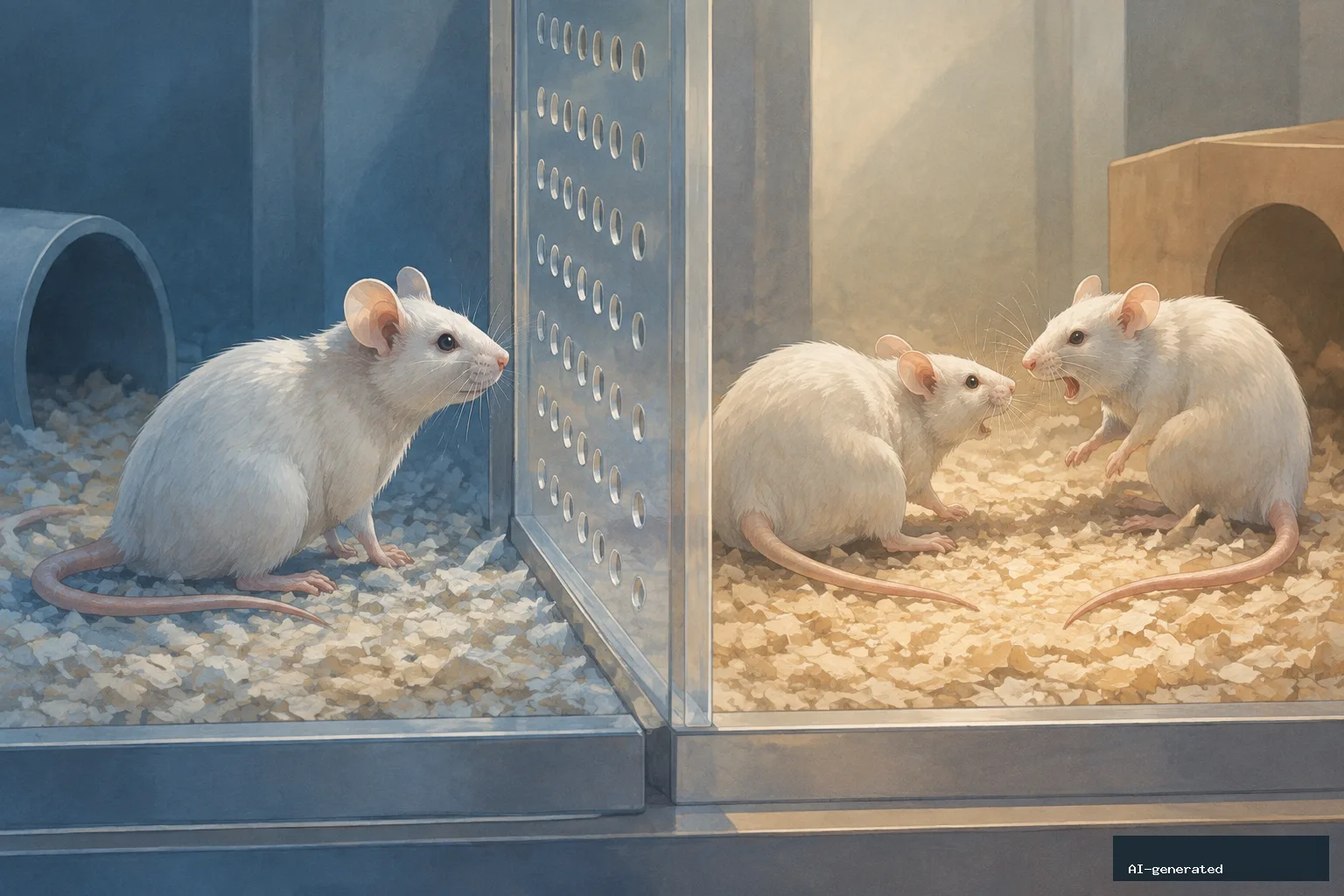
Watching another mouse being attacked produced measurable stress-related changes in male mice, according to a 2026 study, but the effects were generally milder and biologically different from those seen after direct attack.
The findings suggest that vicarious defeat stress may be useful for studying psychological stress in laboratory animals. They also argue against treating it as a simple substitute for chronic social defeat, in which a mouse is physically attacked.
What the study tested
Xin-Ran Sun and colleagues at the Chinese Academy of Medical Sciences randomly assigned 68 young adult male C57BL/6N mice to four groups: controls, directly attacked mice, witness mice and intruder mice. The analyzed behavioral groups included 10 to 12 mice each.
In the direct-attack model, a smaller C57BL/6 mouse is attacked by a larger aggressive CD-1 mouse and then kept in sensory contact with the aggressor through a clear, perforated divider. In the witness model, the physical attack is removed. The witness mouse sees, hears and smells another mouse being defeated while remaining across the divider.
After 14 days, the researchers assessed behavior and examined hippocampal proteins, synapse markers, energy and oxidative-stress measures, neurotransmitters and inflammation-related genes.
Shared stress-related behaviors
Both directly attacked and witness mice showed less interest in being near an unfamiliar mouse than unstressed controls. The reduction was significant in both groups, but social avoidance was stronger among the directly attacked mice.
Both groups also spent less time in the open arms of a raised maze, took longer to eat in a new environment and remained immobile for longer during a tail-suspension test. These tests are used in mice as behavioral stand-ins for anxiety- and depression-like changes; they do not diagnose human mental-health conditions.
Some differences were more specific. Directly attacked mice showed anxiety-related changes in a light/dark-box test and in the center of an open-field test, while witness mice appeared normal on those measures. Directly attacked mice also showed a reduced preference for sugar water. Witness mice did not.
Different biological signatures
The hippocampus showed partly overlapping but distinct protein patterns. Researchers identified 38 altered proteins in directly attacked mice and 32 in witness mice. Of 59 distinct altered proteins, only 11—18.6%—were shared.
Both stress conditions were associated with lower hippocampal ATP, weaker antioxidant defenses in the hippocampus and blood, lower PSD95, higher alpha-synuclein in two subregions, lower dopamine and norepinephrine, and increased activity of the inflammation-related genes IL-1β, TNF-α and IL-6.
The directly attacked mice showed additional changes involving serotonin, glutamate, iNOS, anti-inflammatory signaling and the kynurenine pathway. Overall, this group showed a stronger inflammatory and kynurenine response.
Witness mice, meanwhile, showed lower GABA, higher lactate in the hippocampus and blood, and higher activity of the anti-inflammatory marker IL-10. Their protein changes were more closely linked with synaptic signaling, receptor trafficking and neuronal communication, while the directly attacked group showed changes involving energy production, mitochondria, protein folding and immune pathways.
Why the distinction matters
Witnessed defeat was introduced as a way to isolate psychological stress without physical attack. Earlier work, including studies reported in 2013 and 2018, found anxiety- and depression-like behavior in witness mice, including findings in female mice. A 2020 study also concluded that witnessed and physical defeat are not identical.
The new results support using the witness model to examine how observing social threat affects behavior and biology. They do not support switching between the two models as though they produce the same outcome. Differences between studies may partly reflect laboratory protocols, including the strength of the aggressor.
Important limits
This experiment included male mice only, so it does not establish how the same protocol would affect females. The molecular analyses also involved relatively small numbers of animals, with four mice per group for proteomics and five to 12 per group for other assays across many comparisons.
The researchers measured the hippocampus at one time point shortly after the 14-day stress period and behavioral testing. They did not separate animals that were more susceptible to stress from those that were more resilient, meaning group averages may combine different responses.
Most importantly, the study tested neither treatments nor human symptoms. Its value is in clarifying how two mouse models of social stress differ—not in showing that watching an attack causes depression or anxiety in people.
AI tools were used to assist with the preparation of this article.
Leave a Reply