
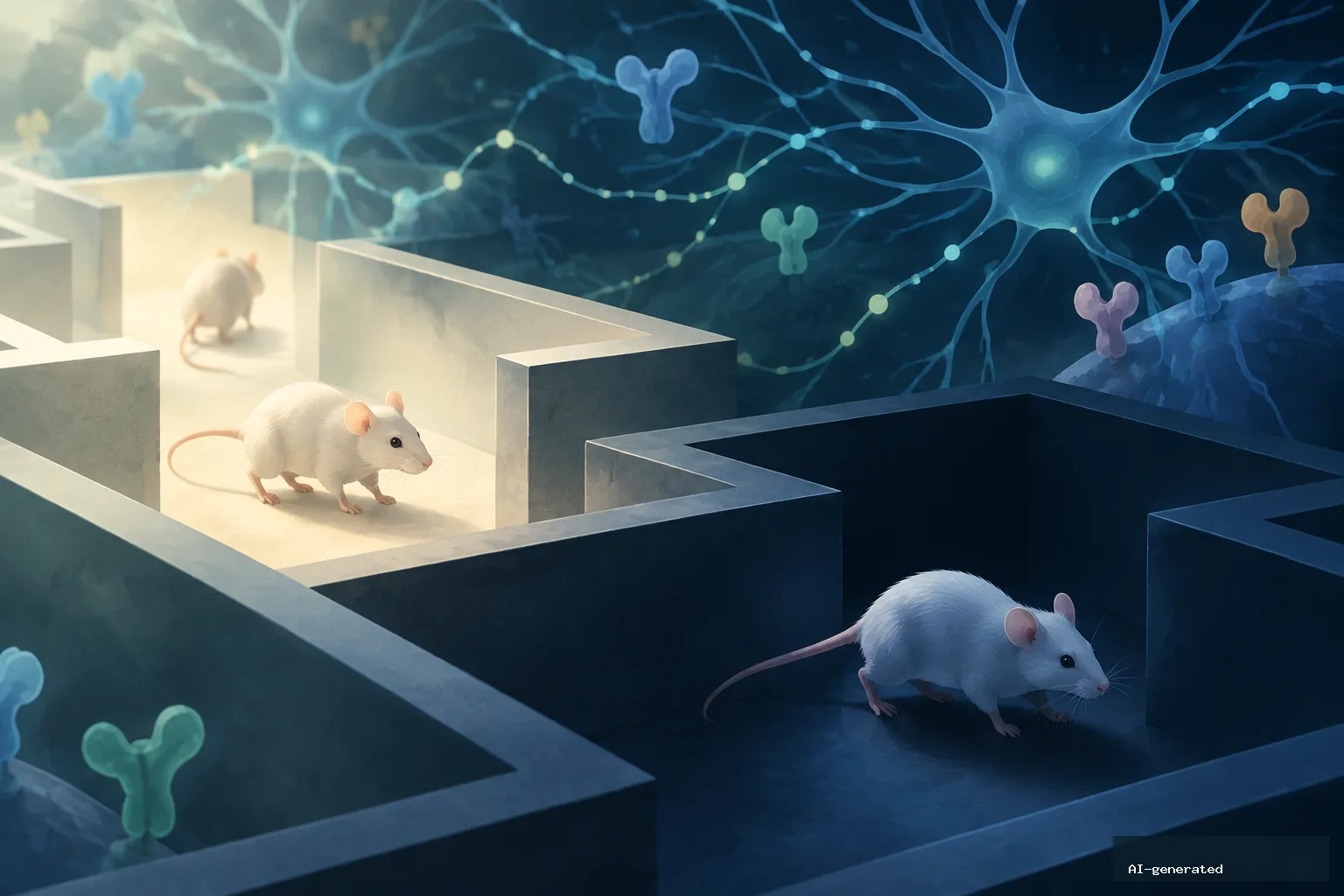
A 2026 study in Frontiers in Pharmacology found that mice born without GPR55, a cannabinoid-related receptor in the brain, displayed more anxiety-like behavior than genetically typical mice. The animals also showed longer immobility in a test commonly used to assess depression-like behavior in rodents.
The findings offer another reason to study GPR55 in anxiety and mood research. They do not show that GPR55 affects anxiety or depression in people, and the experiments did not test a drug or any cannabis- or CBD-based product.
Behavioral differences appeared across several tests
The researchers compared GPR55-knockout mice with normal wild-type littermates from the same breeding pairs. The behavioral group included male and female mice, generally 9 to 12 of each sex and genotype per test. The experiments began when the mice were 6 weeks old.
In the light-dark box, knockout mice spent less time in the lit compartment. In the elevated plus maze, they spent less time on the open arms. They also spent less time interacting with another mouse in a social-interaction test. Each of these differences was statistically significant, with p values below 0.001.
When mice were tested in pairs, knockout pairs had fewer social interactions than comparison pairs, with a p value of 0.003. In the six-minute tail-suspension test, knockout mice remained immobile for longer, with a p value below 0.001.
Researchers use these tasks as behavioral indicators in rodents. They are not direct measurements of human anxiety, depression or mood.
The differences were not explained by general movement
The study found no meaningful difference between genotypes in general movement. Total distance traveled in an open arena produced a p value of 0.804, while arm-to-arm movements in the maze produced a p value of 0.929.
The behavioral effects also did not differ by sex. This suggests that reduced exploration or movement alone did not account for the pattern seen in the anxiety-like tests, although the study cannot identify the precise cause of the behavior.
Changes in amygdala gene activity
The researchers measured activity of genes related to GABA-A receptors in the amygdala, a brain region involved in emotional and stress-related processing. Knockout mice of both sexes had higher amygdala mRNA for the GABA-A receptor α2 subunit, with a p value of 0.002.
However, the study measured mRNA rather than receptor protein or receptor function. The practical meaning of the α2 change therefore remains uncertain. Messenger RNA differences alone do not establish how the receptor system was functioning in the animals.
mRNA for the GABA-A γ2 subunit did not differ by genotype. There was an overall difference between females and males for that measure, with a p value below 0.001.
Acute restraint stress produced additional gene-activity changes
A separate group of mice underwent 30 minutes of restraint stress or remained in their home cages. Stress-related genes were measured 2.5 hours later.
After restraint, Crf increased in the hypothalamus in both genotypes and sexes, while Nr3c1 decreased in the hippocampus. These changes were gene-activity findings rather than measurements of stress hormones in the blood.
Among unstressed males, knockout mice had lower baseline Crf than normal males. The study reported no comparable gap among females and identified a sex-by-genotype interaction. The experiments examined acute restraint stress, not chronic stress.
Why the results need replication
The GPR55 result is not fully consistent with earlier knockout research. A 2013 study using a different GPR55-knockout line found no effect on anxiety or depression-related behaviors and reported poorer coordination on more difficult motor tasks. Differences in mouse lines, genetic background, age or testing conditions could explain the conflicting findings, but the studies did not determine which factor matters.
Earlier rodent studies using drugs also generally reported anxiety-reducing or antidepressant-like effects when GPR55 was activated, while blocking the receptor tended to increase anxiety-like behavior. In one 2017 study, a GPR55-activating drug reduced anxiety-like behavior in acutely stressed male mice; reducing GPR55 in the medial orbital cortex removed that benefit.
The new study used a lifelong, whole-body knockout created by replacing part of the Gpr55 gene. As a result, it cannot establish which brain region or cell type is responsible for the behavior. Developmental adaptations may also have occurred as the mice grew without the receptor.
What the study adds—and what it does not
The findings strengthen the case for investigating GPR55 in laboratory models of anxiety and mood. They also point to possible connections with amygdala GABA-A gene activity and stress-related pathways.
But the work remains an animal study based on behavioral tests and gene-activity measurements. It does not establish a human mental-health effect, identify a treatment, or provide evidence about cannabis or CBD products. Further research would need to replicate the behavioral findings, clarify the receptor’s function and examine more specific brain mechanisms.
Key takeaways
- Mice born without GPR55 showed more anxiety-like behavior across three standard behavioral tests.
- Knockout mice remained immobile longer in the six-minute tail-suspension test, a rodent measure associated with depression-like behavior.
- General movement did not differ between knockout and normal mice, and behavioral effects did not differ by sex.
- Knockout mice had higher amygdala mRNA for the GABA-A receptor α2 subunit, but receptor protein and function were not measured.1? no.
What this means
This study is relevant to readers interested in how researchers investigate the biological pathways involved in anxiety and mood. Its results come from mice and describe behavioral proxies and gene activity, not human diagnoses or proven treatments. The findings are best understood as an early research lead that requires replication and more precise mechanistic work.
What the evidence cannot tell us
- The study used lifelong, whole-body knockout mice, so it cannot establish which brain region or cell type matters; developmental adaptation may have occurred.
- Anxiety-like and depression-like behavior were inferred from standard rodent tests, not directly measured as mood.
- The study measured mRNA only, without protein levels, receptor function or blood hormone levels.
- Only acute stress was examined; chronic stress was not tested.?
AI tools were used to assist with the preparation of this article under our editorial standards.
Leave a Reply