
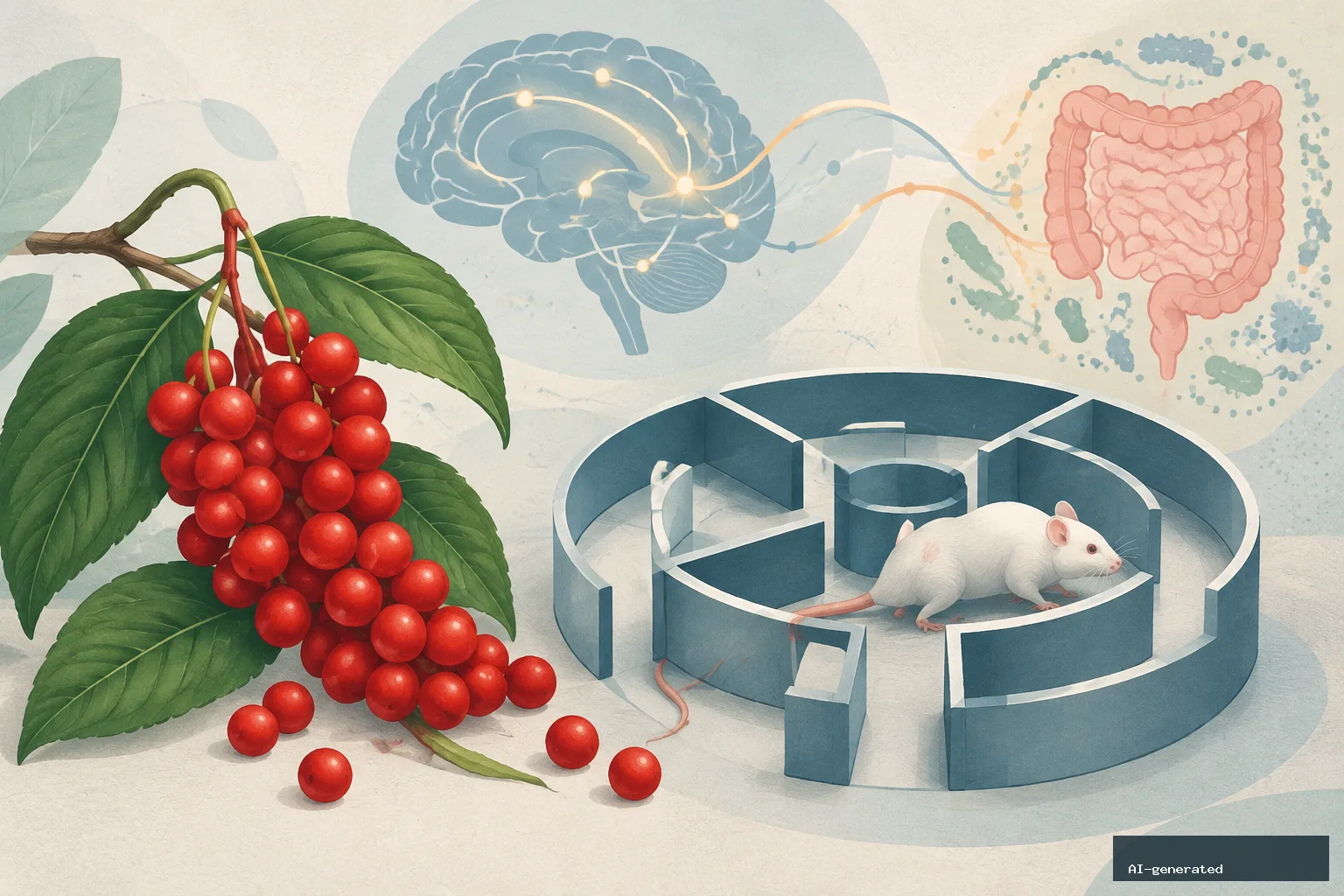
A purified compound from schisandra fruit was associated with less anxiety-like behavior in a small study of male rats, alongside changes in stress hormones, brain signaling and gut measures. The findings offer early biological clues, but they do not show that schisandrin B or schisandra supplements treat anxiety in people.
What the study tested
The 2026 experiment included 48 male Sprague-Dawley rats, divided into six groups of eight. The groups included untreated controls, rats exposed to a fear-conditioning model, a diazepam group and three schisandrin B groups.
The rats received schisandrin B orally at 5, 10 or 20 milligrams per kilogram once daily for 10 days after fear conditioning. Behavioral testing took place 24 hours after the final dose.
Schisandrin B is described as the most abundant lignan in Schisandra chinensis, a climbing vine with red berries used in traditional Chinese medicine. The study used the purified compound rather than a commercial schisandra product.
Maze results were not consistent across tests
In the elevated plus maze, rats given 10 or 20 milligrams per kilogram spent significantly more time in the open arms than untreated rats in the fear-conditioning group. The 5-milligram dose did not produce a significant change, and the two higher doses did not differ from each other.
The researchers selected 10 milligrams per kilogram for later biological analyses. Diazepam also increased open-arm time, with a reported p-value below 0.001; the study used it as a comparison treatment, not as evidence that schisandrin B is equivalent to the medicine.
Results were less clear in the open-field test. Neither schisandrin B nor diazepam significantly changed center time, center entries or zone crossings. Because the equipment did not record total distance or speed, the researchers could not fully rule out changes in general movement.
Changes in brain and stress measures
At the 10-milligram dose, schisandrin B lowered hippocampal glutamate and the glutamate-to-GABA ratio. GABA increased slightly, but the change was not significant.
The compound also reduced most of the measured NMDA and AMPA receptor subunits at gene-activity and protein levels. GluN2A did not decrease significantly at the protein level. Measures associated with synapses, including SYP and PSD-95, increased, while electron microscope images showed less swelling and synapse damage.
Blood levels of CRH, ACTH and corticosterone were lower in treated rats, with each result reported at p < 0.001. These measurements may help describe the biological response in the experiment, but they do not establish which changes, if any, caused the behavioral findings.
Gut findings add another layer
In the colon, schisandrin B lowered fecal pH and restored claudin-1. Changes in occludin and ZO-1 were not significant, and colon length did not recover significantly.
The treated rats also had more bacteria from the Lachnospiraceae NK4A136 group. Lactobacillus and Prevotella were more abundant in untreated anxious rats than in the other groups. These observations describe associations between treatment and gut measures; the study did not use pathway-blocking experiments to show that gut changes caused the behavioral effect.
Why the results are preliminary
The experiment involved only male rats, with eight animals in each behavioral group, and used a short-term fear model. It did not include safety testing, and rat doses cannot be translated directly into human doses.
The apparent benefit was found on the elevated plus maze but not across all open-field measures. The study’s text stated that open-arm entries improved, while its figure showed no significant difference for any treated group. Some results were presented only as figures without exact group means or p-values, and the source notes that parts of the text overstate those figures.
An earlier 2021 rat study reported that raw and wine-processed Schisandra chinensis reduced anxiety-like behavior and reversed some stress-related changes in gut bacteria. That earlier animal result does not resolve whether schisandrin B works in humans or whether whole-plant products have the same effects as the purified compound.
For now, the study is best understood as preliminary animal research pointing to several possible mechanisms for further investigation—not as evidence of a proven anxiety treatment.
Key takeaways
- A 2026 study of 48 male rats found that 10- and 20-milligram-per-kilogram doses of schisandrin B increased open-arm time in an elevated plus maze.
- Schisandrin B was linked with changes in hippocampal glutamate signaling, stress hormones, synapse-related measures and some gut markers.
- The effect was not consistent across behavioral tests, and general movement could not be fully assessed.
- The study tested a purified compound in rats, not schisandra supplements or schisandrin B in people.
What this means
The findings are relevant to people interested in plant-derived compounds and anxiety research because they connect behavior with brain, stress-system and gut measurements in an animal model. They do not establish effectiveness, appropriate dosing or safety for humans, and they do not show that commercial schisandra products contain or deliver the same compound exposure.
What the evidence cannot tell us
- The study included only male rats, with eight rats per behavioral group.
- It used a short-term fear-conditioning model and included no safety testing.
- The apparent behavioral benefit occurred on the elevated plus maze but not in the open-field test.
- The open-field equipment did not record total distance or speed, so changes in general movement could not be fully ruled out. 
AI tools were used to assist with the preparation of this article under our editorial standards.
Leave a Reply