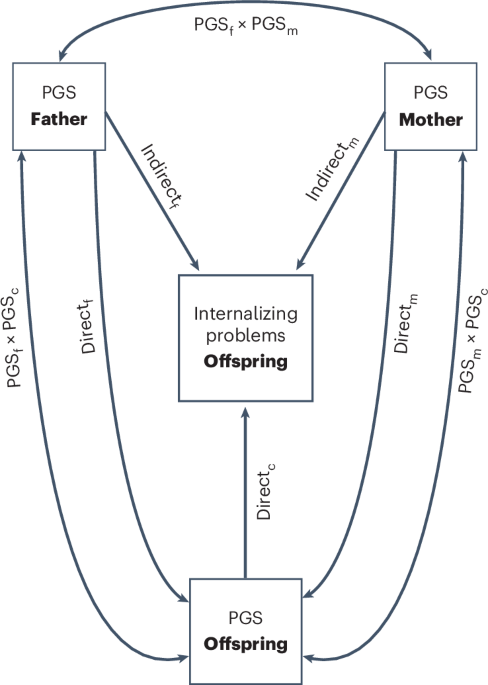
Friedrich, M. J. Depression is the leading cause of disability around the world. JAMA 317, 1517 (2017).
Bernaras, E., Jaureguizar, J. & Garaigordobil, M. Child and adolescent depression: a review of theories, evaluation instruments, prevention programs, and treatments. Front. Psychol. 10, 543 (2019).
Costello, E. J., Mustillo, S., Erkanli, A., Keeler, G. & Angold, A. Prevalence and development of psychiatric disorders in childhood and adolescence. Arch. Gen. Psychiatry 60, 837–844 (2003).
Lawrence, P. J., Murayama, K. & Creswell, C. Systematic review and meta-analysis: anxiety and depressive disorders in offspring of parents with anxiety disorders. J. Am. Acad. Child Adolesc. Psychiatry 58, 46–60 (2019).
McIntosh, A. M., Sullivan, P. F. & Lewis, C. M. Uncovering the genetic architecture of major depression. Neuron 102, 91–103 (2019).
Polderman, T. J. C. et al. Meta-analysis of the heritability of human traits based on fifty years of twin studies. Nat. Genet. 47, 702–709 (2015).
Nikstat, A. & Riemann, R. On the etiology of internalizing and externalizing problem behavior: a twin-family study. PLoS ONE 15, e0230626 (2020).
Fedko, I. O. et al. Heritability of behavioral problems in 7-year olds based on shared and unique aspects of parental views. Behav. Genet. 47, 152–163 (2017).
Bridgett, D. J. et al. Contributions of mothers’ and fathers’ parenting to children’s self-regulation: evidence from an adoption study. Dev. Sci. 21, e12692 (2018).
Jami, E. S. et al. Maternal and paternal effects on offspring internalizing problems: results from genetic and family-based analyses. Am. J. Med. Genet. B 183, 258–267 (2020).
Horwitz, B. N. & Neiderhiser, J. M. Gene–environment interplay, family relationships, and child adjustment. J. Marriage Fam. 73, 804–816 (2011).
Marceau, K. et al. Combined influences of genes, prenatal environment, cortisol, and parenting on the development of children’s internalizing versus externalizing problems. Behav. Genet. 45, 268–282 (2015).
Côté, S. M. et al. Why is maternal depression related to adolescent internalizing problems? A 15-year population-based study. J. Am. Acad. Child Adolesc. Psychiatry 57, 916–924 (2018).
Goodman, S. H. et al. Maternal depression and child psychopathology: a meta-analytic review. Clin. Child Fam. Psychol. Rev. 14, 1–27 (2011).
Sangawi, H., Adams, J. & Reissland, N. The effects of parenting styles on behavioral problems in primary school children: a cross-cultural review. Asian Soc. Sci. 11, 171–186 (2015).
Cui, M., Donnellan, M. B. & Conger, R. D. Reciprocal influences between parents’ marital problems and adolescent internalizing and externalizing behavior. Dev. Psychol. 43, 1544–1552 (2007).
Reiss, F. Socioeconomic inequalities and mental health problems in children and adolescents: a systematic review. Soc. Sci. Med. 90, 24–31 (2013).
Plomin, R. & Bergeman, C. S. The nature of nurture: genetic influence on ‘environmental’ measures. Behav. Brain Sci. 14, 373–386 (1991).
Plomin, R., DeFries, J. C., Knopik, V. S. & Neiderhiser, J. M. Top 10 replicated findings from behavioral genetics. Perspect. Psychol. Sci. 11, 3–23 (2016).
Wolf, J. B. & Wade, M. J. What are maternal effects (and what are they not)? Philos. Trans. R. Soc. B 364, 1107–1115 (2009).
Kong, A. et al. The nature of nurture: effects of parental genotypes. Science 359, 424–428 (2018).
Choi, S. W. & O’Reilly, P. F. PRSice-2: polygenic risk score software for Biobank-scale data. GigaScience 8, giz082 (2019).
Wray, N. R. et al. Genome-wide association analyses identify 44 risk variants and refine the genetic architecture of major depression. Nat. Genet. 50, 668–681 (2018).
Cheesman, R. et al. How important are parents in the development of child anxiety and depression? A genomic analysis of parent-offspring trios in the Norwegian Mother Father and Child Cohort Study (MoBa). BMC Med. 18, 284 (2020).
Shakeshaft, A. et al. Estimating the impact of transmitted and non-transmitted psychiatric and neurodevelopmental polygenic scores on youth emotional problems. Mol. Psychiatry 29, 238–246 (2024).
Tubbs, J. D. & Sham, P. C. Preliminary evidence for genetic nurture in depression and neuroticism through polygenic scores. JAMA Psychiatry 80, 832–841 (2023).
Avinun, R. & Knafo-Noam, A. Parenting as a reaction evoked by children’s genotype: a meta-analysis of children-as-twins studies. Pers. Soc. Psychol. Rev. 21, 107–117 (2017).
Brainstorm Consortium, T. he et al. Analysis of shared heritability in common disorders of the brain. Science 360, eaap8757 (2018).
Grotzinger, A. D. et al. Genetic architecture of 11 major psychiatric disorders at biobehavioral, functional genomic and molecular genetic levels of analysis. Nat. Genet. 54, 548–559 (2022).
Lee, P. H. et al. Genomic relationships, novel loci, and pleiotropic mechanisms across eight psychiatric disorders. Cell 179, 1469–1482 (2019).
Zou, H. & Hastie, T. Regularization and variable selection via the elastic net. J. R. Stat. Soc. B 67, 301–320 (2005).
Albiñana, C. et al. Multi-PGS enhances polygenic prediction by combining 937 polygenic scores. Nat. Commun. 14, 4702 (2023).
Schoeler, T. et al. Multi-polygenic score approach to identifying individual vulnerabilities associated with the risk of exposure to bullying. JAMA Psychiatry 76, 730–738 (2019).
Waszczuk, M. A., Zavos, H. M. S., Gregory, A. M. & Eley, T. C. The stability and change of etiological influences on depression, anxiety symptoms and their co-occurrence across adolescence and young adulthood. Psychol. Med. 46, 161–175 (2016).
Bergen, S. E., Gardner, C. O. & Kendler, K. S. Age-related changes in heritability of behavioral phenotypes over adolescence and young adulthood: a meta-analysis. Twin Res. Hum. Genet. 10, 423–433 (2007).
Meinzer, M. C. et al. Does childhood attention-deficit/hyperactivity disorder (ADHD) predict levels of depressive symptoms during emerging adulthood? J. Abnorm. Child Psychol. 44, 787–797 (2016).
Ghobadzadeh, M., McMorris, B. J., Sieving, R. E., Porta, C. M. & Brady, S. S. Relationships between adolescent stress, depressive symptoms, and sexual risk behavior in young adulthood: a structural equation modeling analysis. J. Pediatr. Health Care 33, 394–403 (2019).
Kashdan, T. B. & Hofmann, S. G. The high-novelty–seeking, impulsive subtype of generalized social anxiety disorder. Depress. Anxiety 25, 535–541 (2008).
Kampman, O., Viikki, M., Järventausta, K. & Leinonen, E. Meta-analysis of anxiety disorders and temperament. Neuropsychobiology 69, 175–186 (2014).
Luo, S. et al. The correlation between resilience and mental health of adolescents and young adults: a systematic review and meta-analysis. Front. Psychiatry 16, 1536553 (2025).
Bingley, P., Cappellari, L. & Tatsiramos, K. Parental assortative mating and the intergenerational transmission of human capital. Labour Econ. 77, 102047 (2022).
Magnus, P. et al. Cohort profile update: the Norwegian Mother and Child Cohort Study (MoBa). Int. J. Epidemiol. 45, 382–388 (2016).
Wray, N. R. et al. Research review: polygenic methods and their application to psychiatric traits. J. Child Psychol. Psychiatry 55, 1068–1087 (2014).
Okbay, A. et al. Polygenic prediction of educational attainment within and between families from genome-wide association analyses in 3 million individuals. Nat. Genet. 54, 437–449 (2022).
Yengo, L. et al. Meta-analysis of genome-wide association studies for height and body mass index in ~700,000 individuals of European ancestry. Hum. Mol. Genet. 27, 3641–3649 (2018).
Karlsson Linnér, R. et al. Genome-wide association analyses of risk tolerance and risky behaviors in over 1 million individuals identify hundreds of loci and shared genetic influences. Nat. Genet. 51, 245–257 (2019).
Savage, J. E. et al. Genome-wide association meta-analysis in 269,867 individuals identifies new genetic and functional links to intelligence. Nat. Genet. 50, 912–919 (2018).
Demange, P. A. et al. Investigating the genetic architecture of noncognitive skills using GWAS-by-subtraction. Nat. Genet. 53, 35–44 (2021).
Howard, D. M. et al. Genome-wide meta-analysis of depression identifies 102 independent variants and highlights the importance of the prefrontal brain regions. Nat. Neurosci. 22, 343–352 (2019).
Mullins, N. & Huang, H. Genetic architecture of bipolar disorder in individuals of Han Chinese and European ancestries. JAMA Psychiatry 78, 248–249 (2021).
Demontis, D. et al. Genome-wide analyses of ADHD identify 27 risk loci, refine the genetic architecture and implicate several cognitive domains. Nat. Genet. 55, 198–208 (2023).
Turley, P. et al. Multi-trait analysis of genome-wide association summary statistics using MTAG. Nat. Genet. 50, 229–237 (2018).
Liu, M. et al. Association studies of up to 1.2 million individuals yield new insights into the genetic etiology of tobacco and alcohol use. Nat. Genet. 51, 237–244 (2019).
Day, F. R., Ong, K. K. & Perry, J. R. Elucidating the genetic basis of social interaction and isolation. Nat. Commun. 9, 2457 (2018).
Baselmans, B. M. et al. Multivariate genome-wide analyses of the well-being spectrum. Nat. Genet. 51, 445–451 (2019).
Quek, Y. H., Tam, W. W., Zhang, M. W. & Ho, R. C. Exploring the association between childhood and adolescent obesity and depression: a meta-analysis. Obes. Rev. 18, 742–754 (2017).
Mendle, J., Ferrero, J., Moore, S. R. & Harden, K. P. Depression and adolescent sexual activity in romantic and nonromantic relational contexts: a genetically informative sibling comparison. J. Abnorm. Psychol. 122, 51–63 (2013).
Rees, D. I., Sabia, J. J. & Argys, L. M. A head above the rest: height and adolescent psychological well-being. Econ. Hum. Biol. 7, 217–228 (2009).
Ryan, S. M., Jorm, A. F. & Lubman, D. I. Parenting factors associated with reduced adolescent alcohol use: a systematic review of longitudinal studies. Aust. N. Z. J. Psychiatry 44, 774–783 (2010).
Trucco, E. M. & Hartmann, S. A. Understanding the etiology of adolescent substance use through developmental perspectives. Child Dev. Perspect. 15, 257–264 (2021).
Watson, H. J. et al. Genome-wide association study identifies eight risk loci and implicates metabo-psychiatric origins for anorexia nervosa. Nat. Genet. 51, 120–126 (2019).
Wickersham, A. et al. Systematic review and meta-analysis: the association between child and adolescent depression and later educational attainment. J. Am. Acad. Child Adolesc. Psychiatry 60, 105–118 (2021).
Ramrakha, S. et al. The relationship between multiple sex partners and anxiety, depression, and substance dependence disorders: a cohort study. Arch. Sex. Behav. 42, 863–872 (2013).
Angold, A. et al. The development of a short questionnaire for use in epidemiological studies of depression in children and adolescents. Int. J. Methods Psychiatr Res. 5, 237–249 (1995).
American Psychiatric Association. Diagnostic and Statistical Manual of Mental Disorders 3rd edn, revised (American Psychiatric Association, 1987).
Birmaher, B. et al. Psychometric properties of the Screen for Child Anxiety Related Emotional Disorders (SCARED): a replication study. J. Am. Acad. Child Adolesc. Psychiatry 38, 1230–1236 (1999).
Birmaher, B. et al. The Screen for Child Anxiety Related Emotional Disorders (SCARED): scale construction and psychometric characteristics. J. Am. Acad. Child Adolesc. Psychiatry 36, 545–553 (1997).
Corfield, E. C. et al. The Norwegian Mother, Father, and Child Cohort Study (MoBa) genotyping data resource: MoBaPsychGen pipeline v.1. Preprint at bioRxiv https://doi.org/10.1101/2022.06.23.496289 (2022).
Kuhn, M. Building predictive models in R using the caret package. J. Stat. Softw. 28, 1–26 (2008).
Zhou, D.-X. On grouping effect of elastic net. Stat. Probabil. Lett. 83, 2108–2112 (2013).
Pingault, J. B. et al. Genetic nurture versus genetic transmission of risk for ADHD traits in the Norwegian Mother, Father and Child Cohort Study. Mol. Psychiatry 28, 1731–1738 (2023).
Kuhn, M. Caret package. J. Stat. Softw. 28, 1–26 (2008).
Leave a Reply