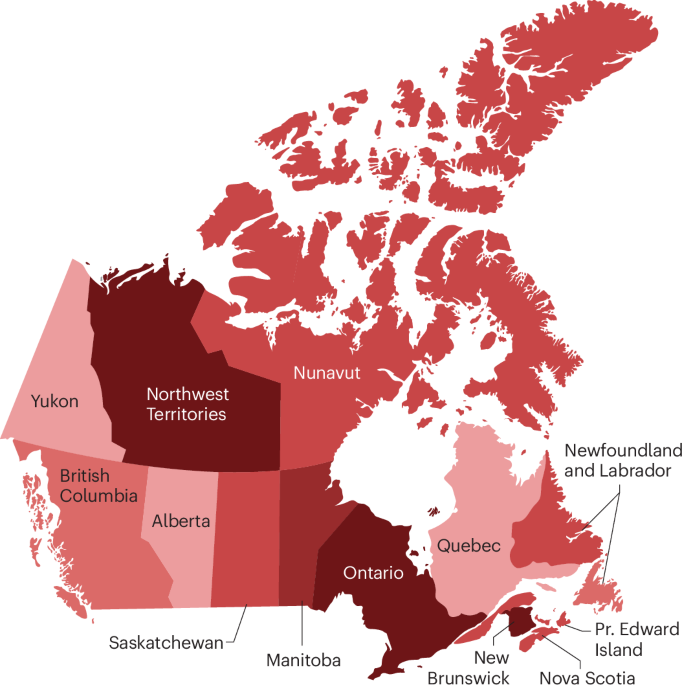
Canada is home to a prolonged public health crisis of overdose deaths, which increasingly involves psychostimulant drugs that are neglected in the intervention response. In this Comment, we examine the risks and harms of psychostimulant use, available interventions, and gaps for improved prevention and treatment.
This is a preview of subscription content, access via your institution
Access options
Subscribe to this journal
Receive 12 digital issues and online access to articles
79,00 € per year
only 6,58 € per issue
Buy this article
- Purchase on SpringerLink
- Instant access to the full article PDF.
39,95 €
Prices may be subject to local taxes which are calculated during checkout
References
-
Government of Canada. Canada.ca https://go.nature.com/4rh9HcW (2025).
-
Fischer, B. Lancet Reg. Health Am. 19, 100437 (2023).
-
Papamihali, K. et al. PloS ONE 16, e0252090 (2021).
-
Langlois, J. et al. Am. J. Addict. 33, 664–74 (2024).
-
Lukac, C. D. et al. Int. J. Drug Policy 102, 103602 (2022).
-
Edinoff, A. N. et al. Health Psychol. Res. 10, 38161 (2022).
-
Palis, H. et al. BMC Public Health 22, 2084 (2022).
-
Suen, L. W. et al. BMC Emerg. Med. 22, 19 (2022).
-
Farrell, M. et al. Lancet 394, 1652 (2019).
-
Sharafi, H. et al. Addict 119, 2 (2024).
-
Coughlin, L. N. et al. Am. J. Psychiatry 182, 11 (2025).
-
Lu, A. et al. Subst. Use Misuse 59, 4 (2024).
-
Mansoor, M. et al. Int. J. Drug Policy 102, 103592 (2022).
-
Ferguson, M. et al. Int. J. Drug Policy 120, 104186 (2023).
-
Slaunwhite, A. et al. BMJ 11, 384 (2024).
Funding
The present study did not receive designated support by any specific funder or sponsor.
Ethics declarations
Competing interests
B.F. has held research and policy support grants and/or contracts in the areas of substance use, health, crime from public funding and/or government organizations (that is, public-only sources) in the past 3 years, and acknowledges present research and policy support from the Waypoint Centre for Mental Health Care/Waypoint Research Institute and the University of the Fraser Valley. B.L.F. declares research (for example, research funding and in-kind) support from Indivior, Indiva and Canopy Growth Corporation; research consultancies from and/or science advisory roles with ThirdBridge, Shinogi, Changemark and NFL Biosciences; travel support from Bioprojet; employment-based research support from the Centre for Addiction & Mental Health and the Waypoint Centre for Mental Health Care; and a clinician-scientist award from the Department of Family and Community Medicine and the Chair in Addiction Psychiatry from the Department of Psychiatry of the University of Toronto. D.J.-A. acknowledges a clinical-scientist career award from Fonds de Recherche du Québec and financial support from the CHUM Foundation; and has received study materials from Cardiol Therapeutics for clinical trials. S.D. declares no competing interests.
Peer review
Peer review information
Nature Mental Health thanks the anonymous reviewers for their contribution to the peer review of this work.
Rights and permissions
About this article

Cite this article
Fischer, B., Dubreucq, S., Le Foll, B. et al. Psychostimulant use in Canada requires enhanced intervention strategies to reduce harm. Nat. Mental Health (2026). https://doi.org/10.1038/s44220-026-00612-w
-
Published:
-
Version of record:
-
DOI: https://doi.org/10.1038/s44220-026-00612-w
Leave a Reply